How to treat scale insects on succulents: a few simple steps to stop the pest from happening again
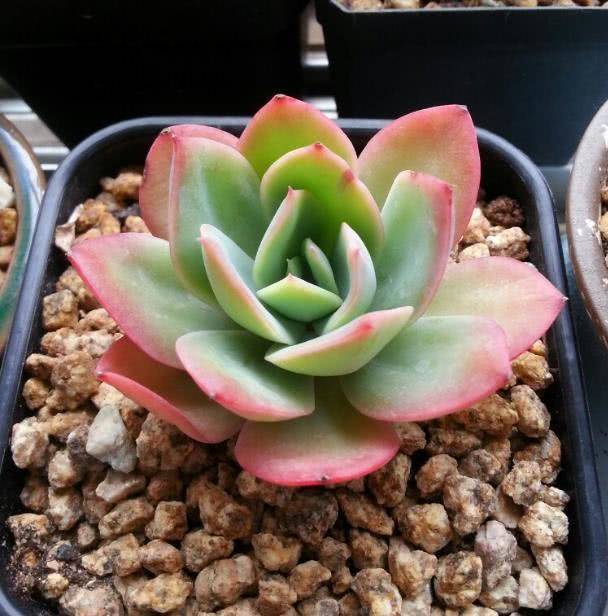
Some flower lovers say that the succulents they grow always have scale insects, and it feels like they can never be cleaned out completely; to avoid infecting the others, they quickly throw them away together with the soil. A few days ago I saw that the Echeveria 'Herbst' (Yudie) had them too, but not many, so I picked them off one by one with tweezers. Black Prince and Echeveria 'Perle von Nurnberg' (Zizhenzhu) were washed bare-root, given fresh soil and replanted by me, and I still do not know whether they will survive. How should this be handled?
Scale insects multiply very quickly; usually by the time you notice them there is already a large swarm, and they will crawl from one pot to several others. They do not only parasitize succulents; they are also the number one of the three major piercing-sucking pests in landscaping, the other two being red spider mites and aphids. They not only suck the sap of succulents but also secrete a sticky substance, which causes sooty mold on succulents.
How great is the mobility of scale insects? Generally speaking, their range of movement is not large; they can only move between different parts of the same plant, or between adjacent plants. Yet even a creature with such slow mobility manages to extend its reach everywhere. We had better choose a safer method to remove the pests. If flower lovers discover a small number of scale insects on their succulents in the early stage, then simply squashing them one by one with tweezers or a needle will do. In fact, household alcohol is also very effective for killing scale insects; succulent growers can dip a brush in 75% concentration alcohol and repeatedly brush the parts of the succulent where scale insects are present, or use a spray bottle to spray directly at the infested leaves, and the cleaning is basically fairly thorough.
Scale insects are the biggest natural enemy of succulents. The reason scale insects are hard to eradicate is that they reproduce quickly, and their body surface secretes a waxy substance and they carry a shield with them (the scale). To improve the resistance of succulents so they can withstand pests and diseases, it is best to use ecologically safe organic fertilizer, a fertilizer-retaining formula specially made for succulents, promoting succulents to grow vigorously, with more leaves, strong plants and strong resistance.
You can wash succulents that have scale insects. Scale insects do not only grow on the leaves; they will also be in the potting soil. In severe cases you can remove the whole plant from the soil, wash it, dry the roots and replant it, and discard the original soil. In less severe cases, lay cloth or paper towels on the surface to prevent washing the insects into the potting soil, set the spray bottle to a column-shaped water output, and use the force of the water stream to wash them off. You can also wash them away with water, using a spray bottle, or tap water connected to a hose with an adjustable nozzle, to wash the scale insects away. Although this cannot eradicate them, it can still effectively control the pest.
For succulents grown outdoors, there are relatively fewer scale insects; perhaps the blazing sun, rain, frost and uninvited insects are also natural disasters for scale insects, whereas in some more sheltered and less ventilated environments, scale insects sometimes break out very badly. Spraying pesticide can also effectively treat scale insects on succulents; after spraying, do not let them get rained on or water them. In addition, although scale insects are contagious, you will often find that one succulent is densely covered with scale insects while the ones next to it are fine, so there is no need to spray all of them just because one has insects, unless you are sure the concentration of the spray is safe.
This is a gathering place for succulent lovers, sharing succulent care tips; you are welcome to follow and exchange ideas.