A wild grass that looks like bamboo leaves, city people keep it as a potted plant, but it is actually the rare Aspidistra
Friendly reminder
Hemu Report aims to share and popularize information about various plants and their uses, for reference only. If medicinal use is needed, it is recommended to consult a professional physician to avoid problems!
Our country is vast and rich in resources, with abundant wild vegetation resources, especially in the mountainous areas of rural regions, where vegetation resources are even more plentiful. Most of these vegetation resources are wild grasses and wild vegetables, and therefore there are also quite a few peculiar wild grasses. Although many people have seen these wild grasses, they cannot name them, and so they do not know them, nor do they know their uses. Apart from old farmers who recognize them, many people are unfamiliar with them. Below, the author will introduce one such peculiar wild grass to everyone, and I believe many friends will find it interesting.
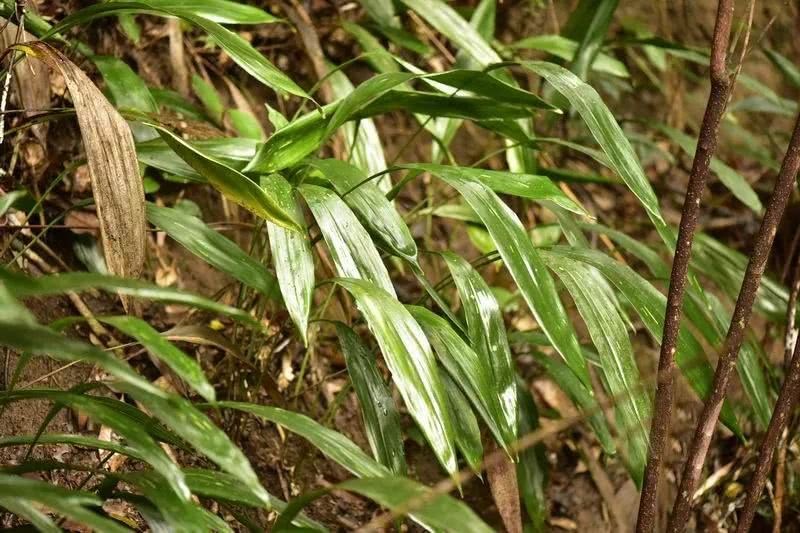
In the great mountains of southern China, there is a kind of wild grass that looks like a miniature version of bamboo. If you do not look at its stem and only look at its leaves, many people would think they are bamboo leaves. This wild grass that resembles bamboo leaves is the rare wild grass commonly known as "Aspidistra," or "spider-holding-egg." Does this name seem strange? When the author first heard this name, I also found it very strange. It clearly looks like bamboo leaves, so why would it have anything to do with spiders? However, when you see its flowers and its fruit, you become enlightened.
It turns out that this wild grass called Aspidistra has very peculiar flowers. Ordinary wild grasses or trees all bloom at the tips of branches, but the Aspidistra blooms at its roots. If you do not look carefully at the roots, you will not notice that it has bloomed, leading many people to think that the Aspidistra does not bloom at all. Moreover, the shape of its flowers and the fruit it produces are also very peculiar. Its flower resembles a small spider, its fruit is a green berry shaped like a spider egg, and the underground rhizome exposed above the soil resembles a spider. This wild grass got its name because of this.
Aspidistra is a perennial wild grass. Its leaves, which resemble bamboo leaves, are upright and neat in shape, and their color is deep green and glossy, remaining evergreen. Therefore, it is also called "thousand-year bamboo," and it has gradually become an ornamental plant loved by many city people, who grow it in pots as bamboo. However, although many people have seen Aspidistra, they do not know its true value.
The uses of Aspidistra are not limited to ornamentation; it also has high medicinal value. According to "Guizhou Folk Medicines," the whole plant and root cluster of Aspidistra can be used as medicine, with effects such as promoting blood circulation and dredging collaterals, relieving pain, and setting bones. In folk medicine, it is often used to treat traumatic injuries, lower back pain, amenorrhea and abdominal pain, headache, toothache, cough due to heat and summerheat damage, diarrhea, sand strangury, and pain in the tendons and bones.
It is precisely because Aspidistra can both be appreciated and used medicinally to treat illness that its value has become higher and higher. Therefore, many farmer friends also specifically cultivate Aspidistra to sell. According to what the author has learned, a potted Aspidistra costs about 20 to 30 yuan per pot, while medicinal Aspidistra is about 20 yuan per jin. This has also turned this wild grass from the rural mountains into a rare commodity.
Dear friends, have you ever seen Aspidistra? You are welcome to leave a message and share your thoughts!
Text/Hemu Report, Images/Internet
If you like Hemu's articles, you are welcome to follow!