How to grow a pomegranate bonsai so it brings many sons and blessings and a prosperous, fiery red life
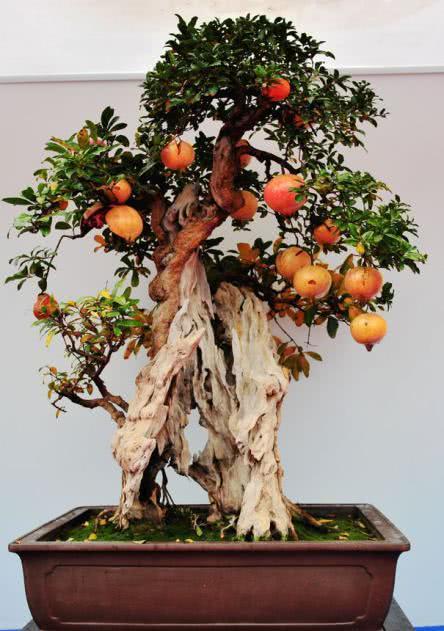
Pomegranate is a fruit that I believe everyone has eaten, but how much do you know about pomegranate bonsai and how they grow? Then let me walk everyone through it and share a bit of plant knowledge, haha.
Pomegranate bonsai belongs to the same category as honeysuckle bonsai; both are shrubs, and the pomegranate bonsai is a tropical plant. In tropical climates it is an evergreen tree. Its morphological features can be described in terms of the crown and the roots: the crown is naturally clump-forming and round-headed in shape, while the roots are yellowish-brown. The pomegranate grows very vigorously, and it sprouts especially easily from the root zone. Its external height reaches 5-7 m, while ordinary pomegranates grow to 3-4 m, but some dwarf pomegranates grow only about 1 m tall, and some are even shorter. The pomegranate has no special requirements for its growing environment, because it is a drought-tolerant plant that grows easily and is not strict about soil, so it is a plant that is very easy to grow.
When a pomegranate bonsai grows, there is a very obvious characteristic: a pomegranate tree that grows well will have many thorns, while a pomegranate tree that grows poorly will have few thorns. I do not know why this is so, but it is a fact, so when you see a pomegranate that is growing very well, you should be careful to avoid touching its thorns and prevent being pricked or scratched.
When a pomegranate has ripened, it becomes a large, multi-chambered, many-seeded berry, and each chamber contains multiple seeds; its outer shape is like a round ball, with a thick and brittle skin, also mixed with a thin white layer of epidermis. After tearing it open, you can see these berries, which are bright red, juicy, sweet with a touch of sourness, and these seeds are the edible part.
I checked the information carefully: the pomegranate's place of origin is the Balkan Peninsula and neighboring areas such as Iran, and it can be planted in tropical and temperate climate regions all over the world. In China, in places around the Three Rivers basin with an average altitude of about 2800 m, large numbers of pomegranate trees are planted.
So, conversely, how should a pomegranate bonsai be cultivated? Then please read on.
The propagation method for potted pomegranate is generally cutting propagation or seed propagation. I think everyone knows how to do seed propagation, so I will not explain it in detail here. Let us talk about cutting propagation: in summer, it is recommended to use some young stem cuttings, as this gives a high propagation rate. Take branches that are more than 2 years old, cut them into sections about 20 cm long, then bury them for about one month, and in spring insert them as cuttings; after a week they can take root and sprout.
The appearance of the pomegranate bonsai has ornamental value, and generally some people who love bonsai plants will very much enjoy collecting them, especially the pomegranate bonsai, which bears a bright red fruit, representing prosperity and many sons and blessings!