Monotropa uniflora is a mysterious plant known as the ghost flower.
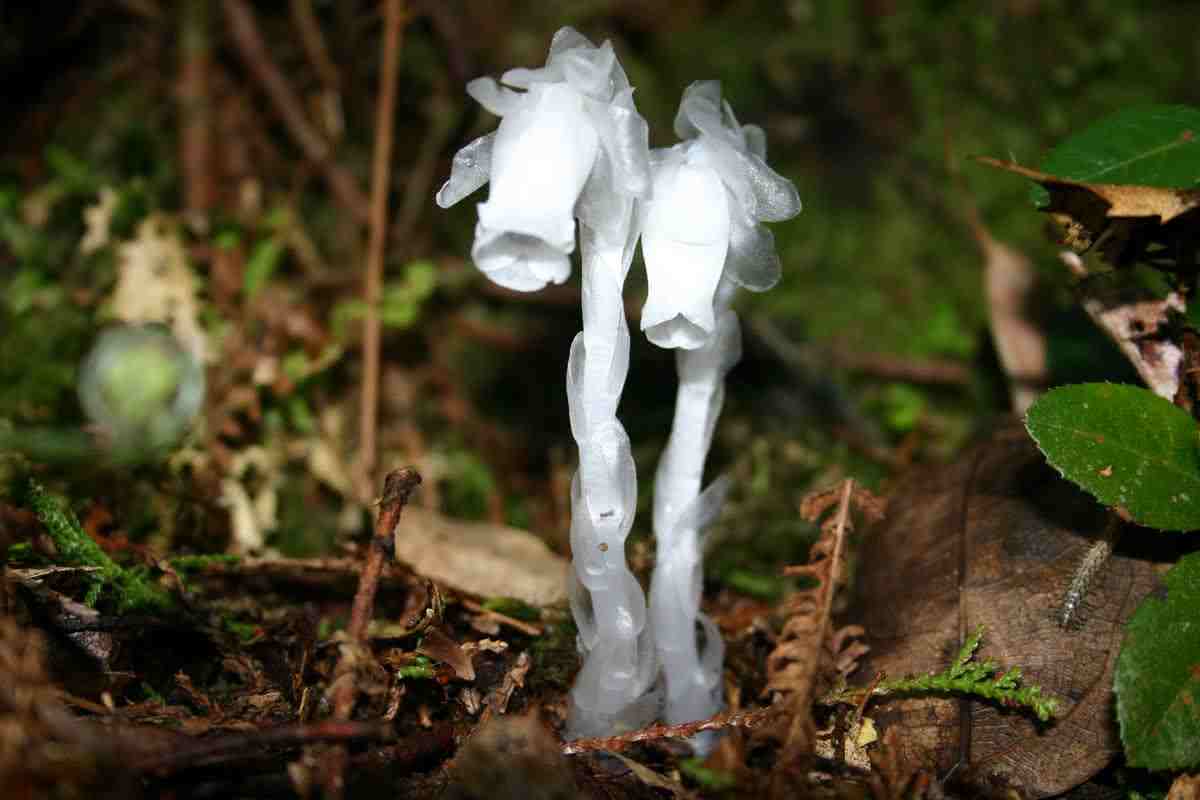
Monotropa uniflora is a perennial herbaceous mycoheterotrophic plant in the family Ericaceae (formerly Pyrolaceae), genus Monotropa. The stem is erect, unbranched, up to 30 cm tall; the whole plant lacks chlorophyll, is white and fleshy; the leaves are alternate, oblong or narrowly oblong or broadly lanceolate, with obtuse tips, glabrous or the upper leaves slightly hairy, with nearly entire margins. The flower is terminal, first drooping, then erect; the corolla is tubular-campanulate; the bracts are scale-like, of the same shape as the leaves; the sepals are scale-like, cuneate or obovate-oblong; the filaments have coarse hairs; the anthers are yellow; the capsule is ellipsoid-globose. It flowers from August to September and fruits from September to November.
Monotropa uniflora
It is distributed in the Chinese provinces and regions of Shanxi, Shaanxi, Gansu, Qinghai, Zhejiang, Anhui, Taiwan, China, Hubei, Jiangxi, Yunnan, Sichuan, Guizhou and Tibet. It is also found in the Soviet Union, Japan, India, Southeast Asia and North America. It grows under mountain forests at altitudes of 800-3850 m.
Monotropa uniflora
This species emits an alluring white glow in dark places, making it a plant that draws people to stop and admire it.
Monotropa uniflora obtains its organic nutrients entirely from the soil. The entire epidermis of its roots is covered with a dense mass of hyphae of a certain fungus, and the mycelium is 1-2 times thicker than the epidermis itself. The tips of the small roots are enclosed in a fungal sheath, and individual or bundled hyphae separate from the fungal sheath on all sides, which differs from parasitic fungi, because the hyphae of the latter remain only on the surface of the root and do not invade the root tissues. Clearly, in Monotropa uniflora it is the hyphae that take on the task of supplying nutrients, and the hyphae physiologically replace the role of the root hairs of Monotropa uniflora.
Monotropa uniflora
In nature, Monotropa uniflora is not a rare "ghost" that is hard to come by; as long as you know its habits and choose the right place and timing, anyone can behold its beauty. The best season for viewing Monotropa uniflora is generally around mid-April in the south, and slightly later in the north; the Monotropa uniflora seen during this period is at its most perfect. Too early, and Monotropa uniflora has not yet sprouted; too late, and because Monotropa uniflora gradually ages, brown spots appear on it, and one can no longer appreciate its clear, transparent, dreamlike beauty. "Emerging unstained from the mud" refers to the lotus, yet in humus soil, with not a single green leaf, it can still produce lovely white flowers, and that is none other than Monotropa uniflora.
Monotropa uniflora