What are the four virtues of bonsai? This article explains in detail
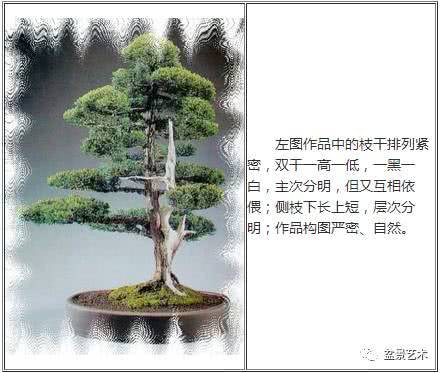
(1) Having a compact structure The branches and the trunk can complement each other, interlock closely, have primary and secondary elements, and highlight the center. The upper and lower parts, and the left and right parts, can cooperate and echo each other, just as writing an essay requires introduction, development, transition, and conclusion. Viewed from below, the front and back spread out and the layers are distinct. When there are many branches, they are arranged appropriately; when there are few branches, they are sparse and airy.
(2) Having balance and a center of gravity In bonsai, whether it is the upright style, slanting trunk style, cascade style, or lying trunk style, the balance of the tree shape is very important. If balance is handled well, then the composition is harmonious and natural, and the plant looks alive. No matter how its density and length vary, it appears stable in its center of gravity and composed. Otherwise, it violates the laws of plant growth, the plant does not look like a real tree, and then there is no beauty to speak of.
(3) Having variation, movement, and stillness Bonsai composition has sparse and dense areas: where it is sparse, a horse can pass through; where it is dense, not even wind can get through. This is variation, but it is not average top-to-bottom or uniform left-to-right. However, sparse does not mean so sparse that it is empty and lifeless, and dense does not mean so dense that there is no room to stand a needle. Only with movement and stillness can it appear vivid and lively. If there is movement without stillness, too much movement makes it chaotic; conversely, if there is stillness without movement, too much stillness makes it stiff. With both variation and movement and stillness, it is vivid and lively.
(4) Having qi and strength Qi is the inner vitality of bonsai. Qi and strength come from method, that is, from the laws of plant growth. The principle is the same as calligraphy: according to the brush method, when it should be straight, it is straight; when it should turn, it turns. Writing boldly gives it momentum. If when putting brush to paper one is half-hearted and hesitates to move forward, when it should be straight it is not straight, and when it should turn it does not turn, then naturally there is no qi and no strength.