Amaryllidaceae flowers are highly ornamental, and the prototype is actually this
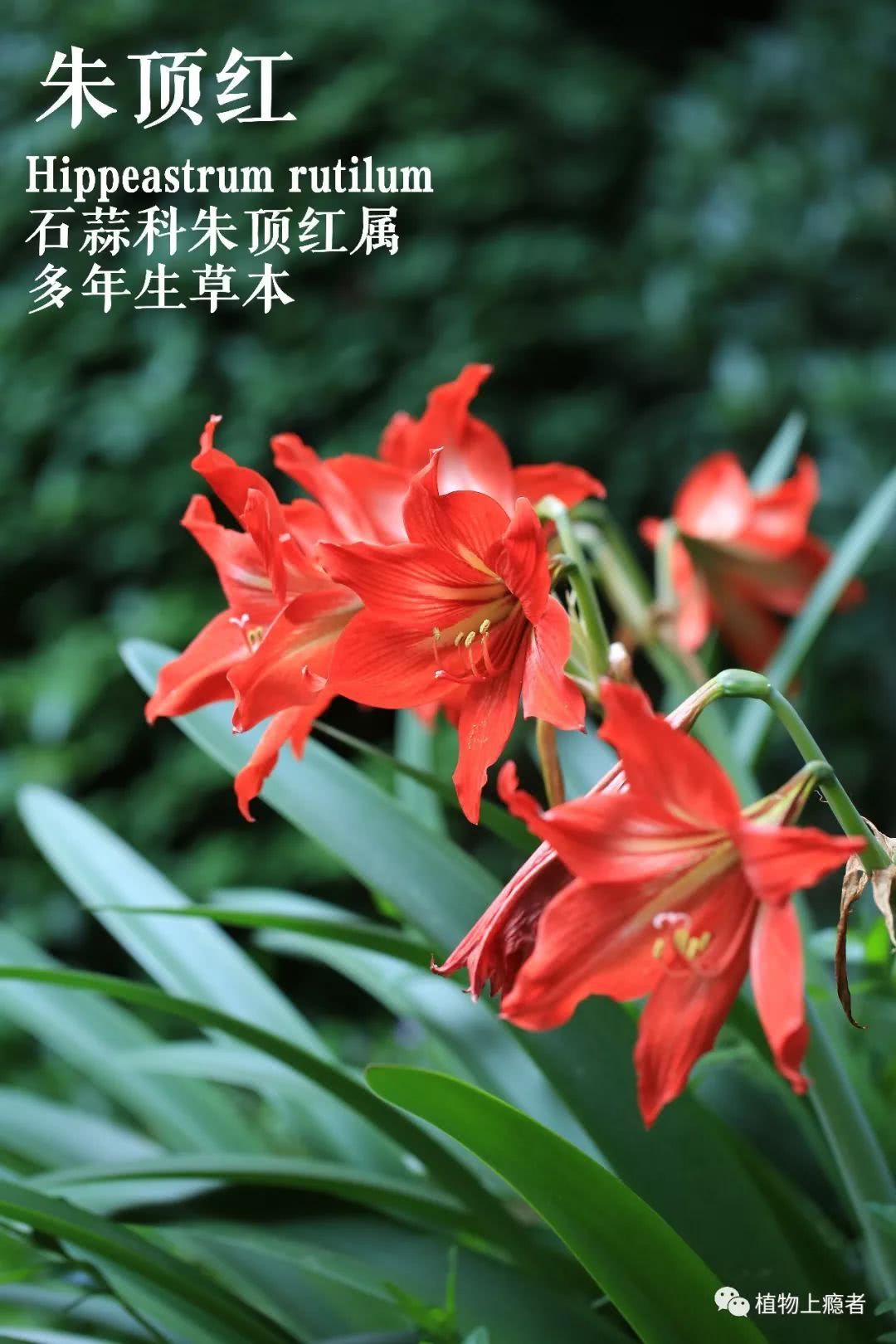
In the past, I never much liked Hippeastrum. Every year in late spring and early summer, whenever I saw its huge red flowers bloom, it always gave me a feeling of being a big clumsy thing.
Later I discovered that it is actually one of the most popular bulb plants in the world. Foreigners are extremely passionate about breeding horticultural varieties of Hippeastrum, and to date over a thousand varieties have been developed, with new varieties still being continuously bred. What is so good about this flower?
Perhaps I just lacked the right opportunity to become interested in it. That opportunity finally arrived not long ago: last month when the Clivia bloomed.
Thick, fleshy strap-shaped leaves
A single scape emerging from the base
Umbel inflorescence, inferior ovary
Perianth with 6 lobes, 6 stamens
The above is the standard portrait of Amaryllidaceae
The advantage of large flowers is that the features of each part can be observed very clearly with the naked eye. A typical Hippeastrum has 4 flowers per inflorescence, with flowers held horizontally or slightly drooping, commonly known as "cannon firing at four gates," which is very vivid. At the top of the scape there is a membranous spathe, above the pedicel is the ovary, and above the ovary is the flower.
Hippeastrum flowers are truly large, like a big red trumpet, over ten cm in diameter. The fused perianth tube is very short, while the 6 perianth lobes are very long; the 3 outer ones are wider and the 3 inner ones are narrower, with each lobe having a thick white keel down the middle visible on both sides. The 6 stamens extend along the lower inner perianth lobes, with tips curving upward, and the style tip splits into 3 branches.
Flowers horizontal or slightly drooping, with a membranous spathe at the base
Outer lobes wider than inner ones, with a white keel down the middle
Style tip 3-lobed
There is a hidden feature that distinguishes Hippeastrum from other genera in Amaryllidaceae: at the throat of the Hippeastrum flower, there are small scales.
Scales at the throat
The scape of Clivia is flat, while the scape of Hippeastrum is cylindrical, with a layer of white powdery bloom on the surface. If you squeeze it, you will feel that the scape is hollow - this point is quite important, because it concerns its past and present, and a name inseparably linked to it: Amaryllis.
Originally, the founding father of plant taxonomy, Linnaeus, named the genus Amaryllis and designated it as the type genus of Amaryllidaceae (which can be understood as the family representative); the name Amaryllidaceae comes from here. The Hippeastrum lineage was originally placed in the genus Amaryllis, so it is the prototype of this family's standard portrait.
Later, botanists discovered that this family actually had two major groups, with rather different morphological features and distribution areas. One group has solid stems and is distributed in South Africa - this is the genus Amaryllis; the other group has hollow stems and is mainly distributed in Central and South America - this is the genus Hippeastrum that was later separated out.
However, in today's international flower market, many horticultural varieties of Hippeastrum are still traded under the name "Amaryllis." That's just how willful it is.
Scape hollow
The genus name Hippeastrum comes from the Greek roots hippeus (knight) + astron (star), meaning "knight's star." In China, it has another name, "Huazhou orchid," with a similar meaning, both referring to its broad, long leaves resembling a sword and its red flowers resembling a medal. Its species epithet rutilum means orange-red, referring to the flower color.
Fruit and seeds
The genus Hippeastrum has about 70 species, with wild species concentrated in Brazil, Peru, and Bolivia in South America. Since being introduced to Europe in 1789, Hippeastrum has been enthusiastically sought after, and California and Florida in the United States, as well as the Netherlands, successively became research centers for Hippeastrum worldwide.
Over more than 200 years, Hippeastrum has now been hybridized into over a thousand varieties with diverse colors and flower forms, and the Hippeastrum bulb trade has become a big business. Its bulb may be the largest in Amaryllidaceae, and its shape is also the most typically round.
Abroad, Hippeastrum is a common and widely popular holiday gift. It blooms in winter and is a star Christmas flower; a single flower has a long blooming period and is also very suitable as a cut flower. The International Huntington's Disease (a genetic neurodegenerative disorder) Association even chose Hippeastrum for its logo.
In China, the market often divides Hippeastrum into "native" and "foreign" types; native bulbs are relatively cheap, while foreign ones are more expensive. Actually, they are all foreign goods, because China has no native species of Hippeastrum. The so-called native type is probably an earlier-introduced variety, while the foreign type is a newer variety. Horticultural varieties are my weak spot, and double-flowered ones leave me even more confused, so I won't dig a pit for myself to fall into; I'll just share a few photos of different varieties.
Striped-leaf Hippeastrum, a commonly seen variety in China
Hippeastrum reticulatum var. striatifolium
Zhang Yongmei. Photographed in Xiamen
Red-edged carnation (horticultural variety)
Hippeastrum "Picotee"
Xia. Photographed on my own balcony in Dalian
Jiexian. Photographed in South Australia
The article and plant photos (unless otherwise credited) are all original by the author
If you like it, please share, thank you for your support ^_^
Plant Addict
WeChat ID: plantfiend
Discovering the unique beauty of every plant