Variety Profile of the Yellow-flowered Bergeranthus Succulent
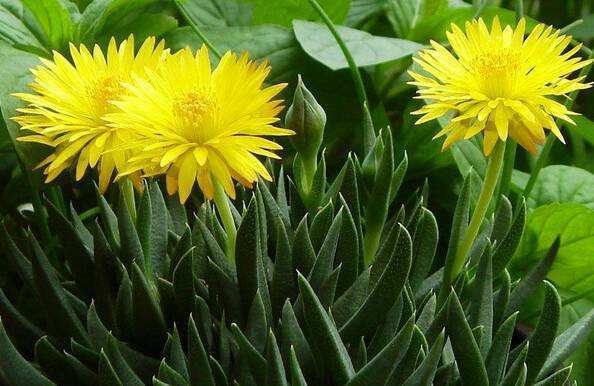
Bergeranthus, a succulent in the Aizoaceae family. This species grows relatively fast and is easy to cultivate. Its slender, deep green leaves are about 3 cm long, and it produces yellow flowers. Watering should also alternate between dry and wet periods, but prolonged drought and waterlogging must be prevented. During high summer temperatures, shade is needed, and exposure to blazing sun should be avoided. It is a perennial succulent herb with no stem, short and small, initially solitary and later densely clustered, with a height of 5-6 cm and a spread of 6-10 cm.
Yellow-flowered Bergeranthus
Each solitary plant has 6-8 leaves at its base, arranged in a radial pattern; the leaves are highly succulent and soft, 3-5 cm long and 0.6-1 cm wide; they are obtrullate-linear, flat on the upper surface and with a keel-shaped ridge on the back; the leaves are opposite, connate at the base, white there, and gradually tapering toward the tip; the epidermis is smooth, green to dark green, densely covered with small transparent dots.
Yellow-flowered Bergeranthus
The flowers are golden yellow, solitary, daisy-like, with pedicels 2-3.5 cm long and a flower diameter of 2-2.5 cm; the flowering period is summer, and a single flower can remain open for 7 days. The capsule is fleshy; the seeds are very small and numerous.
It prefers a warm, dry environment with plenty of sunlight. It is not cold-tolerant, tolerates drought and partial shade, and dislikes waterlogging and blazing sun. It needs fertile, loose, well-drained sandy loam. The optimum growing temperature is 18-24°C, and the winter temperature should not be lower than 10°C.
Yellow-flowered Bergeranthus
Geographic distribution:
This species is native to southern Africa and is relatively concentrated in Cape Province.