Which succulents are easy to propagate from leaf cuttings? A veteran gardener teaches you how to become a succulent tycoon
Flowers are herbaceous plants with ornamental value, a general term for green plants grown for appreciation. Growing flowers can beautify the environment, delight the eye and mind, and benefit physical and mental health. Have you ever propagated succulents from leaf cuttings? Below I will introduce several succulents that can be grown from leaf cuttings.
I. Graptoveria 'Titubans'
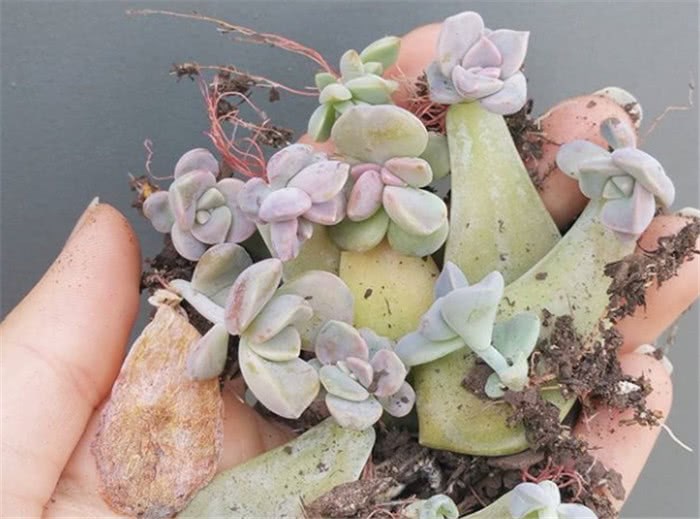
Graptoveria 'Titubans' is a succulent of the genus Graptoveria in the family Crassulaceae. The stems and leaves are succulent, and the leaves range from grayish-white to grayish-green, with a faint white powder on the surface; the leaf tips turn pale pink in sunlight. The stems are sturdy, and the alternate leaves are arranged in a rosette; the leaves are obovate, and the white leaves open like peony blossoms, very beautiful. Propagation is mainly by leaf cuttings and stem cuttings. For leaf cuttings, lay a complete mature leaf flat on moist sandy soil and place it in a shaded spot; after about ten days, small leaf clusters and new roots grow from the base of the leaf. Bury the roots in the soil, give plenty of sunlight, water appropriately, and it will gradually grow into a new plant. The new plant is best grown in sandy soil with good drainage and aeration, which can be made from leaf mold, sandy soil and garden soil. Graptoveria 'Titubans' blooms in spring; the corymbose inflorescence extends from the leaf axils, and the small bell-shaped flowers have five petals, deep yellow, with fine red dots on the petals. It has a certain ornamental value.
II. Graptosedum 'Bronze'
Graptosedum 'Bronze' is a perennial herbaceous plant, a succulent. It is a small plant, with waxy petals, and the leaves arranged in an elongated rosette shape, covered with white powder or with awns at the leaf tips. It likes a sunny, warm and dry environment, is drought-tolerant, and spring and autumn are its main growing seasons. It is usually green, and with sufficient sunlight the leaves turn vermilion with a brown tinge, very attractive. Propagation methods include beheading, cuttings and leaf cuttings; after the stem becomes woody, the lower leaves can be pulled off for leaf cuttings, and the remaining old plant can be used for single-plant shaping. For soil, a culture soil of half loam and half coarse sand can be used. During the growing season it needs to be placed in sunlight, and watering should not be excessive to avoid rot. It can overwinter safely as long as the winter temperature stays above zero degrees. Graptosedum 'Bronze' blooms in spring with small yellow star-shaped flowers, and has ornamental value.
III. Sedum rubrotinctum
Sedum rubrotinctum is a succulent of the genus Sedum in the family Crassulaceae, a perennial succulent herbaceous plant. It is much branched, with swollen alternate succulent leaves, green; under sufficient sunlight, the leaves turn reddish-brown. Sedum rubrotinctum is cold-tolerant and not afraid of scorching sun, and the more sun its leaves get, the redder they become. Propagation can be done by cuttings or leaf cuttings; take the pruned branches, cut them into 5 cm stem segments, leave them in a shaded spot to dry for three to five days, and once the cut is slightly dry, insert them into a seedbed; for leaf cuttings, remove complete leaves from the stem, leave them for three days and then insert them, giving a high survival rate. For soil, a culture soil of half loam and half coarse sand can be used. It likes a warm environment with a marked difference between day and night temperatures. Sedum rubrotinctum is mainly grown for its foliage; in autumn, under low temperatures and strong sunlight, the leaves turn bright red, very attractive.
IV. Echeveria 'First Love'
Echeveria 'First Love' is a succulent of the genus Echeveria in the family Crassulaceae. The leaves are relatively thin, long-spoon-shaped, with the front section slanting to a triangular point, and the leaf body curving upward, forming a loose rosette. The color of Echeveria 'First Love' is quite variable; with different seasons, temperatures and light, the leaves may appear grayish-green, orange-yellow or pink, colorful and gorgeous. Echeveria 'First Love' likes a warm, dry and sunny environment, is not cold-tolerant, and tolerates partial shade and drought. Propagation can be done by leaf cuttings or stem cuttings; in late spring, cut mature leaves for cuttings, and after the cut dries, insert them into a sand bed; they root after about three weeks, and once seedlings grow they can be potted up. Choose a loose, airy potting mix, such as peat soil and perlite. Water thoroughly only after the soil has dried out. Echeveria 'First Love' blooms in late spring, with a scorpioid cyme, and small bell-shaped flowers with five petals, yellow. It has a certain ornamental value.
Of these succulents above, which ones have you propagated from cuttings? You are welcome to share your thoughts in the comment section below. If you enjoyed this article, why not subscribe, and more wonderful articles will be shared with you.