What foliage plants are suitable for the living room? An old gardener recommends four colorful varieties
There are countless plant varieties in the world, and those suitable for growing and cultivating differ from region to region, country to country, and area to area. Once some of these plants are potted and brought into the home, the places they suit according to their habits also differ. So do you know which plants are most suitable for growing in the living room?
Now let an old gardener with rich experience in growing flowers tell you about the four most common colorful foliage plants on the market today that are suitable for the living room. See whether any of them is a variety you want to plant and grow?
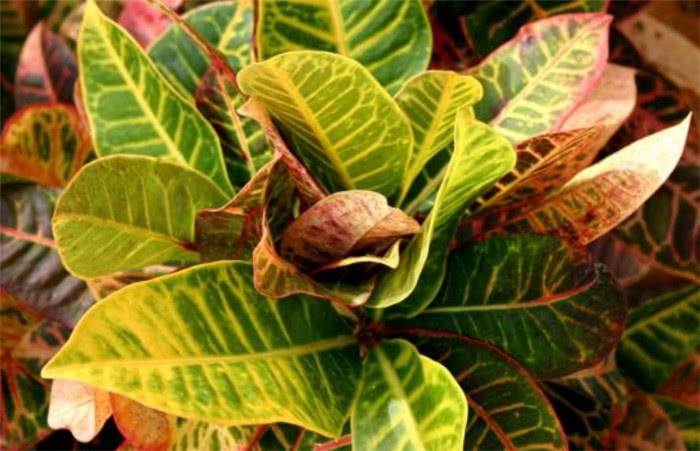
1. Croton
Croton is a perennial shrub or small tree of the Euphorbiaceae family, able to grow up to 2 m in the wild, and is also commonly called variegated laurel. Its branches are hairless with obvious leaf scars, and its leaves are rich in color, containing large amounts of anthocyanins, with colors including green, white, red, pink, scarlet, purple and so on, all mixed together on a single plant, making it highly ornamental. Because croton varieties differ, leaf shapes also vary, including long linear, lanceolate, ovate, or leaves with deep lobes, and the leaves are generally leathery in texture with a metallic sheen. Croton can bloom, with axillary racemes, bisexual, male flowers white, female flowers pale yellow, and capsules nearly spherical, slightly flattened and hairless. This tree is suitable for planting in fertile, clay loam with good water retention, and for pots a mix of potting soil, leaf mold and coarse sand works well. Croton likes ample sunlight; apart from needing appropriate shade in summer, it can receive full light in the other seasons. Its optimum growing temperature is between 10-30 degrees, and it likes warmth and fears cold. During the growing period from May to October it can be watered fully, while in autumn and winter watering should be reduced. As for fertilizer, applying a decomposed liquid fertilizer once every 2 weeks is enough to meet its growth needs, and nitrogen fertilizer must not be excessive.
2. Inch plant (Tradescantia zebrina)
Inch plant is a perennial creeping trailing herbaceous plant of the genus Tradescantia in the Commelinaceae family. Because its leaves resemble bamboo and are very beautiful and ornamental, it has become one of the most common varieties grown in modern homes. Inch plant has weak green stems, fleshy ovate leaves, sessile leaves with acute tips, the upper surface of the leaves purple-green mixed with silvery white and with purple markings on the middle edges, and the underside purplish red. Its branches trail downward, are branched, and bear adventitious aerial roots at the nodes. The small flowers of inch plant are white and axillary, usually gathered in clusters within bract-like leaves, one large and one small, terminal; the fruit is a capsule, and the flowering period is irregular. It likes a warm, humid climate, is fairly shade-tolerant, not cold-tolerant, and tolerant of wet conditions. It is suitable for planting in fertile, loose, well-drained humus loam, and also tolerates poor soil, though it is not drought-tolerant. Inch plant is not strongly cold-hardy, and the minimum winter temperature must not fall below 10 degrees. It likes light, and insufficient light will affect the plant's growth, so shade is needed in summer. During the growing season, water only when the surface soil is dry to 2.5 cm, while in winter water when the soil is dry to halfway down. During the growing period, applying a nitrogen-based compound fertilizer once every half month can meet its growth needs.
3. Coleus
Coleus is a perennial herbaceous plant of the genus Coleus in the Lamiaceae family, and is a typical foliage plant. Old plants can grow into a subshrub form, but the plant shape is rather unattractive, so as an ornamental plant it is mostly grown for one to two years. The plant height is about 50-80 cm, the whole plant is hairy, the stem is four-angled, and the base is woody. The leaves of coleus are simple and opposite, ovate in shape, with long acuminate tips and blunt-toothed edges; the main color of the leaf surface is green, with bright markings in peach red, vermilion, purple, yellow and other colors. The terminal raceme bears small flowers in light purple or blue. After the flowers fade, the small nutlets formed are smooth and glossy. Coleus is a plant variety with very strong adaptability within our country, and is more common in the south. It likes a warm growing environment, and the winter temperature must not fall below 10 degrees. It likes ample light, and the more sufficient the light, the richer the leaf color, but it needs appropriate shade in summer. It is suitable for planting in sandy loam rich in humus, loose, fertile and well-drained, and its optimum growing temperature is 10-25 degrees. During the growing season the potting soil must be kept moist, neither too dry nor waterlogged, and when growing it, attention must be paid to pinching in time to shape it.
4. Purple velvet plant (Gynura aurantiaca)
Purple velvet plant is a perennial herb or subshrub of the genus Gynura in the Asteraceae family, with thick, many-branched stems. Its leaves are opposite, oblong-ovate in shape, and the leaf margins have relatively coarse double serrations. Its name comes from the dense purple-red fine hairs on its stems and leaves that look like velvet. Purple velvet plant has a trailing habit, with stem sap; when young it is upright, and after growing up it droops or creeps along the ground. Its leaves appear very distinctive among foliage plants, and it can bloom. The flower heads are axillary, orange-yellow or yellow in color. However, because these flowers have an unpleasant smell, the buds are often removed and it is grown mainly for its foliage. It is suitable for planting in loose, breathable, water-absorbing loam mixed from vegetable garden soil, furnace slag and the like; its optimum growing temperature is 18-30 degrees, it fears cold and frost, and the winter minimum must not fall below 10 degrees. Purple velvet plant likes a semi-shaded growing environment, fears direct strong light in summer, and needs shade. During the growing season it likes moisture and high air humidity, and can be watered fully. Purple velvet plant is a fertilizer-loving plant, and the fertilization principle is "apply dilute fertilizer frequently, small amounts and many times, complete nutrition."
What the living room needs is color, and these foliage plants are as brilliant to the senses as flowers that never fade, yet without having to face the decline when flowers wither. They are always full of vitality and energy, so that you can feel pleasure and happiness the moment you enter the door, making them truly the first-choice plant varieties to grow in this area.
How much more do you know about the topic of this article? You are welcome to share your views in the comment section below. If you like this article, you might as well subscribe, and more wonderful articles will be shared with you.