How to make a peach tree bonsai? Detailed method and steps
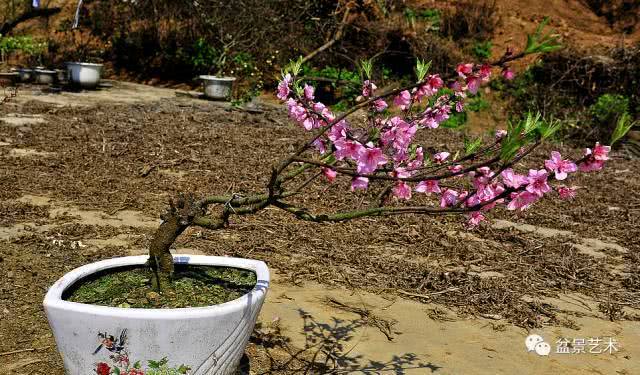
1. Varieties: Bonsai peaches are grown mainly for ornamental purposes, so late-maturing superior varieties that bear fruit early, form flower buds easily, produce large fruit, and have good quality are mainly chosen, such as Zhonghua Shoutao, Yangtun Jutao, Xinchuan Zhongdao, Zhongtao No. 21, Ruipan No. 4, and other varieties.
2. Flower pot selection: Generally, a clay pot with a diameter of 30 cm and a height of 25 cm is chosen, because clay pots are loose and porous in texture, making it easy for excess water in the pot to drain out and for air to circulate, which is suitable for root development, and they are cheap, light, and convenient to use.
3. Preparation of nutrient soil: Nutrient soil must not only be rich in nutrients but also have good air permeability. There are generally two preparation methods. One method is 4 parts garden soil, 4 parts humus soil, and 2 parts cinder and sand; this nutrient soil is suitable for newly transplanted small seedlings. The other method is 6 parts garden soil, 2 parts humus soil, and 2 parts cinder; this mixture is mostly suitable for cultivating mature seedlings.
4. Potting and planting
1. Planting time: Potting should be done in spring when buds sprout or in autumn after leaves fall. At this time, plant growth is in a relatively slow state, stored nutrients are abundant, and after potting it is easy for roots to develop and for the plant to survive.
2. Seedling selection: Choose seedlings with well-developed root systems, many fibrous roots, appropriate trunk thickness and height, a beautiful tree shape, uniform branching, and robust growth.
3. Potting method: First check whether the bottom of the flower pot is unobstructed, then cover the hole with a broken pot piece with its convex side facing up, to avoid soil leakage or blockage. When planting, the roots should be spread out and in close contact with the soil. The planting depth should be just enough to cover the original soil surface of the seedling, and the graft union should be exposed above the soil surface. The pot soil should be filled to 80 percent full to facilitate watering. After potting, water thoroughly.
5. Peach tree styling: The tree shape should mainly be peculiar, novel, beautiful, and elegant, with exposed roots, dense branches, and a compact plant shape as the standard. There are generally three tree shapes:
1. Straight-trunk style: The trunk is a single stem, tall and upright, with distinct layers, evenly distributed fruit, and a sense of majestic standing.
2. Curved-trunk style: The trunk bends upward in a zigzag shape, mostly with two layers, resembling a swimming dragon.
3. Slanting-trunk style: The trunk leans to one side, generally with a slight bend, and the crown leans to one side, tilting outside the pot, with a distinctive charm.