Homestays bring new opportunities to the countryside, and the countryside opens up vast new horizons for homestays.
In a modern society advancing rapidly in urbanisation, the countryside has been redefined and endowed with many new colours. Compared with the increasingly cramped and crowded living space of towns and cities, the countryside of memory with its little rivers has become the best interpretation of an ideal life for a generation.
Rural tourism is booming, and the whole series of supporting products and spin-off products related to it are also much sought after; homestays are one of them.
As a product combining old nostalgia with the new rural life, homestays are described as accommodation with warmth and a life with soul. Driven jointly by multiple actors, homestays have shown explosive growth in recent years. Taking the Hangzhou area as an example, in the first half of 2015 alone the number of homestays around West Lake in Hangzhou surged by as much as forty percent, and homestays have become an important battleground where all kinds of contenders vie for tourism.
The development of the homestay economy has become a composite of rural economic development, the most effective entry point for the integrated development of rural industries, and even more a focus of the structural reform of the agricultural supply side; it will play an important role in driving the implementation of the new concept of rural development.
The development of the homestay economy immerses the countryside in the market economy as completely as never before, and lets farmers roam the ocean of the market as freely as never before. This is the greatest change that the homestay economy has brought to the countryside.
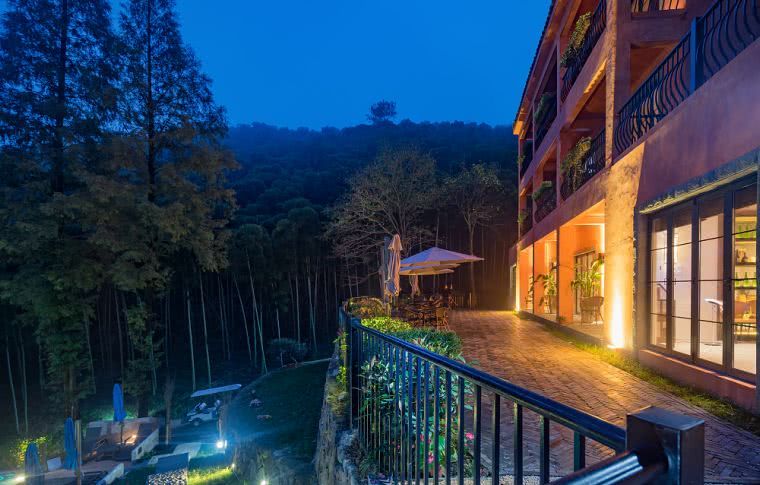
A rural homestay turns a farmhouse into a hotel with a rustic exterior and a modern interior, places a refined little house amid green hills and clear waters, and moves modern urban life to the countryside. A homestay lets visitors enjoy tranquillity amid green hills and clear waters, walk and breathe among blue skies and white clouds, experience the wonder of local culture, and relax on holiday in a rural farmhouse. A rural homestay: a mature tourism market, a standardised tourism industry, a replicable business model, a novel economic format.
The homestay economy is even more an entry point for integrating the development of the primary, secondary and tertiary industries in rural areas, the "nose ring" that pulls together rural resources, and a big platform linked to the overall development of the countryside.
Among the new economic formats that represent the future direction of rural development, the rural homestay economy undoubtedly has enormous room for growth.Almost without notice, rural homestays have sprung up like bamboo shoots after rain in recent years, and the scenery here is especially fine. Mountain ridges, small streams, bamboo groves, tea gardens, fields and islands, once desolate and silent and ignored by all, are now completely renewed, and homestays with distinctive themes and full of vitality are appearing before people one after another. Villages that had once declined and fallen silent have developed into thriving specialised homestay tourism villages.
Rural tourism began with farmhouse entertainment, and then moved on to homestay tourism.If farmhouse entertainment is the basic version of rural tourism, an early, shallow and single-form kind of rural tourism, then homestay tourism is the upgraded version, an in-depth, leisure-oriented and diverse kind of rural tourism. The boundary between the two is still hard to clarify in today's rural tourism, but homestay tourism is certainly a higher form of the industry and one that can connect with future trends in rural tourism.
Homestay tourism is an inevitable development of rural tourism.Homestay tourism, which originated in Japan, the United Kingdom and Taiwan, China, only began to rise on a large scale more than 30 years ago, but its all too tempting business model quickly swept the globe and became an important format in the world's tourism industry.
Hundreds of millions of city dwellers are willing and able to spend a quiet period of time in the countryside, which established the inevitability of homestay tourism development. Farmers who for decades have loved to devote themselves to building houses can fully provide spacious, comfortable and inexpensive homestay houses for homestay tourism. The rich rural folk customs and natural landscapes have created an attractive big market for rural homestay tourism.
Homestay tourism brings the most complete market economy, and may even make rural change in a short time exceed the sum total of the past several thousand years.This conclusion is not something imagined by a reporter who studied history; it can be imagined without much complexity, and it can be interpreted on the basis of theory and practice, especially as it can be foreseen within not too long a time.
Homestay tourism is even more a business-based entrepreneurial income, and this income will become the most substantial part of farmers' income structure. The homestay economy drives local agricultural products into the market quickly and with added value, so that income from primary-industry agriculture also grows by a fairly large margin. Homestay tourism will contribute a considerable number of jobs, giving part of the rural surplus labour force wage income. It can be said thatthe development of the homestay economy combines property income, entrepreneurial income, primary-industry agricultural income and wage income together, opening up unlimited space for increasing farmers' incomes.
The development of the homestay economy gives farmers' income a more complete, more stable and more substantial diversified structure.Homestay tourism turns the spare rooms of farmers' own homes into commercial use as inns and hotels, thus generating a considerable amount of property income.Only when property income and entrepreneurial income become the main body of farmers' income can farmers truly become wealthy at the root.
The development of the homestay economy makes the silent and declining countryside lively and active again, allows traditional rural culture to be inherited and carried forward as it circulates and gains value, and makes many long-standing abuses in the countryside disappear along with it; its positive influence will help drive a fundamental change in the face of the countryside.
The development of the homestay economy is comprehensive, profound and far-reaching in changing the countryside. As the homestay economy, a modern service industry, flourishes in rural areas, all kinds of factors begin to flow to the countryside. Migrant workers have come back, young university students have come back, maker-entrepreneurs and country gentry have come back, capital has come back, and the government's policies, funds and public goods are also tilting more towards the countryside. This is decisive in changing the countryside. This force makes the silent countryside lively again, makes the declining villages prosperous again, and makes the barren land green again.
Any homestay tourism will develop folk cultural resources to the utmost. Only in the process of circulating and gaining value can rural customs and cultural value be permanently maintained and passed on. Folk tourism is precisely a good vehicle for folk culture to circulate, gain value and then be passed on. As long as homestay tourism thrives, the local customs and cultural value can be passed on more completely. What is more, the modern civilisation and culture brought by numerous urban tourists will also deeply influence and change everything in the countryside.
The development and rise of the rural homestay economy is a continuation of rural renovation and construction in the new era, and is the result of farmers' creation and government support.A new rural economic format, a new rural social form, a new rural life ecology, are approaching us as never so closely before. The homestay economy has brought a touch of beautiful colour to the vast countryside, brought a breath of fresh vitality, and brought a profound influence. They have ignited the bright prospects of rural civilisational progress, radiated the vigorous vitality of ancient villages, and continued the powerful vitality of sustained rural development over thousands of years. The relationship between the countryside and homestays can be summed up in one sentence:Homestays bring new opportunities to the countryside, and the countryside in turn opens up an even broader horizon for homestays.
In your own secret garden
how could there be a shortage of flowers and plants?
Come and shop at Linju Jiacheng
Lin Mei is waiting for you~