How to tell lavender and salvia apart? Visiting a salvia estate
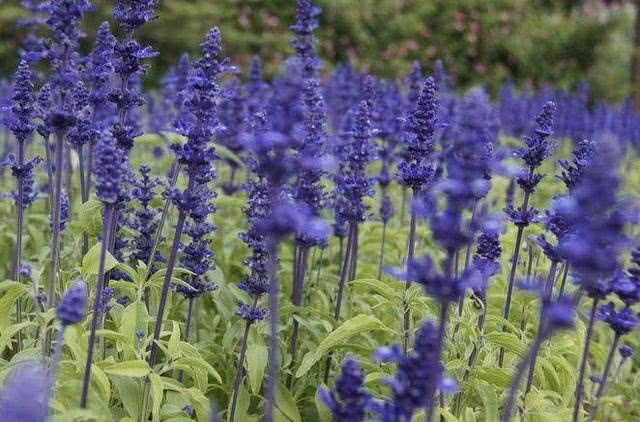
Flower friends, have you ever been to a salvia estate? Imagine those clusters of salvia swaying in the wind - do you feel like going there sometime?
The salvia that looks most similar to lavender is blue salvia (Salvia farinacea); their inflorescences are extremely similar, so telling the two apart is quite a skill. Next, this editor will introduce a method for everyone, and flower friends can also share their own views.
1. Distinguishing by leaves
Lavender leaves are mostly alternate, and most lavender leaves are linear or lanceolate. Blue salvia leaves, however, grow close to oval or even triangular, and the leaf surface of blue salvia has a bumpy texture.
2. Distinguishing by flower shape
Lavender's flower stalk is green; the upper lip of the petal is two-lobed, the lobes are relatively large and round, and they slightly overlap each other; the lower lip is split into three lobes, and the lobes are smaller than the upper lip. There are blue, deep purple, pink and so on. Blue salvia's flower stalk is purple; the upper lip of the petal is small, oval or ovate. And on the lobes of blue salvia, there are obvious white spots.
3. Distinguishing by scent
The simplest way to tell the two apart is still to smell them directly - it's faster. Lavender smells light with a slight woody sweetness; the scent is fairly fragrant, and smelling it makes people feel relaxed and happy. Blue salvia's scent is more pungent and extremely strong; smelling too much of it may make people feel irritable.
4. Distinguishing by the plant itself
The lavender plant is relatively large, and once mature, lavender forms a ball at least half a meter in diameter, with a woody form below. The shape of lavender looks much like a broom.
Salvia's posture is more varied, but most appear upright. Unlike lavender, salvia does not have a broom-like shape.
5. Different medicinal value
The effect of salvia is that it can be used to treat headaches, insomnia, and even headaches caused by menopause. For relieving conditions like headaches, salvia is very useful.
As for lavender, its main effect is that it can calm and induce sleep, helping people relax. And it is worth mentioning that lavender can also be used for antibacterial and anti-inflammatory purposes; lavender can inhibit the growth of bacteria - it can inhibit the growth of 17 kinds of bacteria and 10 kinds of fungi.
As for this editor's method of telling them apart, I wonder if everyone has learned it. I wonder what other advice the formidable flower friends have?