Are Succulents Desert Plants? Understanding Their Growing Environment and Caring for Them by Variety Makes Them Even More Beautiful
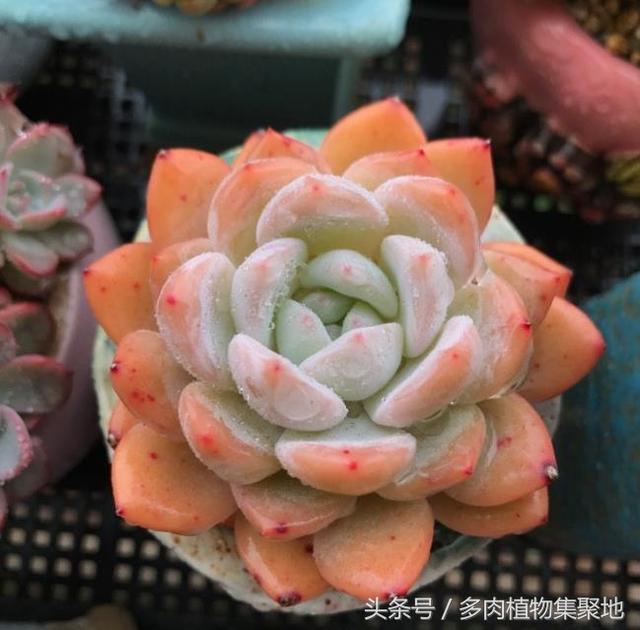
Succulents refer to higher plants with enlarged vegetative organs, usually possessing three vegetative organs - roots, stems and leaves - and three reproductive organs - flowers, fruits and seeds. In horticulture, they are also called succulent plants or succulent flowers, but the name succulents is the most commonly used. Succulents are also very common in China; for example, some varieties of Sedum and Kalanchoe often appear on rooftops in rural areas, and wild tuberous-root species are also sometimes found in the mountains and fields. It is just that we do not pay much attention to these plant types and have not developed them into commercial products, whereas today countries such as South Korea and Japan have cultivated them and sell them all over the world.
There are more than 10,000 species of succulents worldwide, and the vast majority of them belong to the higher plants (most are angiosperms). In plant classification they belong to several dozen families. A few experts believe that 67 families contain succulents, but most experts believe there are only just over 50 families. As potted plants, succulents are widely popular around the world. Most of the common types currently belong to the Crassulaceae and Cactaceae, and South Africa and Mexico are the countries with the most succulents in the world. Japan, the United States and Western Europe, meanwhile, have many very famous hybrid varieties.
Desert plants generally refer to plants that can survive under desert environmental conditions. Some succulents are desert plants, but the ones we like are often not. Desert plants are deep-rooted plants, usually with relatively well-developed root systems, and their leaves are reduced to needle-like forms; most importantly, their drought tolerance is unlike that of ordinary plants. Plants that can survive under desert environmental conditions are mainly characterized by drought resistance. The leaves of ordinary desert plants are relatively small, in order to reduce water loss caused by transpiration. The main representatives are the cactus ball, the pencil cactus (Euphorbia tirucalli), aloe and so on.
In the broad sense, succulent plants (also called succulents) include some plants from more than 50 families, such as Cactaceae, Aizoaceae, Crassulaceae, Euphorbiaceae, Apocynaceae and Liliaceae. Most of them originate from tropical and subtropical arid regions. The stems and leaves of the plants are thick and succulent, with well-developed water-storage tissue. There are more than 10,000 species of succulent plants worldwide.
When it comes to watering succulents, some people like to cite the fact that succulents are desert plants, and that the large environment has no water at all, so naturally they should not be watered much. But in fact, there are many kinds of succulents, and only some of them truly grow in desert environments, such as some Cactaceae, Euphorbiaceae and Aizoaceae species that are really fleshy succulents, and some even grow in deserts near the coast, such as species of Copiapoa that draw water from coastal fog.
For the relatively common Echeveria genus, there are probably very few that grow in deserts; most grow in high-altitude areas, which is to say the temperature is not too high, ventilation is certainly good, and water is certainly not as harsh as in the desert, so they actually have little to do with desert plants. What is more, Echeveria is a large hybrid genus, and the many horticultural varieties under it have nothing to do with the desert.
This is a gathering place for succulent lovers. Share succulent care tips, and you are welcome to follow and join the discussion.