How to carefully avoid the two major problems of heatstroke and "stuffy tank" in summer
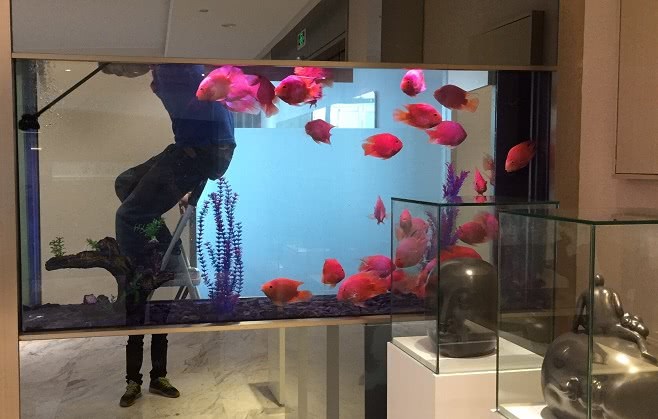
In May in Shenzhen, the weather is already so hot that you could cook something just by walking down the street. There is a risk of heatstroke both indoors and outdoors (unless you have air conditioning). Even people can't stand this kind of weather, so what about our fish? They'd be cooked in a stuffy tank, right? So in summer, what fish keepers care about most is probably how to prevent fish heatstroke and stuffy tank. But heatstroke and stuffy tank are two similar yet different situations, so how should you tell them apart and take the relevant measures? Please read on!
Heatstroke
Usually refers to the phenomenon in which water temperature is too high and dissolved oxygen in the water is too low, causing severe impairment of the central nervous system function of ornamental fish. It occurs most often in the afternoon during the hot midsummer season. The main cause is mostly failure to put up a shade screen in time, resulting in excessively high water temperature, which in turn reduces the dissolved oxygen content in the water, causing fry and adult fish to be unable to endure the stimulation of high temperature and blazing sun along with oxygen deprivation, leading to fainting and death.
Stuffy tank
Usually refers to a disease in which the weather is muggy, air pressure is low, and water temperature is high, and then showers and heavy rain occur, causing rapid changes in the water temperature inside the tank. This causes the upper and lower layers of water in the tank to rapidly convect, and feces and waste at the bottom of the tank rise up, causing fish to die from oxygen deprivation. This is especially true at night when green algae continue photosynthesis and consume oxygen in the water together with the fish, causing the fish to lack oxygen, float at the surface for a long time, and die from exhaustion.
Heatstroke and stuffy tank are severely harmful to ornamental fish. They occur mostly in the afternoon or at night in hot summers, and are even more likely to occur in muggy weather.
Causes
The suitable growth temperature for warm-water fish is 23-28°C, but once summer arrives, the air temperature often reaches above 33°C, and sometimes around noon it can even reach above 40°C. In hot seasons, if shade and cooling measures are not taken, the water temperature will rise along with the air temperature. When the water temperature reaches 35-39°C, dissolved oxygen in the water decreases, causing fish to be unable to endure the stimulation of high temperature and blazing sun along with oxygen deprivation, leading to fainting and death. In summer, when indoor air conditioning is used for cooling, heatstroke can also occur if you directly use tap water that has been exposed to sunlight for a water change. Under muggy and high-temperature conditions, showers or heavy rain can cause severe convection between the upper and lower water layers, making waste at the bottom of the pond rise. Especially at night, algae also consume oxygen, leading to excessively low dissolved oxygen in the water, and ornamental fish will die from oxygen deprivation caused by a stuffy tank.
Main symptoms and pathological changes
Fish suffering from heatstroke or stuffy tank float at the surface. Some keep hitting the tank wall, have difficulty breathing, and their body color gradually fades. Some have congestion in the capillaries around the mouth or in the fins. They float at the surface for a long time and gradually die.
Prevention and control measures
The principles of prevention and control are to strengthen feeding management, control water temperature, maintain good water quality, and promptly add oxygen to the water.
In hot seasons, ornamental fish kept outdoors or on balconies should have a shade screen put up around 9 a.m. to avoid direct blazing sun exposure that can cause heatstroke.
Regularly clean waste from the fish pond (tank) to maintain good water quality. Especially before the rainy season arrives, do an even better job of cleaning waste and appropriately add fresh water. After rain, immediately siphon out the stale water at the bottom of the pond (tank) (about 1/5-1/3 of the total water volume) and add fresh water to prevent stuffy tank.
For fish that have not yet stopped breathing, immediately change the water to lower the temperature. You can also drip 2-3 drops of hydrogen peroxide into the water or use an aeration pump to add oxygen. For fish that have just stopped breathing, artificial respiration can also be used for rescue. The method is to aim at the fish's mouth and blow hard several times, then splash water at the fish's mouth, or hold the sick fish by hand and move it back and forth in the water, and gently press the fish's belly with your hand for several minutes, and it can be revived.