Making a root-over-rock tree stump bonsai this way makes it look as if it sprang naturally from a crack in the stone
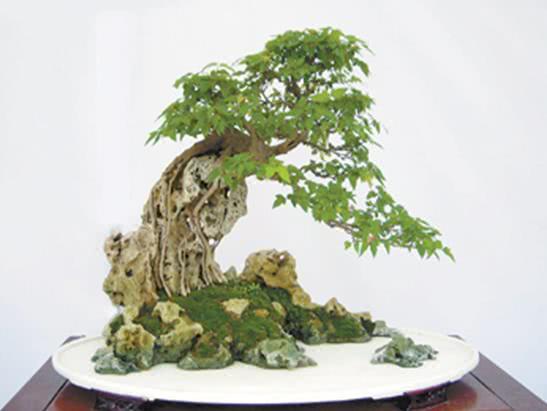
As technology develops, people pay more and more attention to home decoration, and the types and styles of ornaments and bonsai are increasing too, shifting from buying expensive ornaments with good value for money to low-cost, high-end ornaments made with your own hands. Today we will talk about how to make an exquisite and beautiful root-over-rock bonsai yourself, to replace those expensive potted plants.
A root-over-rock bonsai, as the name suggests, is a bonsai attached to a rock. Usually, a plant that can grow out of a crack in a rock must have very tenacious vitality, and for this reason the root-over-rock bonsai represents perseverance, carrying the profound meaning of tenacious struggle and a positive, upward spirit, while also offering excellent ornamental value according to its tree shape and the form of the rock.
At present, there are two ways to make a root-over-rock bonsai according to how the rock body is modified: first, the hollowed-out style; second, the inlaid style. The hollowed-out style means chiseling holes from the surface of the rock, with a few holes distributed at set positions on each face, and the holes ultimately connecting with one another, so that the center of the rock body is hollowed out into a shape that is "small at the mouth and big in the belly." Then, while putting nutrient soil in through the holes, put the plant's roots in as well, stirring from time to time to avoid the roots tangling together. Note that the roots need to fit tightly against the nutrient soil so that they can easily absorb water and grow.
After the interior is finished, the appearance of the rock body can be modified; the bottom of the rock body can be flattened for easy placement. If you want a water-style bonsai, you can place it in a shallow basin filled with water; if you want a dry style, you can also directly chisel the rock body from top to bottom into a hollow form, still "small at the mouth and big in the belly," then pass the tree stump through it and plant it in a pot filled with soil. In this way, some roots are inside the rock body and some are in the soil, and as the tree grows it gradually merges with the rock body, becoming a seamless whole.
The inlaid style means carving several parallel long grooves with equal spacing on the surface of the rock body, with their depth and width determined by the thickness of that tree species when mature, and soaking the rock body in water for several days before taking it out. Then carefully insert the roots into these grooves, fixing them temporarily with tape as you go, then wrap and bind them with thin lead wire to secure them; once secured, the tape can be removed.
To make the root system bind and grow more tightly with the rock body, seal and coat the tree roots with thick, sticky mud, then wrap the surface with green moss, and still bury the lowest roots in the nutrient soil; the initial work is then complete. After that, water carefully every day; after about one year the green moss can be removed, after two years the thin lead wire can be removed, and thereafter just keep watering and tending it carefully.
Note that different tree species suit different rock bodies, and aquatic and dry-land types also require different choices; the specifics depend on the tree species you want to plant. Let's all make a root-over-rock tree stump bonsai that suits our own taste!