How to make a hydroponic Echelon plant pot: a step-by-step guide
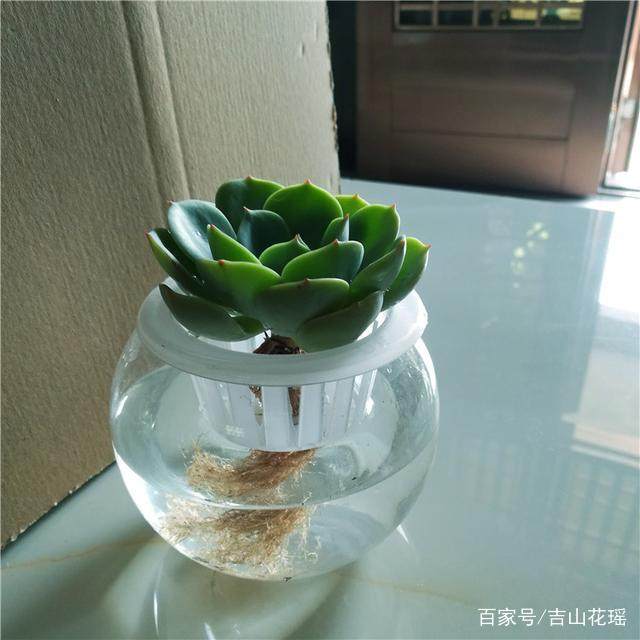
Teaching you how to make a hydroponic Echelon plant pot?
Echelon is a perennial succulent herbaceous plant. The rhizome is thick, creeping, with many long filamentous aerial roots. The leaves are numerous, densely whorled on the upper part of the stem, forming a rosette, the leaves are thick, wedge-shaped obovate, with a short, sharply pointed apex, hairless, slightly reddish, without petioles, as shown in the picture. The leaf surface is covered with a white powder, blue-gray. The flower stalk is 20-30cm tall, a raceme single-branched cyme. The flowers are red outside and yellow inside, flowering from June to August.
Hydroponic Echelon plant pot
(1) Choose a soil-grown plant with a beautiful shape, remove it from the pot, remove the soil, rinse the soil off the roots with clean water, and plant it in a container with clean water to carry out the induction culture of water roots.
(2) The Echelon plant is small, so it is advisable to choose a small-mouthed container for planting.
(3) After the Echelon plant has grown water roots, replace the clean water with nutrient solution, immerse 1/3 of the root system in the nutrient solution, and replace it every 10-15 days.
2. Care guide
(1) Light: Echelon is suitable for growing in a warm, dry, sunny, well-ventilated environment. It is tolerant of strong sunlight, tolerant of shade, tolerant of drought, and averse to waterlogging, but it cannot be placed in a shaded place for a long time, otherwise the plant is prone to leggy growth and sparse leaves. Spring and autumn are the growing seasons for Echelon plants, and sufficient light should be provided, otherwise it will cause the plant to grow leggy, the plant shape to become loose, the leaves to become thinner, the leaf color to become dull, and the white powder on the leaf surface to decrease.
(2) Temperature: The winter temperature must not be lower than 10°C. When the temperature drops in autumn, the frequency of nutrient solution replacement can be appropriately extended. When the temperature is high in summer, the plant grows slowly, or even stops growing, so it needs to be kept in a well-ventilated place for care, and attention should be paid to shading.