What are the ways to finish the apex of a bonsai? A complete explanation of bonsai styling basics
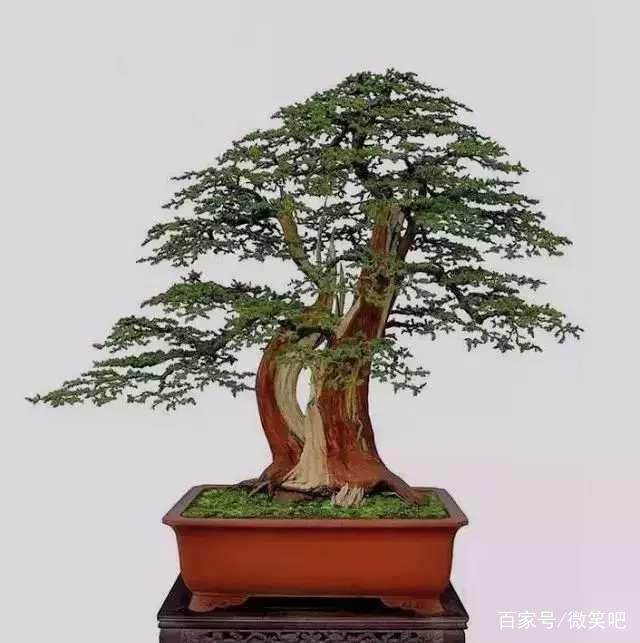
Wu Chengfa's work
The bonsai apex is the making of the bonsai, that is, the treatment of the top of the bonsai; most of it is the highest dry part at the top of the bonsai, with methods such as the natural apex and cloud-formed apex; it is related to the integrity and ornamental value of the tree, and is a necessary condition for the success of every work. Bonsai.
Some people also believe that the trunk can have one apex in order to achieve a layered goal. A double-trunk bonsai has two apexes. Of course, if the trunks are close, we take the tallest trunk as the apex. First, if the tree belongs to the attributes of a tree, then secondly it is the expression of the author's personality.
Special techniques for pine and cypress bonsai
Pine and cypress bonsai require growth suppression methods. In old pines, old cypresses and junipers, they often show curvature of the internodes, with sudden and dense internodes, and the momentum of the whole body is directed to this purpose.
The spine should be stable, neither leaning backward nor forward. But the apex can lean slightly forward, giving the best viewing angle in the body posture, and so on. In this way, there is a sense of intimacy, and the two are a subtle beauty.
The top branch does not necessarily have a long branch. If there is elimination or reduction or twisting, the top branch will easily form a "big cap" because of its apical dominance. It must be clear and distinct, not just a string of green. All overlapping branches should be cut off.
Bonsai apex. According to the shape of the treetop, it can be roughly divided into scattered crown, fan-shaped crown, triangular crown, flat-topped crown, rear crown, and trunk crown.
Wu Chengfa's "Flying to the Sky"
Scattered point crown
The crown of the scattered crown is a junction in professional terminology, but it simply means that the tip of the treetop protrudes upward. The side branches at the top of the apex are distributed at multiple points. This product mainly shows the natural, concise and vivid feeling of the bonsai. It is suitable for tall bonsai, straight-trunk bonsai, slanting-trunk bonsai, etc.
Deng Xiuzhen's work on elm
Fan-shaped crown
Then, the crown of the fan-shaped crown is the apex, with the top and side branches divided into three levels. It is mainly distributed as a high tip, dense distribution and radiating.
Elm golden casting project
Triangular crown
The crown of the triangular crown is high and low, with the main branches distributed upward. The side branches spread out. They mostly appear at the top of dry-style bonsai.
Parallel crown
In the parallel crown, all the branches of the treetop are horizontally curved and basically cloud-like. This distribution can show regularity and conciseness.
A juniper and cypress surviving from the Qing Dynasty
Crown crown
The crown is not very obvious, but basically the treetop returns to the main trunk surface. It mainly forms a visual impact through the vertical contrast of the vertical branches and the WACOM trunk.
Branch crown
The crown of the shoot is dominated by the crown crown and points to the sky of dead branches. But Shimobe Mieshigeruhashi has a strong contrast between rises and falls. This is commonly seen in Shirley's dry bonsai.