The Mexican bird of paradise was chosen to honor Saint Clarus, prince of the Frankish Kingdom
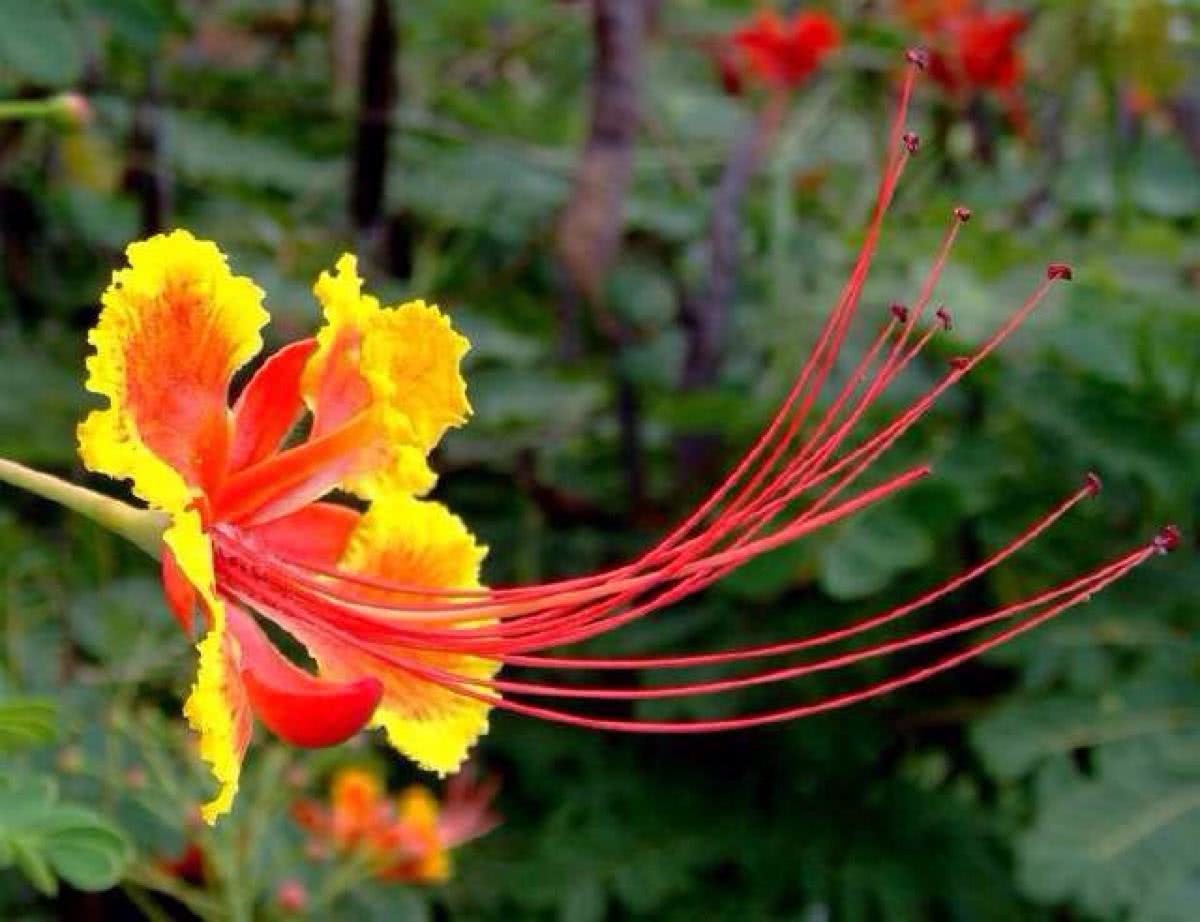
Mexican bird of paradise: large shrub or small tree; up to 3 m tall, branches green or pinkish-green, with sparse thorns. Bipinnate compound leaves in 4 to 8 pairs, opposite, leaflets in 7 to 11 pairs, oblong or obovate, base oblique, apex notched, leaflet stalks very short. Racemes terminal or axillary, petals round and stalked, orange or yellow, pedicels up to 7 cm long. Pods black. Seeds 6 to 9. Flowering and fruiting period almost year-round. Native to the West Indies; cultivated in Yunnan, Guangxi, Guangdong and Taiwan, China. One of the valuable ornamental trees of tropical regions. It is the city flower of Shantou City, Guangdong Province.
Mexican bird of paradise
Cultivation techniques:
Its demand for fertility is not very high. Generally, in soil of medium fertility with relatively high phosphorus and potassium, it blooms profusely and the color is also vivid; in soil with sufficient moisture and relatively high nitrogen, the branches and leaves are luxuriant and it also blooms more, but the color is less vivid. When planting, it is advisable to apply decomposed cake fertilizer or garbage as a base fertilizer, and topdress with phosphorus and potassium fertilizer before flowering and during peak flowering. The tree shape is not very attractive, but it has sprouting ability; in management, trunk cutting or pruning and shaping can be used to promote a fuller crown, and 3-5 plants can also be planted together to improve the ornamental effect.
Mexican bird of paradise
Ornamental:
The Mexican bird of paradise is an erect evergreen shrub of the genus Caesalpinia in the Fabaceae family. Up to 3 m tall, the corolla is orange-red with golden-yellow edges, blooming on the branches year-round like flame-like butterflies, and it is one of the valuable ornamental trees of tropical regions. Among flowers, the Mexican bird of paradise does not attract attention by color or fragrance, but mainly wins by its posture and form. The flower shape of the Mexican bird of paradise is especially ingenious; the flower is just like a flying phoenix, with a head, a tail, wings and feet, vivid and lifelike, just like a phoenix in flight, making people marvel at the wonder and brilliance of nature's creation.
Medicinal:
The Mexican bird of paradise is a famous Chinese medicine. The seeds are used medicinally and have the effect of promoting blood circulation and menstruation. The stems are squeezed for juice and taken with yellow rice wine.
Mexican bird of paradise
Plant culture:
Birthday flower; in the sixteenth century, the flower of Saint Clarus, prince of the Frankish Kingdom.
Since ancient times, Christianity has had the habit of linking saints with specific flowers, following the custom that when the church commemorates saints, it often decorates the altar with blooming flowers! In medieval Catholic monasteries, various flowers were even grown like in a gardening center. Over time, the church paired the 366 days' saints with different flowers respectively, forming the so-called flower calendar. At that time, most monasteries were located in Southern Europe, and Southern Europe has a Mediterranean climate, extremely suitable for planting flowers and plants. The Mexican bird of paradise, which belongs to the Asteraceae, was chosen as the flower to honor the prince of the Frankish Kingdom, Saint Clarus. It is said that Saint Clarus gave up the right of succession to the throne and preferred to be a monk; he not only helped the weak and supported those in need and cared for the suffering, but also performed many miracles.