Why is the Cleome considered a symbol of mystery?
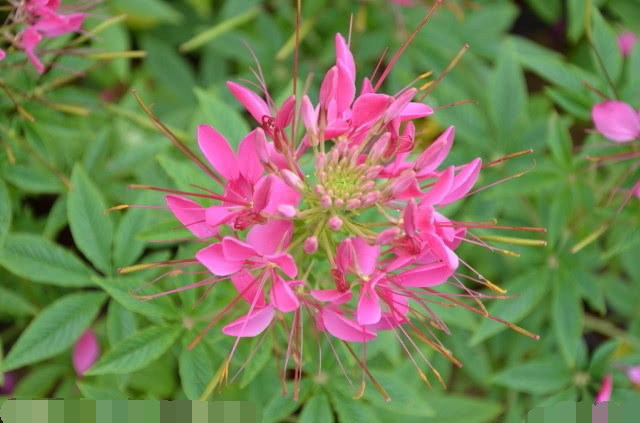
Cleome: An annual herbaceous plant. The flowering stems are upright, and the plant height is 40 cm-60 cm, with some varieties reaching 1 m. The stems bear fine sticky hairs and give off a strong, distinctive odor; the leaves are palmately compound, with 5-7 leaflets that are oblong-lanceolate; the raceme is terminal, and the flowers open successively from the bottom upward, with lanceolate petals curling outward and backward, red buds, and rose-red or white petals, and very long stamens; the capsule is cylindrical, and the seeds are light brown. The flowering period is from June to September. Its flowering stems are long and sturdy, and when the flowers are in full bloom, the raceme forms a full flower ball, with each small flower resembling a dancing butterfly, very beautiful.
Cleome
There are no wild populations in China, and it is commonly cultivated in major cities. Native to tropical America, it is cultivated from the tropics to temperate zones worldwide for ornamental purposes, and it is also an excellent nectar plant. It has strong adaptability. It prefers high temperatures, is relatively tolerant of summer heat, and dislikes cold. It likes sunny locations and also grows well in semi-shaded areas. It is not demanding about soil; in fertile soil with sufficient water and fertilizer, the plants grow tall; in generally medium-fertility soil, it also grows well; it grows poorly in sandy loam, somewhat heavy clay soil, or alkaline soil. It likes moist soil and is also relatively tolerant of drought, but dislikes waterlogging.
Cleome
Landscaping:
The petals of the Cleome are light and graceful, and when in full bloom they look like butterflies dancing, which is quite interesting. It can be used in summer and autumn to arrange flower beds and flower borders, and it can also be grown as a dwarfed cultivar for potted ornamental display. In landscape applications, because it can tolerate semi-shade, it can be planted under trees or on the shady side of buildings for viewing.
Economic:
The Cleome opens in the evening and withers the next day, so it is also called the flower of summer nights; its brief life gives a feeling of illusory impermanence. This Cleome is native to the tropical regions of South America and is a very good pollution-resistant flower, with strong resistance to sulfur dioxide and chlorine gas; it can beautify the environment and is a very good pollution-resistant flower, and it can also grow well in heavily polluted factories and mines. It is also an excellent nectar plant, and high-quality essential oil can be extracted from it.
Cleome
Decoration:
The flower stalks of the Cleome are long and sturdy, and the raceme forms an abundant flower ball, with red and white colors setting each other off and a suitable balance of deep and light tones. In particular, its long-clawed petals and long stamens extending beyond the corolla resemble spiders, and also dragon whiskers, which is quite interesting. When the Cleome opens, the petals slowly spread, and the long claws go from curved to popping out of the flower, in a process like a movie sequence played in slow motion. When planted in the ground, it can be placed by courtyard walls and under trees. When potted, it can be displayed on a windowsill or desk, and the plant shape should be controlled so it does not grow too tall.
Medicinal:
Whole plant: pungent, astringent, neutral. Slightly toxic. Dispels wind and disperses cold, kills insects and relieves itching. Fruit: traditionally used in folk medicine for liver cancer.