Lychnis blooms with the beauty of wit, resentment and solitude
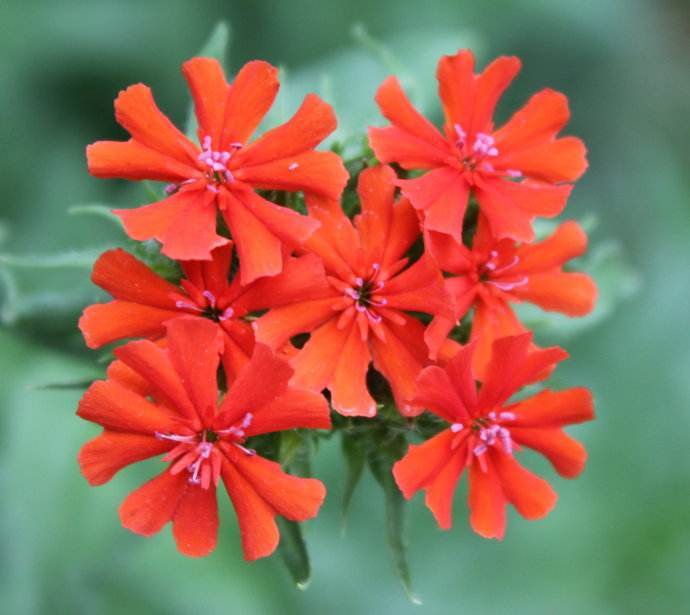
Lychnis fulgens, scientific name Lychnis fulgens, a plant of the genus Lychnis in the family Caryophyllaceae. Perennial herb, 50-80 cm tall, roots clustered and spindle-shaped, slightly fleshy, stems erect, leaves ovate-oblong or ovate-lanceolate, dichasial cyme with several flowers, rarely many flowers, contracted into a corymb, petals dark red, claw not exserted from the calyx, narrowly lanceolate, fimbriate, limb outline obovate, corona scales oblong, dark red, fringed, capsule long elliptic-ovate, seeds kidney-shaped, flowering June-July, fruiting August-September. Lychnis fulgens likes sun, coolness, high and dry conditions, is drought-tolerant, and has no strict requirements for soil. Lychnis is native to China, and is also distributed in Japan, Korea and Russia, often growing in low-mountain open forests and shaded wet places in shrub meadows. In gardens, Lychnis is often arranged in a natural style, either planted in clumps or used as background material, and can also be used as a cut flower.
Lychnis
Propagation techniques:
Seed propagation: both spring and autumn sowing are possible, with autumn sowing being better; the suitable temperature for seed germination is 20 degrees. Division propagation: division can be done in both spring and autumn, generally once every 1~2 years, which can make the plants grow vigorously and prevent decline. Root cutting propagation is also possible: place the cut end of the root level with the soil surface, with the lower end of the root deep in the soil, and under semi-shaded conditions adventitious buds grow from the cut end, thus forming new plants.
Lychnis
Cultivation methods:
Site selection and land preparation: choose well-drained sandy loam, calcareous soil is also acceptable. When preparing the land, deep plow more than 20 cm and apply 800~1000 kg/mu of decomposed farmyard manure. Make beds or ridges 1.2 m wide.
Sowing and seedling raising: for spring sowing in the Greater and Lesser Khingan Mountains region, sow in early May, mainly in drills, with a row spacing of 20 cm and a depth of 1 cm; after sowing cover with soil about 0.8~1.0 cm thick and press lightly; the sowing rate is 250~300 g/mu; germination occurs when the temperature reaches 20°C, seedlings emerge in about 15 days, with an emergence rate of 80%. Transplant in late May, with a row spacing of 30~40 cm; pinch the seedlings when they have 7~8 pairs of leaves to encourage more branching, and they will bloom in July~August. For autumn sowing, sow in late August, cover with grass or leaves in winter for cold protection, plant out in early May of the following year, and bloom in July.
Lychnis
Field management: during the growth period, weed and loosen the soil in a timely manner to prevent weeds from growing; apply topdressing once before flowering each year; when used medicinally, harvest the whole plant in summer and autumn and it can be used as medicine. As a flowering plant it can overwinter in the open field.
Pest and disease control:
For Lychnis leaf spot, spray copper-based fungicides such as Bordeaux mixture for control; for Lychnis rust, spray chemical agents such as ferbam and triadimefon for control.