Removing formaldehyde from a new home: an old gardener recommends these small and medium-sized indoor plants
For ordinary families, when buying a house they usually choose small and medium-sized layouts, because these layouts are not only economical and practical, but also easier to renovate. However, after a new house is renovated, a lot of harmful substances remain, and formaldehyde is a typical one. So what methods can be used to remove formaldehyde from the home? Next, the old gardener editor will recommend several plant varieties for everyone.
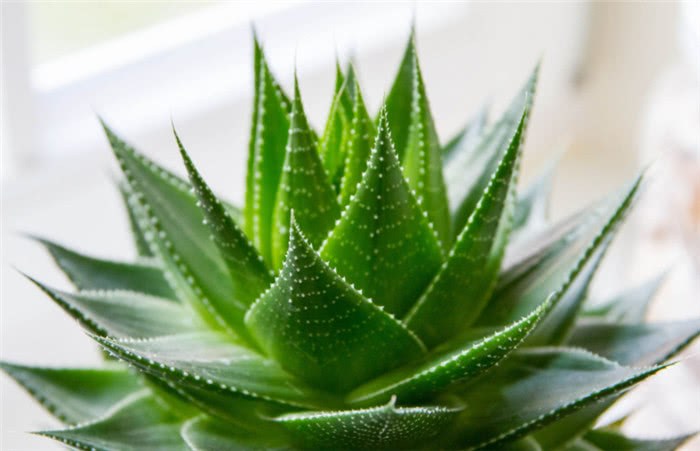
First, aloe
Aloe is a very common green plant, also called nu hui, lao wei, xiang dan, and so on. It belongs to a perennial herbaceous plant of the Liliaceae family. Aloe has a very wide range of origins; it can be seen in the central and southern regions of Africa, as well as in the West Indies of South America. The leaves of aloe are arranged in a lotus shape, thick and plump, strong and upright, and they also grow a row of fine small thorns on top, looking very peculiar. Aloe by nature likes a growth environment with plenty of sunlight, warmth, and dryness, and it has a certain tolerance for poor soil and cold. Its most suitable growth temperature is between 12-30°C. If the ambient temperature drops to minus 4°C, the leaves of aloe will suffer mild frostbite.
Second, peace lily
Peace lily is also called he ping yu, or bao ye yu, yi fan feng shun, and so on. It is also a perennial herbaceous plant of the Araceae family. The peace lily has a large plant shape and can grow to about 50 cm. Its leaves are oblong, fat and broad, green and glossy, and especially its flowers, which are cylindrical in shape and pure white in color, looking fresh and elegant, very beautiful. Usually, the most suitable growth temperature for peace lily is 15-30°C, but when growing it in winter, the ambient temperature must be kept above 12°C so that the peace lily plant can avoid frostbite. In addition, peace lily is very afraid of strong sunlight. If the summer light is too strong, it is very easy to sunburn the leaves of the peace lily.
Third, miniature coconut palm
Miniature coconut palm also has many nice names, such as dwarf coconut, miniature palm, miniature fan palm, dwarf fan palm, and so on. Miniature coconut palm belongs to an evergreen perennial shrub plant. Its plant is relatively large, and in a pot it can grow to about one meter. It is lush and green, with lance-shaped leaves and golden-yellow flowers that are small and charming, looking very elegant and lovely. Because miniature coconut palm is a typical shade plant, it very much likes a warm, humid, cool, and pleasant growth environment. If it is in a semi-shady environment, miniature coconut palm can grow even more vigorously. In addition, miniature coconut palm also has very simple requirements for growing soil; as long as it is well-drained sandy soil rich in humus, it is very suitable for the growth of miniature coconut palm.
Fourth, peacock arrowroot
Peacock arrowroot is also called blue flower banana, or five-color arrowroot. It is also a perennial herbaceous plant. Its place of origin is the central region of Brazil, and it is a flower variety that was introduced to our country only in recent years. Peacock arrowroot has an elegant plant shape, and its leaves are oblong, with stripes of different shades growing on them, just like the patterns on a peacock, which is why people gave it such a vivid name. Peacock arrowroot has relatively strong adaptability; it relatively likes a warm, humid, ventilated, and cool growth environment, and it has certain characteristics of tolerance to poor soil and resistance to cold. In addition, peacock arrowroot also has very simple requirements for soil; as long as it is sandy soil with good drainage, it can keep peacock arrowroot growing very well.
Above, the old gardener editor introduced several kinds of flowers for removing formaldehyde, and I hope this content can bring you some help. How much more do you know about the topic of the article? You are welcome to share your views in the comment section below. If you like this article, you might as well subscribe, and there will be more wonderful articles to share with you.