What plants and flowers are suitable for growing in the bedroom? An old gardener recommends these
Not all plant species are suitable for growing in the bedroom, because some plants have scents that are too fragrant or pungent, which is not conducive to calming the mind and sleeping; while some plant species do not carry out photosynthesis at night, so they also do not absorb carbon dioxide from the air and release oxygen, and they bring no benefit to the human body either.
So which plant species are both elegant and tranquil, and suitable for growing in the bedroom? In the time that follows, let the old gardener tell you. You can see which ones you are actually growing in your home.
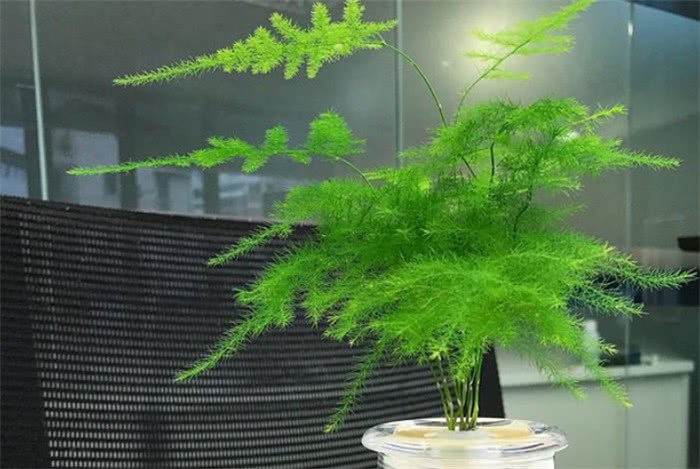
1. Asparagus fern
Asparagus fern is also known as cloud pine, cloud bamboo, thorn asparagus, and so on. It is a multi-branched evergreen climbing plant of the genus Asparagus in the family Asparagaceae, and in the wild it can grow to several meters. Its roots are slightly fleshy, and its stems are soft, clustered, and slender. Asparagus fern has very many branches, and they are relatively smooth. Its leaf-like branches usually form clusters of 10-13, are slightly triangular, and are bristle-like. The base of its scale-like leaves has a slightly spiny spur, or the spur is not very obvious. Asparagus fern can bloom, with 1-3 flowers borne in the leaf axils, white in color, with short stalks. The flowering period is from September to October, and the berries are purple-black when ripe, containing 1-3 seeds. Asparagus fern likes a warm, humid, well-ventilated, and semi-shaded growing environment. It is not drought-tolerant, not tolerant of waterlogging, and not tolerant of severe cold in winter. In summer it should be kept from direct sun exposure, and it is suitable for planting in loose, fertile humus loam with good drainage. The room temperature is best kept between 15-25 degrees, and above 20 degrees it needs heat dissipation; in winter it must not go below 5 degrees. With asparagus fern, the main thing to master is watering: it must not be too dry, nor too wet, and you need to follow the rule of not watering until dry, and watering thoroughly when you do, with no water accumulating in the pot. As for fertilizer, apply small amounts less often, and do not apply strong fertilizer; generally applying a thin, well-rotted liquid fertilizer once a month is enough.
2. Golden pothos
Golden pothos is a large evergreen vine of the genus Epipremnum in the family Araceae, with climbing habit and well-developed aerial roots. On mature branches of golden pothos, the leaf stalks are thick and strong, about 30-40 cm long, slightly expanded at the base, and the upper joint is about 2.5-3 cm long and slightly thickened; the upper surface of the leaf blade has a broad groove, the leaf sheath is long, and the leaf blade is thinly leathery, emerald green in color, with most leaf surfaces having irregular pure yellow patches. The leaf blade is entire, shaped as an unequal-sided ovate or ovate-oblong leaf, with a short acuminate tip and a deeply heart-shaped base, slightly thick, with both sides slightly raised. Golden pothos is a shade-loving plant that likes a warm environment and avoids direct sunlight. It is suitable for planting in loose, fertile, slightly acidic loam, and its overwintering temperature must not be below 15 degrees. For water and fertilizer, it needs sufficient watering during the growing season to keep the potting soil moist; in summer you can also water the leaves to increase humidity, and for topdressing, a liquid inorganic fertilizer once every 15 days is enough.
3. Arrowroot
Arrowroot is a perennial plant species of the genus Maranta in the family Marantaceae. Its rhizome is fleshy and spindle-shaped, and its stems are weak, with branches, about 0.4-1 m tall. The leaves are thin, ovate or ovate-lanceolate in shape, 10-20 cm long and 4-10 cm wide, green in color, with a tapering tip and a rounded base, hairless or thinly covered with long soft hairs on the underside; the pulvinus is 5-10 cm long and covered with long soft hairs. It is sessile or has a short stalk, and the ligule is round. The arrowroot inflorescence is a terminal raceme, 15-20 cm long, with several small white flowers. The fruit is oblong, about 1 cm long, and the flowering period is summer and autumn. Arrowroot likes a warm, humid, and semi-shaded growing environment, is afraid of direct sunlight and dryness, and is not tolerant of severe cold in winter. It is suitable for planting in loose, fertile soil with good drainage and rich in humus. The suitable growing temperature for arrowroot is between 20-28 degrees, and the minimum must not be below 18 degrees. Different varieties also differ in their watering needs: those with thin, large leaves like water, while those with thick, slender leaves prefer somewhat drier conditions. Arrowroot is very sensitive to high-concentration fertilizer and must not be over-fertilized. For topdressing, thin fertilizer applied frequently can be used.
4. Lily
Lily is also known as Qiangshu, fanjiu, shandan, daoxian... and so on. It is a perennial herbaceous bulbous plant of the genus Lilium in the family Liliaceae, and its bulb is rich in starch and can be eaten as well as used medicinally. Its fleshy roots are also called immortal roots and have extremely strong water-absorbing ability; the stem is upright, cylindrical in shape, often with purple spots, hairless, and green. Lily flowers are large, mostly white, with some pink varieties as well, richly fragrant, huge in flower shape, funnel-shaped, and borne singly at the top of the stem. Its capsule is long ovate, with blunt ridges. Its seeds are numerous, ovate, and flat in shape. Lily likes a cool environment and is relatively cold-tolerant, growing poorly in high-temperature areas. It likes dryness and fears waterlogging, and is suitable for growing in deep, fertile, loose sandy loam. Its bulb is white in color and relatively thick in flesh. Lily has a well-developed root system and is fertilizer-tolerant. Fertilizer is mainly organic fertilizer.
These four types of plants all belong to shade-loving species. They do not need sunlight to carry out photosynthesis, can grow naturally in the bedroom, and absorb the waste gas exhaled by the human body while releasing fresh oxygen. Therefore, for the health of your family and yourself, and also to beautify the bedroom environment, if you want to grow plants in this area, choosing these kinds is definitely the right choice.
How much more do you know about the topic of this article? You are welcome to share your views in the comment section below. If you like this article, you might as well subscribe, and there will be more wonderful articles to share with you.