Purslane succulents are easy to grow, and the old florist's recommendations guarantee there is always one that suits you
People today like to grow succulent plant varieties, believing that they are simpler and easier to keep alive than traditional grasses, trees and flowers, with few care points. In fact, there are so many succulent varieties that they cannot all be lumped together, and they also need to be treated differently.
If you want to grow a few of the easiest succulents to keep alive, with no difficult care points, the old florist can tell you that choosing the following drought-tolerant, heat-tolerant purslane succulents (Portulaca) is sure to be right, and you can be sure that at least one of them will survive for you.
1. Variegated Purslane (Portulaca umbraticola 'Hinton')
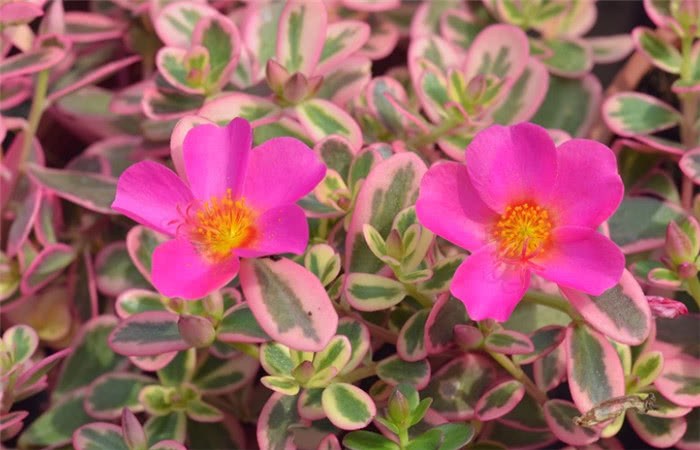
Variegated Purslane is a perennial succulent herbaceous plant of the Portulacaceae family, genus Portulaca, also known as rainbow purslane, variegated purslane, variegated moss rose and so on. Its appearance is very distinctive; it can grow prostrate or upright, its stems are succulent, its leaves alternate, the stems are flesh-red, the leaf shape is ovate, the leaf tip is bluntly rounded, the leaf base is blunt, and the leaves are succulent and slightly thick. The leaves of Variegated Purslane have alternating light and dark green in the middle, with creamy white markings around them, and rose or pink blushing at the leaf margins; when the temperature difference is large, the color that comes out is very beautiful, just like a rainbow. The flowers of Variegated Purslane bloom singly or in clusters, the flowers are bisexual and can self-pollinate, with five petals, peach-red in color, and the seeds are black and flat-round in shape. Variegated Purslane is very easy to grow; the soil mix can be horticultural soil or a conventional succulent mix, and it must be loose with good drainage. It can take full sunlight, but must not be exposed to scorching sun in summer; in other seasons, sufficient light makes it grow strong and well, and if there is not enough, the leaf color and shape will be greatly diminished. Below 0°C in winter, it needs to be grown indoors. It is very drought-tolerant and does not need frequent watering normally; just water thoroughly once after the potting soil has completely dried out. As for fertilizer, top-dress once a month with a thin, well-rotted liquid fertilizer.
2. Purple Rice Grains (Portulaca 'Purple Rice')
Purple Rice Grains is also called rice-grain flower, purple rice dish, meteor, purple pearl and so on; it is a succulent variety of the Portulacaceae family, genus Portulaca. Its appearance is very mini, with tiny rice-grain-shaped leaves; although small, they also have an obvious succulent feel, and the flowers are purple-red in color and very beautiful. The leaf shape of the rice-grain flower is not much different from that of Crassulaceae succulents, but it can be clearly distinguished by its flowering. Purple Rice Grains is suitable for growing in loose, well-aerated sandy loam; in summer it needs shading and ventilation, avoiding damp and stuffy environments, and in other seasons it needs more light. For watering, master the principle of "water thoroughly only when dry"; in winter, control water and keep the potting soil dry. Because its plant is small, it does not need much or heavy fertilizer; applying a thin liquid fertilizer once a month is enough.
3. Money Tree (Zamioculcas zamiifolia 'Zenzi' / Portulaca 'Money Wood')
Money Wood is a perennial evergreen herbaceous plant of the Portulacaceae family, genus Portulaca, named because its thick, fleshy leaves are neatly arranged and their shape closely resembles copper coins. Money Wood grows about 50-80 cm tall, with a large tuberous stem underground; the above-ground part has no main stem, and pinnate compound leaves emerge from the top of the tuber, with each leaf axis bearing 6-10 pairs of opposite or nearly opposite leaflets, ovate in shape, thick and leathery, green in color, with a metallic luster. Its flower buds are spathe-shaped and boat-shaped, and the spadix is relatively short. It likes a warm, humid growing environment, likes partial shade, is drought-tolerant, but dislikes scorching sun and fears cold and waterlogging in the potting soil. The most suitable growing temperature is between 20-32°C. Except in summer, it can take full sunlight. Money Wood is suitable for growing in loose, breathable, slightly acidic loam; for watering, follow the principle of "do not water until dry, and water thoroughly when you do." As for fertilizer, during the growing season, top-dress once a month with a thin, well-rotted liquid fertilizer.
4. Elegant Beauty (Portulaca 'Yale Zhihua')
Elegant Beauty is a perennial herbaceous plant of the Portulacaceae family, genus Portulaca. In the wild, its plant can grow to 3-4 m tall; the old stems are purple-brown, the young branches are purple-red, the branches are nearly horizontal, and the succulent leaves are opposite, with green obovate leaves. The leaves of Elegant Beauty are variegated, mixed with white, generally on the inner side, also called inner variegation. Its green leaves have an uneven, undulating feel and are very beautiful. It likes a warm, dry, sunny growing environment, is tolerant of drought and partial shade, and not tolerant of waterlogging. It is suitable for growing in fertile, well-drained sandy soil; except for shading needed in summer, it needs more light in other seasons, otherwise the leaves become large and thin, lose all their luster and have no beauty at all. For watering, just water thoroughly after it dries out, and apply a thin, well-rotted liquid fertilizer once every 15 to 20 days. It has strong sprouting ability, so it should be pruned and buds removed regularly to maintain the plant shape. In addition, repot once every 2-3 years in spring.
They all belong to the same root and species, yet the varieties and appearances have no similarity at all. If there is anything in common, it is that they are among the very easy-to-grow types of succulents. There are not many care points, and no extra care is needed. If you usually do not have much experience growing flowers, starting with them is a good choice.
How much more do you know about the topic of this article? You are welcome to share your views in the comment section below. If you like this article, why not subscribe, and more wonderful articles will be shared with you