This plant looks like a little kid's bottom - what is the best way to care for it?
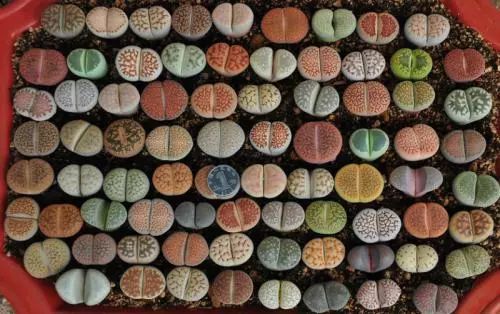
Lithops, a plant that looks like a stone, comes in a riot of colors and has a unique form, and is very much shaped by its environment. It is also called "butt flower" because it looks just like a row of little kids' bottoms. Recently many gardening fans have been complaining that Lithops develop stunted growth during cultivation - how should this be handled?
1. What causes stunted growth?
Stunted growth means the plant stops growing: it is not dead, but it simply will not grow. The main cause of stunted growth in Lithops is mostly that the roots do not grow or cannot normally absorb water and nutrients. This is usually caused by going a long time without watering and then suddenly watering, which shocks the roots.
2. How to handle stunted growth in Lithops
Changing the soil and transplanting the seedlings is currently the most effective method. That said, this method cannot solve the problem of stunted growth one hundred percent; every gardening fan's Lithops are in a different condition and everyone's transplanting skill differs, but this method suits the vast majority of gardening fans.
3. Key points for the care and management of Lithops
Soil:
Lithops is not very strict about environmental conditions, and cultivation and management are relatively easy. The potting soil can be made by mixing 4 parts leaf mold, 3 parts calcareous material and 3 parts river sand.
Watering:
Lithops needs more water during the growing period, but it must not be too wet, as moss easily grows and affects the normal growth of the spherical leaves.
Sunlight:
In summer, keep Lithops in a semi-shaded spot, or give it 50% shade, and the leaf color will be even more beautiful. In the other three seasons it can be kept directly in a spot with direct sunlight.
Temperature:
The optimum growing temperature for Lithops is 15°C to 25°C. It fears high temperatures and stuffy heat, and enters dormancy in the intense summer heat when the temperature is above 33°C.
Fertilizing:
Lithops needs fertilizing once every half month, but the fertilizer solution must absolutely not touch the spherical leaves. Pause fertilizing after flowering in autumn.
Pests and diseases:
Lithops is mainly affected by leaf spot disease and leaf rot disease, which can be sprayed with a 600-fold dilution of 65% zineb wettable powder. Pests include ants and root-knot nematodes; changing the soil reduces nematode damage.
Growing Lithops is actually fairly undemanding; it is generally left to grow on its own, because it is very easy to grow and very easy to keep alive. When it is not flowering it is a riot of color, and in fact it is even more beautiful after it flowers. Paired with pebbles, it looks even better.