Succulent leaves can be twisted off and used to propagate dozens of pots - so why worry about killing them?
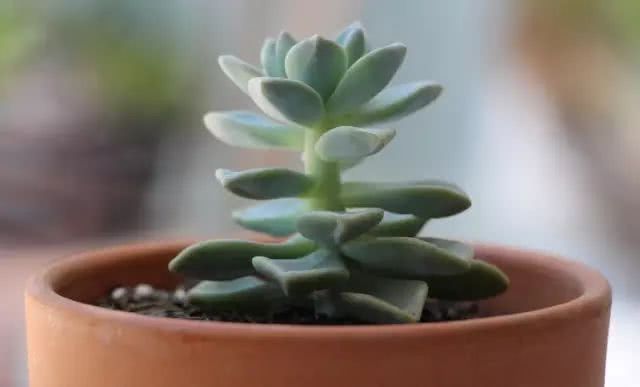
It's not only girls who love cute succulents - this editor is crazy about them too! I love filling my balcony and windowsill with succulent plants.
But unfortunately, the Graptopetalum paraguayense I was growing still became leggy. The reason was that one windowsill didn't get enough sunlight, so I had to re-propagate this "long-legged" succulent. With its long stem and sparse leaves, it was no longer cute at all!
If your succulents have also become this leggy, don't worry - they can be turned into even better succulents. Below, this editor will teach you step by step!
But before the big makeover, I looked at it from the top, and from above it still looked quite nice and neat - but that's all an illusion!
Succulents are truly amazing plants - whether roots, stems or leaves, they can all be used for propagation. Now this editor is going to get to work!
First, we carefully remove the lower leaves. Hold a leaf with your hand, give it a gentle twist, and with a slight turn it will come off. Each leaf must be complete.
As you can see, the leaves that were twisted off are all very complete. Above, they are laid out in a ventilated, shaded place to let the wounds dry - here they were left to dry for a full day.
The photo above shows it after the leaves were removed. Now it's time to cut it directly with scissors. The cutting position must be appropriate - not too low, and not too high. The upper part is too tender, and if cut short it won't sprout; cutting at the middle is just right. (This is the so-called "beheading.")
A sharp pair of scissors is used here. Before cutting, you can soak them in boiling water or heat them with fire to sterilize them.
The beheaded seedling also needs its wound to dry, so just put it together with those leaves! (The seedling is still quite cute.)
Here we carry out leaf propagation. The soil used is wood shavings plus fine sand and leaf mold, lightly sprayed with a little water - the soil just needs a bit of moisture. Place the succulent leaves flat in the pot with the front side facing up, and just arrange them. (Remember, do not water.)
Graptopetalum paraguayense has a very high success rate with leaf propagation, which also made me happy. In the photo above you can see the seedling is almost two cm, and can be transplanted. Its mother leaf has also begun to shrivel. (It sprouts in two weeks, and grows quite big in less than a month.)
Once it has grown into a seedling, you can give it a little water - note, just a little water. The seedling also needs to gradually get light, otherwise it will also become leggy, but it must not be exposed to harsh sun.
The photo above shows various different leaves, and there will also be unsuccessful cases, such as the ones on the left and right in the photo above. The left one is still okay - although the mother leaf withered too early, the seedling can still survive. But the leaf on the right only grows roots and doesn't sprout - so annoying.
The photo above shows them after transplanting. I didn't buy good pots, so I just planted them like this. They feel quite cute. Propagating a big group gives a full sense of achievement. Generally, water once a week, using a succulent-specific curved-spout watering can.
Don't forget there is also a beheaded stem! What will it evolve into? Here, don't rush to water it first - let its wound heal and slowly form a scab.
Then it will slowly grow small buds. Here, very luckily, five small buds grew - very impressive. I estimate this will become my new favorite in the future!
What remains is the beheaded seedling, which is also left to dry its wound and then replanted, with just a little soil covering it. Don't water at first; wait 5~7 days before watering.
It has also begun to grow slowly, and feels very cute. The care experience above is all personal. Propagating succulents by leaf cuttings and stem cuttings is all covered above, and stem planting counts too!
Fellow gardeners can try more. It won't necessarily succeed, but you can keep trying. Pay attention to drying the wounds and sterilizing the potting soil, and pay attention to the timing of watering.