Never spray water on the leaves of these potted plants, or they will die
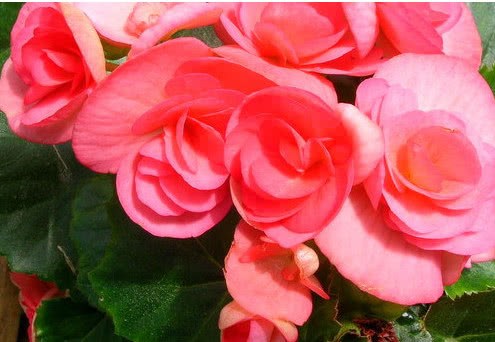
In spring the air is rather dry, and many flower lovers like to mist their plants to make them grow more lush and to clean the leaf surfaces. But with some flowers, spraying water on the leaves causes rot of the leaves and the crown, and in serious cases the plant will just up and die on you! Come and see which flowers must not be sprayed with water on their leaves! The begonia can be said to be one of the most popular flowers in China, and so many people keep begonias at home; among them, the wax begonia (Begonia semperflorens-cultorum) is the most common, with its compact, rounded habit, abundant and dense flowers, great ease of combining with other bedding plants, and long four-season flowering ornamental period, it is becoming ever more popular; its flowers come in single and double forms. The wax begonia likes a warm, humid environment, and is afraid of cold, of drought and of intense heat, and dislikes waterlogging, so it grows best in a semi-shaded, humid, warm setting. The wax begonia has a long flowering period and many flower colors with rich variation; it is a flower that is beautiful in both bloom and foliage. It suits both outdoor cultivation in courtyards and flower beds, and indoor display on desks, tea tables, table tops and shop windows. After Qingming, potted plants can be moved outdoors to a shade frame for care. In East China, from April to October they must be kept under full-day shade, but in the morning and evening it is best to let them see a little sunlight; if the leaves are found to curl and develop scorched spots, this is the symptom of sunburn damage. After Frost's Descent, they must be moved indoors to be protected from freezing and kept warm, otherwise, if hit by frost, they will freeze to death; indoor placement should be in a sunny spot. If the room temperature stays above 15°C, applying a top dressing will let it keep on flowering. Light, water, fertilizer, temperature and pinching are the keys to growing wax begonias well. After planting out, wax begonias can take direct sunlight in early spring, and as the sunlight intensifies they must be shaded appropriately.
At the same time, attention should be paid to water management; too much water easily causes root rot, bud rot and stem rot; high temperature and high humidity easily bring about various diseases. After planting out and the seedlings have recovered, apply a liquid fertilizer as a top dressing once every 10 days. Promptly prune long branches and old branches to stimulate new side branches; more pruning helps keep the plant's shape attractive. As for the soil conditions for cultivation, a neutral or slightly acidic soil rich in humus and with good drainage is required; it fears both drought and waterlogging. In spring and autumn, the vigorous growth periods, the soil needs to contain more water, watering should be timely, and moisture should be kept up. The requirement for watering is "two more, two less", that is, spring and autumn are the growth and flowering periods, so the water should be appropriately greater and the potting soil slightly moist; in summer and winter, which are the semi-dormant or dormant periods of the wax begonia, the water can be less and the potting soil a little drier, and especially in winter watering should be reduced further, keeping the potting soil always slightly dry. The timing of watering should also be noted in different seasons: in winter, water around midday in the sunlight, and in summer it is best to water in the morning or evening, so that the temperature difference between the air and the potting soil is smaller, which benefits the plant's growth. The principle of watering is "do not water if not dry; when dry, water thoroughly". The wax begonia likes a humid environment, but in the hot summer it is best to keep the potting soil only slightly moist. Do not water a fixed number of times per day or once every fixed number of days; instead, always watch the wet or dry condition of the potting soil, and water as soon as the potting soil turns pale, with the amount not too great. It is best to water around 9 o'clock; as far as possible, do not water if not dry, and when you do water, water thoroughly, but do not wait until it is completely dry before watering. Water must not be sprayed on its leaves either; if water is sprayed on its leaves, the downy stomata on the leaves are easily blocked, and once blocked, problems easily arise, such as leaf rot and pests and diseases. So when watering the wax begonia, water slowly along the rim of the pot.
The cactus ball, commonly known as the grass ball, is a perennial succulent herbaceous plant of the Cactaceae. Its stem is spherical or oval and green, and the flowers are borne among the clusters of spines on the vertical ribs; cactus balls usually flower in the early morning or at dusk, lasting from a few hours to one day. The cactus ball is a plant whose stem, leaves and flowers all have high ornamental value; it is an artistic treasure among hydroponic flowers. It generally grows in dry, rain-scarce desert regions. The cactus ball is a natural air freshener, can also absorb ultraviolet rays, and has the effect of adsorbing dust and purifying the air. Moreover, the cactus ball releases carbon dioxide by day and absorbs carbon dioxide by night, releasing oxygen, which helps people sleep. As for watering times, in summer the early morning is best, in winter it should be done in the forenoon on clear days, and in spring and autumn either morning or evening is fine. Under normal circumstances, do not pour water from the top, otherwise over time the ball will develop unsightly spots. Under normal circumstances, watering must be thorough, and for this the soil must be loosened often so that the potting soil can evenly absorb enough water. Summer is the growth period of the cactus ball; the temperature is high and the water demand is great, so it must be watered fully, and this is best done in the early morning or evening when the temperature is low; at noon it is hot, and watering easily causes burns on the ball. In the hot, plum-rain season, watering should also be moderated appropriately. For those cactus balls with a sunken top, be careful not to water into the depression, so as to avoid causing rot, and this should be paid even more attention when watering in the evening. During the winter dormancy period, watering should be moderated, keeping the potting soil no more than not excessively dry; the lower the temperature, the more the potting soil should be kept dry. Mature large balls tolerate drought better than small seedlings. In winter, watering should be done on clear mornings. As the temperature rises, the plant will gradually come out of dormancy, and only then can the watering frequency and amount gradually increase. Water for the cactus ball must also not be sprayed on the ball; even when watering, do not get water on the ball, otherwise the cactus ball easily develops rot and cannot survive. And the cactus ball must be watered only after it has dried out, and then watered thoroughly; also be careful not to let the cactus ball stand in water, because standing water easily rots the cactus ball's roots.
Cyclamen, also known as radish begonia, rabbit-ear flower, rabbit flower, yipin crown, bonfire flower and turned-petal lotus, is a perennial herbaceous plant of the family Primulaceae and the genus Cyclamen. The leaves grow from the top of the tuber, are heart-shaped, ovate or kidney-shaped, have fine serrations, are green on the upper surface with white or gray mottling, and are green or dark red on the underside, with fairly long, reddish-brown leaf stalks. Cyclamen is a commonly grown flower, suitable for growing in indoor pots, and in winter it needs greenhouse cultivation. Some cultivated varieties of cyclamen have a rich fragrance, while others are faintly fragrant or have no fragrance. Cyclamen is somewhat contradictory when it comes to water absorption: it very much likes a humid environment, yet it is also afraid of too much water, so when we water it we should give a moderate amount once a day to keep the potting soil moist, while also controlling the amount of water; the potting soil must not have standing water, so as not to rot its roots from too much water. In summer, spray it often to ensure a normal amount of water absorption. Cyclamen is a plant that fairly likes fertilizer, but what it likes is light fertilizer; especially during its growth period, we should give it a light fertilizer about once every ten days, and when cyclamen is budding we should also give an extra top dressing of liquid fertilizer. During the flowering period, fertilize as little as possible; even if you do fertilize, it should be an occasional light fertilizer, and do not apply nitrogen fertilizer. When fertilizing, be especially careful not to pour the fertilizer water directly on the flowers and leaves, otherwise they are easily burned.
Gloxinia (Sinningia speciosa) likes to grow in a warm, humid, semi-shaded environment, and dislikes direct strong light and a loose, fertile, slightly acidic sandy soil rich in humus. The suitable temperature during the growth period is 20-25°C; it is not cold-hardy, and when the winter temperature drops to around 5°C it goes dormant; too high a temperature also affects normal plant growth, and when the summer temperature reaches above 30°C the plant will enter a semi-dormant state. During the growth period it requires high air humidity, does not like heavy watering, and rain should be kept from getting in. In the winter dormancy period it needs to be kept dry; if the humidity is too high or the temperature too low, the tuber easily rots. Watering: the flowers and leaves of gloxinia bear fine hairs, and once they get water droplets on them they very easily rot, so do not spray water on the flowers and leaves. It is best to water by the immersion method. Normally, water in moderation; too much very easily causes the tuber to rot, the leaves to turn yellow and dry, and even the whole plant to die. In the high-temperature phase of summer, water 1-2 times a day, and during the flowering period rain must be avoided. Soil: gloxinia likes a loose, fertile humus soil with good water retention, and is best cultivated in a humus-rich, loose, slightly acidic soil; it is commonly mixed from 1 part perlite, 1 part river sand and 3 parts leaf mold plus a small amount of rotted, sun-dried, finely crushed poultry manure, and potted gloxinia commonly uses a mixed medium of leaf mold, coarse sand and vermiculite. Temperature: the suitable growing temperature for gloxinia is 10-25°C. Different seasons have different requirements: from January to October it is 18-25°C, and from October to January of the following year it is 10-12°C. A suitable temperature can make the leaves grow luxuriant and emerald green, and the flowers large and vivid. When the plant withers and goes dormant, take out the bulb and store it in slightly moist sand. Light: gloxinia is a semi-sun plant, and normally needs appropriate shading to avoid direct strong light. In winter, during the seedling stage, it should have ample sunlight; in summer it must be placed in a well-ventilated shade frame with scattered light and carefully tended; during the growth period the light must not be too strong, and at flowering time the shading period should be appropriately extended; in the winter dormancy period the potting soil should be kept appropriately a little drier.