Corn auction volume in May increased once again; when will the decline finally stop?
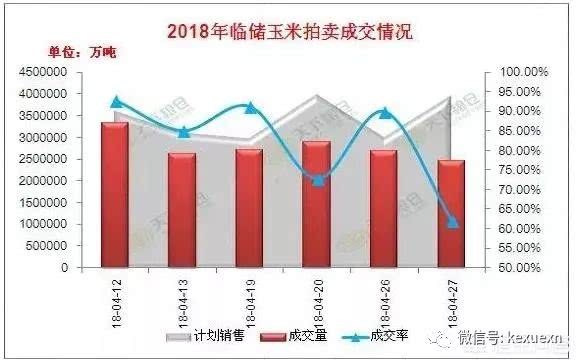
To judge the future trend of the corn market, let us first look at the auctions launched by the temporary reserve on April 12. From this we may be able to see some clues.
The first round on April 12-13: a total of 6.67 million tons was auctioned, with an overall transaction rate of 89.66%. Then the second and third rounds of auctions were held in succession. By the third round on April 27, the transaction rate had fallen to 60%. The temporary reserve auctions had still not ended by then, and 8 million tons were immediately put on the market in May. Judging from the auction that just ended, 5.28 million tons were sold, with a transaction rate of 66%. In terms of transaction rate, the overall trend is declining, which also shows that the market already has relatively abundant grain and is no longer as eager for corn as it was during the first round of auctions.
After four consecutive rounds of temporary reserve releases, the supply and demand structure of the corn market has gradually become more relaxed. As a result, corn market prices have also gradually moved lower. Overall corn prices fell 4% in April, and the first auction in May has now ended. Can the future market reverse from here? Science Xingnong believes it will still be quite difficult! Below is a personal view.
Policy grain is abundant
From the four rounds of temporary reserve corn market releases we reviewed above, the transaction rate gradually shrank while the transaction rate at the bottom price gradually rose, which is enough to show that the current market is no longer so urgent for corn and that the tightening of corn supply and demand in the market has clearly eased. At the same time, as large quantities of policy grain from auctions flow into the market, the market supply of corn will become more relaxed. Naturally, as the supply-demand relationship reverses, corn prices moving downward under pressure becomes a logical outcome.
Weather warms and farmers sell grain
It is now May, and the weather is gradually warming. Hot and humid summer weather is also a major problem for grain storage. As a result, the remaining grain at the grassroots level will also be gradually released, and in this way the market supply will become even more relaxed. Of course, the remaining grain in farmers' hands is still of much better quality than the grain from temporary reserve auctions. This remaining grain in farmers' hands is expected to flow to the livestock sector, so the impact of temporary reserve grain will be relatively small, and the situation of high quality commanding a high price will continue.
Limited feed use
As is well known, hog prices have continued to fall this year and have already dropped below the cost line for hog farming. With hog prices falling without stop and consumption sluggish, farmers' willingness to actively restock is relatively low, and many farmers have even gradually chosen to exit the farming industry due to factors such as capital costs. Large farming enterprises have also taken the initiative to reduce their inventories to lower farming costs. The resulting suppression of feed consumption has left corn with poor sales channels.
Future market judgment
Given the strong willingness to destock corn this year, this May auction will not be the end point. It is expected that before the wheat harvest there may be another wave of temporary reserve grain being sold from warehouses. In this way, the pattern of relaxed corn grain supply in the market will continue further, and with the generally sluggish farming industry this year, feed channels will also greatly reduce sales outlets. After the Ministry of Commerce announced on April 4 the additional tariffs on US-origin agricultural products and the anti-dumping ruling announcement on US sorghum, this formed a certain positive factor for domestic corn, but the degree of this positive factor is still very limited. After all, in 2017 China's total corn imports were only more than 3.6 million tons, which is still less than the volume of a single temporary reserve auction.
As far as the current market is concerned, the supply and demand structure is already relaxed, and corn prices across the country are under relatively great pressure. Therefore, there is unlikely to be any improvement in the May market.
The above is a view shared with you by Science Xingnong, and we hope it is helpful to you.