Croton is a green plant suitable for growing indoors
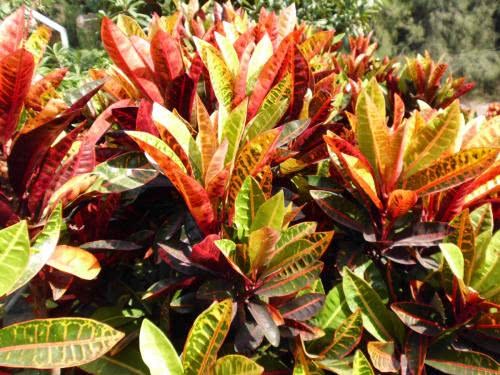
Croton is a shrub or small tree of the Euphorbiaceae family, reaching up to 2 m in height. The branches are hairless. The leaves are thinly leathery, and vary greatly in shape and size. The base is wedge-shaped, both surfaces hairless, green, pale green, purplish red, purplish red alternating with yellow, or green leaves scattered with yellow or golden-yellow spots or markings; the petiole is 0.2-2.5 cm long. Racemes are axillary, the male flowers white; the pedicels slender; the female flowers pale yellow, without petals; the disk is ring-shaped, the flowers curving outward; the pedicels somewhat thick. The capsule is nearly spherical, hairless; the seeds about 6 mm long. The flowering period is September-October. Native to the Malay Peninsula of Asia through to Oceania; widely cultivated in tropical regions. Commonly cultivated in the provinces and regions of southern China. This species is a common foliage plant for gardens or parks in tropical and subtropical regions; it is easy to propagate by cuttings, and there are many horticultural cultivars.
Croton
It prefers a high-temperature, humid environment with plenty of sunlight, and is not cold-tolerant. The optimum growing temperature for croton is 20-30°C, from March to October 21-30°C, and from October to March of the following year 13-18°C. In winter the temperature should not fall below 13°C. For a short period at 10°C, the leaf color becomes less vivid, appearing dull and lacking luster. At 4-5°C, the leaves suffer cold damage, causing heavy leaf drop, or even the death of the whole plant from freezing. In addition, croton also likes moisture and fears dryness.
Croton
Pest and disease control:
If the growing environment is hot and dry, croton is prone to damage from scale insects, red spider mites and aphids. For red spider mites and aphids, dimethoate can be sprayed at a 1000-fold dilution for control; for scale insects, petroleum emulsion can be sprayed at a 100-150-fold dilution for control; if sooty mold occurs, wipe it off with clean water or spray the leaves with carbendazim at a 500-1000-fold dilution to kill it.
Croton
Because croton displays beauty of color and beauty of form in its leaf shapes and leaf colors, it is deeply loved by people among foliage plants. In southern China it is mostly used for beautifying parks, green spaces and gardens; it can be planted in clumps or used as a hedge, and in the Yangtze River basin and areas to the north it is all grown as a potted flowering plant to decorate rooms, halls and set up meeting venues. Its branches and leaves are ideal foliage material for flower arranging.
Croton
Croton is a precious tropical foliage plant. Its unusual form and brilliant, gorgeous colors make it attractive. It is a good potted foliage plant, and can be used to beautify rooms, corridors, halls and meeting venues, with good decorative effect, and can convey a tropical atmosphere. However, it is not very shade-tolerant, so it is generally best placed indoors in a spot with strong scattered light, and for no longer than 2-3 weeks.