Why is American beef so cheap?
Observant friends may have noticed that the prices of American agricultural and sideline products seem to be lower than those in China. The price of soybeans is more than 50 yuan per ton lower than in China, and corn is still more than 30 yuan per ton lower. Even though domestic pork prices fell by 20% this year, they are still more expensive than American pork. And as the question says, American beef prices are also low. This is indeed true, though the claim of 10 yuan per jin may be somewhat exaggerated, the fact that American beef prices are low is indisputable.
As for the claim that American beef prices are relatively low, Science Xingnong believes there can be two interpretations: 1. The price itself is indeed cheap; 2. It feels cheap to buy, that is, cheap relative to wages. Below is a detailed introduction to exactly how American beef is cheap.
Low price
As mentioned earlier, the prices of American agricultural products are generally low. From this angle, at least the input cost of raising cattle in the US is considerably lower than in China, since it already has an advantage in feed costs. But this is not the biggest factor in low American beef prices. The key point is that American animal husbandry generally adopts a large-scale strategy, which offers a considerable advantage over China's traditional "free-range" farming method. Over there in the US, when people talk about who is in the farming business, those are millionaire-level people. What they call farming is large-scale batch farming, not raising a few head like we do here.
The US has a large population relative to its land? No, it has a lot of land and few people, and crucially it also has many plains, which are precisely suited to agriculture and animal husbandry. A single farm may have a rearing volume of over 100,000 head, with fewer than 100 workers. A key factor is the application of large-scale mechanization, which directly lowers farming costs. What is most expensive in today's world? Labor! Even Foxconn is seeking to replace labor with robots, and Apple moved its production lines to China to shift labor costs, all for the same reason. The same naturally applies to animal husbandry. The US has greatly reduced its labor costs, operates farming at scale, and its centralized beef cattle rearing system directly slashes American farming costs.
In addition, there is ractopamine, which is banned in China. It is reported that the ractopamine residue standard in the US is more than 4 times higher than the international standard, making the feed-to-meat conversion efficiency in American beef cattle farming much higher than in China and even many other countries. At the same time, American beef cattle farming is overly intensive, and to prevent large-scale epidemics, farm owners use antibiotics on a wide scale, just like chicken farming in China. Therefore, although American beef is low in price, it is not very popular in the world.
Finally, one more point: American agricultural subsidies. Everyone knows that China has agricultural subsidies. After the agricultural tax was abolished in 2004, farmers still receive some subsidies every year for farming and raising livestock. But here it should be noted that China was not the first to do this; the US implements subsidies as well. In the US, agriculture and animal husbandry are the pillar industries of many regions. The US is a major industrial country, and it is also a major agricultural country. This agricultural power is a true agricultural power. By comparison, China is instead an industrial power rather than an agricultural power, because agriculture's share of national income in China is very low. In this year's China-US trade war, you may also have seen a hint of this: China's sanctions against the US target agriculture and animal husbandry, while US sanctions against China target industrial goods! In US fiscal subsidy spending, subsidies for the livestock and meat products industry account for 60%. It is clear that with such strong fiscal support, the cost of raising beef in the US is naturally not high.
Buying American beef feels cheap
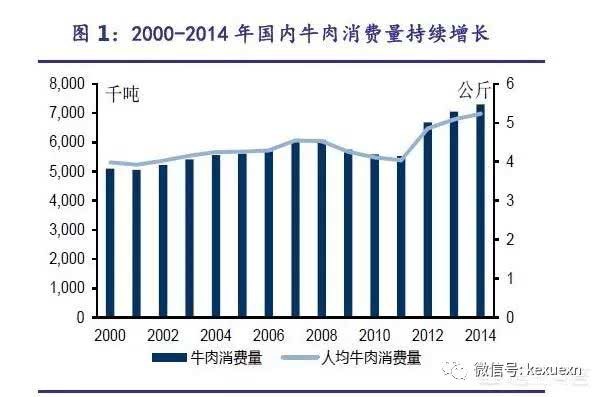
Feeling that the price is low and the price actually being low are clearly two different things. For example, for a billionaire, spending 10,000 yuan on an iPhone X still feels very cheap, because their daily spending is at the level of tens of thousands or millions. For ordinary people, it may feel much more expensive. The reason American beef feels cheap to buy is that relative to American national income, the price of American beef products is indeed very low. Per capita beef consumption in the US reflects the state of the national economy. Looking at the consumption rankings, China is outside the top 40. On the other hand, this also shows that the Chinese people's spending power for beef is insufficient.
If you convert beef into working hours by region, Americans need about 2.6 hours to buy one kilogram of beef, while in comparison China requires 18.9 hours of work. From this comparison, when buying beef under the same conditions, Americans naturally do not find it expensive. As the saying goes, your wage level determines your consumption level. When you have a sufficiently high wage, you naturally have greater purchasing power when consuming.
From the several reasons analyzed above, it is not surprising why American beef is so cheap. Of course, the price of cheap American beef is naturally not low either; the huge government subsidies are also inseparable from it. And as the pillar industry of many regions in the US, the livestock industry naturally receives the government's attention and willing investment. In addition, the relatively high level of national income in the US also makes Americans willing to spend on beef. In this respect, China still has a considerable gap.
The above are a few views shared with you by Science Xingnong, and we hope they are helpful to you.