The rubber plant is a green plant suitable for indoor cultivation.
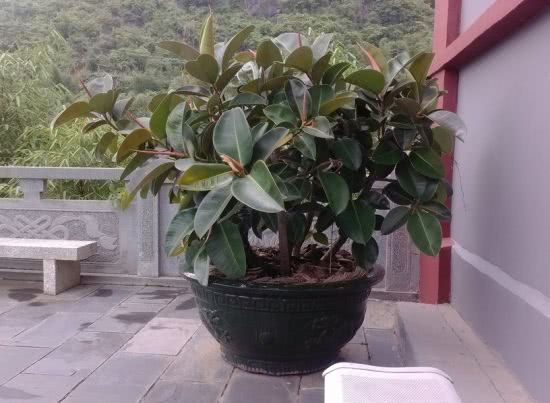
Rubber plant, also known as: rubber tree, Brazilian rubber, is an evergreen tree of the genus Ficus in the mulberry family. Its leaves are thick and broad, deep green in color, with bright red growing tips; when the stipules split open, they hang down just like a red tassel, full of charm. The rubber plant has a distinct trunk, few branches, and grows aerial roots. The leaves are simple and alternate, long elliptical, thick and leathery, glossy green, with many parallel lateral veins; young leaves are red, and the leaf stalks are thick and sturdy. The rubber plant has high ornamental value and is a well-known potted foliage plant. It is extremely suitable for indoor beautification arrangements. Small and medium-sized plants are often used to beautify living rooms and studies; medium and large plants are suitable for placement on both sides of the entrance halls of large buildings and in the center of lobbies, appearing majestic and magnificent, and can reflect a tropical style. It is small in size, and its leaves are so verdant they seem to drip, making it very endearing.
Rubber plant
Growing environment:
It likes a high-temperature, humid environment with plenty of sunlight. Tissue culture of the rubber plant does not have very strict requirements for temperature and light conditions; generally, under natural scattered light, seedlings grow very well in glass bottles, and the most suitable temperature range is 18-28°C. It dislikes direct sunlight. It can also tolerate shade but not cold, and the safe wintering temperature is 5°C. It tolerates dry air. It dislikes clayey soil and does not tolerate poor, barren soil or drought; it likes loose, fertile, well-drained, slightly acidic soil.
Rubber plant
Distribution range:
Native to Brazil; now widely cultivated in tropical regions of Asia; cultivated in Taiwan, China, southern Fujian, Guangdong, Guangxi, Hainan and southern Yunnan, with more planting in Hainan and Yunnan.
Species classification:
Commonly cultivated varieties and cultivars include: Golden-edge rubber plant, whose leaf margins are golden yellow; Variegated rubber plant, whose leaves are slightly rounded at the margins and have many irregular yellow-white patches, with weaker growth vigor and slower propagation; White-spot rubber plant, whose leaves are narrower and have many white patches; Golden-star broadleaf rubber plant, whose leaves are far larger and rounder than ordinary rubber plants, brown-red-green when young, and after the leaves mature the red-brown fades slightly, with sparse needle-head-sized spots scattered near the edges, which can be distinguished with a little attention. It is an excellent variety of rubber plant.
Rubber plant
The rubber tree is the most important natural rubber plant. The rubber plant has the effect of purifying dust and formaldehyde. Placed in the living room, it is full of vitality and vigor. The rubber plant has a unique function of purifying dust, and can also purify formaldehyde among volatile organic compounds. The rubber plant can also absorb carbon monoxide, carbon dioxide and hydrogen fluoride from the air, purifying the air. The rubber plant likes places with plenty of sunlight, which ensures vigorous photosynthesis and transpiration. For offices with more dust, it is most suitable to place it by the window. The rubber plant is not cold-tolerant, so do not place it in a low-temperature place in winter. Repot once every 2-3 years.