A Detailed Guide to Making and Caring for Buddha Belly Bamboo Bonsai
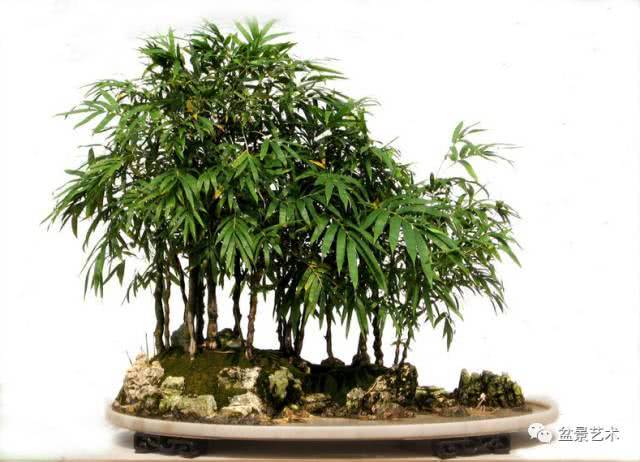
Buddha Belly Bamboo is also known as Arhat Bamboo and Dense-node Bamboo. The plant is relatively short; the culms of young seedlings are green, while older culms turn orange-yellow. If an old culm is properly cared for, its leaves remain as emerald green as those of a young culm. What sets Buddha Belly Bamboo apart from ordinary bamboo is that its nodes are thinner, and the internodes are short and swollen, resembling the belly of Maitreya Buddha, or else stacked arhats, which is how it got its name. Whether planted in the ground or in a pot, Buddha Belly Bamboo displays an elegant, free-spirited posture. This bamboo is sturdy and upright, handsome and refined; it does not wither through frost and snow, and stays lush through all four seasons, appealing to both refined and popular tastes, naturally suited to painting. Since ancient times, people have regarded bamboo as a symbol of uprightness, chastity and the virtue of humility. Bamboo planted together with plum, orchid and chrysanthemum was called the "Four Gentlemen" in ancient times, and bamboo planted together with pine and plum in a single pot forms the famous "Three Friends of Winter." The great Song dynasty poet Su Dongpo wrote: "I would rather eat without meat than live without bamboo; without meat one grows thin, without bamboo one grows vulgar." From these lines one can see just how infatuated the ancients were with bamboo.
1. Shaping and pot selection ; When making a bonsai from Buddha Belly Bamboo, a forest-style arrangement is mostly used to express the natural charm of a bamboo grove, though some bonsai are also made with one or two Buddha Belly Bamboo plants. If two plants are set in one pot, they should be one large and one small, one thick and one thin, one tall and one short, one straight and one slanting; the upright plant is generally tall, large and thick, while the slanting plant should be small, thin and short, with the former as the main subject and the latter as the complement. If the two plants are similar in size and both upright, the bonsai will be less interesting. When making a forest-style Buddha Belly Bamboo bonsai, depending on the size of the pot, generally 5, 7 or 9 plants are planted together in one pot. Taking 5 plants as an example, based on plant size they are numbered 1, 2, 3, 4 and 5; when arranging, plants 1, 3 and 4 are often grouped together as the main body of the bonsai, while plants 2 and 5 form a group as the secondary body, serving as a foil, and an appropriate distance should be kept between the two groups.
For a forest-style Buddha Belly Bamboo bonsai, a relatively shallow rectangular or oval purple clay pot is best, followed by a glazed ceramic pot. If some appropriately scaled, finely crafted and beautifully shaped ornaments such as pandas are placed in it, the bonsai will gain even more poetic charm. If 2-3 Buddha Belly Bamboo plants of differing heights are planted in the pot and exquisitely shaped rocks are placed at suitable positions, it becomes a beautifully composed three-dimensional Chinese painting, the "Bamboo and Rock Picture."
2. Planting and propagation ; For Buddha Belly Bamboo, propagation, repotting and planting are all best done in May or September. Propagation commonly uses division: tip the plant out of the pot, remove about 1/2 of the old soil around the roots with a bamboo strip, find the thick roots connecting the plants, cut them through, and the divisions can then be planted separately. When planting, keep plenty of old soil around the roots to improve the survival rate. In conjunction with division and repotting, old roots, overly long roots and dead roots should be cut away, and upright branches, drooping branches and overly dense branches should also be pruned to reduce water loss from the plant, help it survive and make the plant's shape more attractive. Buddha Belly Bamboo likes loose, fairly fertile, well-drained acidic sandy soil; a mix based mainly on leaf mold with a small amount of sandy soil blended in evenly is ready to use.
3. Care and management
(1) Location. A newly planted Buddha Belly Bamboo bonsai should be watered thoroughly, then kept in a shaded place for about 10 days, then in a spot with half shade and half sun for 5 days, and then placed in a sunny, airy, warm and humid environment for careful care. Because the pot is shallow and holds little soil, exposure to the scorching sun in summer can easily damage the roots, so some shading is necessary. In late autumn and early winter, when the nighttime minimum temperature drops to about 5°C, it should be moved indoors, and a room temperature of about ℃ is sufficient; too high a room temperature is unfavorable for growth the following year. In the south, simply burying the pot in soil in a sunny, wind-sheltered spot is enough for it to overwinter safely.
(2) Watering. Buddha Belly Bamboo likes moisture and should be watered frequently to keep the soil moist, but water must not accumulate in the pot. Summer is its vigorous growth period and the temperature is high, so it should be watered once in the morning and once in the evening. After it is moved indoors in winter, dust collects on the leaves, so water should be sprayed on the leaves as appropriate to keep them green and attractive.
(3) Fertilizing. Buddha Belly Bamboo bonsai should not be fertilized too much; excessive fertilizer and water make the branches and leaves shoot up, harming its appearance. From March to September, applying one dilute application of rotted liquid fertilizer per month is sufficient.
(4) Shaping. Buddha Belly Bamboo grows quickly, so branches not needed for the design should be pruned away promptly to avoid wasting nutrients. Whether to keep or remove new culms can be decided by their form: if the internodes are short and the belly is large, they should be kept even if they somewhat affect the design, and can be planted separately when division is done in September; if a new culm is thin and has long internodes and also harms the design, it should be pruned away promptly.
(5) Pest and disease prevention. Buddha Belly Bamboo has few pests and diseases, mainly bamboo borers, aphids and scale insects, which should be dealt with promptly.
To grow Buddha Belly Bamboo as a bonsai and make its internodes short and its belly large, the following points should be noted:
Keep summer culms. If Buddha Belly Bamboo is grown in the north without the right methods, the new culms have long, thin internodes, hardly different from moso bamboo, and it loses its distinctive charm. Buddha Belly Bamboo has two budding periods a year, the first in early summer and the other in early autumn. Generally, new culms grown in early summer have short internodes and a large belly (though with improper care they will still become thin and long), and these should be kept; new culms grown in early autumn, however, are thin and have long internodes, so autumn culms should generally be pruned away except those kept as seed culms.
Control watering. Once the bamboo shoot emerges from the potting soil, watering should be controlled. When the potting soil is fairly dry and the young leaves of the mother plant are slightly wilted, first move the Buddha Belly Bamboo to a shaded place for half an hour; after the temperature of the soil and the bamboo has dropped somewhat, spray water on the leaves first, and one hour later water thoroughly. Repeat this several times, and when the new culm has grown to about 40 cm tall, the internodes will basically be set, and normal watering can be resumed.
Soil. Buddha Belly Bamboo likes acidic soil, but soil in the north is weakly alkaline, so "alum fertilizer water" should be used for fertilizing to enable it to grow vigorously.
Peeling the shoot sheaths. Each node of a bamboo shoot is wrapped on the outside by a relatively thin sheath, which encloses the side branches. When the shoot has grown to a certain height (because culm thickness varies, the height reached in the same period differs greatly), 1-2 sheaths at the base of the shoot can be peeled off, and thereafter one more each week. Be especially careful when peeling the sheaths so as not to bruise the shoot stem or the side buds. Peeling is best done in the morning. Peeling the sheaths promotes the growth of side branches and makes the internodes shorter and thicker, achieving the goal of dwarfing the plant.
Pinching the tips. Depending on the size and thickness of the Buddha Belly Bamboo, once it has grown to a certain height, the top 5-8 cm of the shoot can be cut off to stop the plant's upward growth and promote side branch growth. After the first pinching, if the vigorous side branches near the top grow very fast, a second pinching should be done, cutting the vigorous top side branches short and leaving 2-3 internodes.