These succulents die as soon as they are exposed to the sun in summer; the last one turns straight into a dried succulent
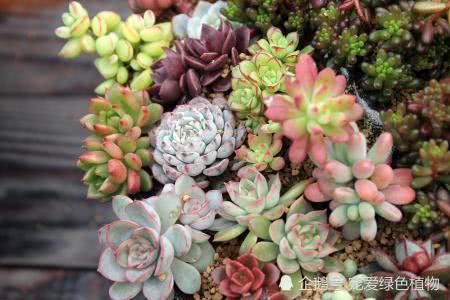
Although succulents love sunlight, not every succulent does better the more it is exposed to the sun. Many succulent lovers often move their plants out to sun them in summer, overlooking the fact that not every succulent can take sun exposure, and as a result the plants sacrifice their lives just like that. How regrettable to think about it! Below, the editor introduces several succulent plants that must not be exposed to too much sun in summer. Be sure to pay attention when caring for succulents in summer!
Echeveria 'Alan'
The leaves of Echeveria 'Alan' are flat and round. Under conditions of ample light and a large temperature difference, the plant turns pink and is very cute, closely resembling Pachyphytum oviferum (moonstone). It likes soil with good drainage and breathability, generally peat soil plus granules; the granules can mainly be kanuma soil, akadama soil, and maifan stone. Because the Echeveria 'Alan' plant is rather delicate, it must not be exposed to blazing sun in the hot summer.
Echeveria 'Alan' succulent
Rosary vine
Rosary vine, also called heart vine or one-inch heart, has slightly fleshy, heart-shaped leaves, with gray net-like patterns on the leaf surface and a purplish-red underside; round tubers grow at the leaf axils. It likes diffused light and avoids direct strong light. It does not like fertilizer, and especially avoids high-phosphorus and high-potassium fertilizer. Its flower language is: heart to heart, love you for a lifetime, companion lovers, forever of one heart.
Rosary vine succulent
String of pearls
The string of pearls succulent is a plant that cannot be exposed to blazing sun. It is generally better to keep it in an environment with relatively ample diffused light; about 1-2 hours of diffused light each day is enough. Especially in the hot summer, if you put the string of pearls in the sun to bake, then after the second day your string of pearls will have its life ended just like that. Even if its life is not ended, then it will certainly be sunburned, so be sure to pay extra attention when caring for string of pearls in summer!
String of pearls succulent
Haworthia cooperi
Haworthia cooperi is divided into large Haworthia cooperi, Haworthia cooperi var. pilifera, Haworthia cooperi var. venusta, and so on. The Haworthia cooperi plant is small and exquisite, with crystal-clear leaf color and rich variation. It is one of the small succulents with relatively high popularity in China in recent years. It likes a cool environment with ample light. Its main vigorous growth period is in spring and autumn. In summer it avoids high temperature, humidity, and blazing sun; after blazing sun exposure its color turns grayish-white, losing its ornamental value.
Haworthia cooperi succulent
Sedeveria 'Letizia'
Sedeveria 'Letizia', also called green flame, has leaves arranged in a lotus shape, very beautiful, with short pointed leaf tips, obovate-cuneate, with a keel on the leaf underside and very short stiff hairs on the edges. In summer or when light is insufficient, the leaves appear green, but in autumn and winter when the temperature difference changes greatly, with ample light, the leaves appear red, so people call it "green flame."
Sedeveria 'Letizia' succulent
Sedeveria 'Letizia' likes a warm, dry, ventilated, and sunny environment. It is drought-tolerant, not cold-tolerant, and can tolerate slight semi-shade. But it cannot tolerate blazing sun. From personal experience, last June I forgot to move it back indoors, and as a result, after a round of sun baking, the next day it directly became a "dried Sedeveria 'Letizia' succulent"! So when caring for Sedeveria 'Letizia' succulents in summer, they absolutely must not be exposed to blazing sun!