Succulents look even more beautiful when grown as hanging plants, so I decisively gave up on pothos and spider plants
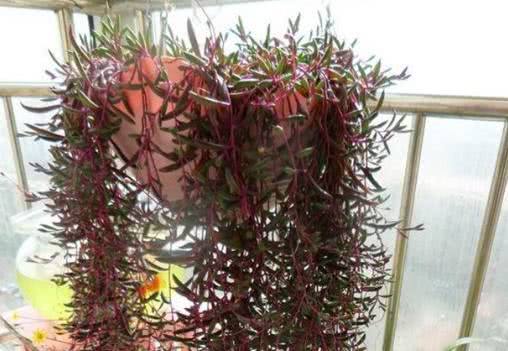
Not many people know this succulent, and of course not many people can get it to bloom. It is called purple moon (Othonna capensis), named because its leaves turn from green to purple. The flowers it produces are yellow and very beautiful. This thing grows extremely fast and likes a humid environment. Although it likes light, it does not like high temperatures. If you understand its habits, it is actually quite easy to grow. The suitable growing temperature is 15-28°C, and in winter it should not go below 10°C. For the soil mix, a blend of peat, vermiculite and perlite can generally be used. During the growing season, water thoroughly after the soil dries out. During the growing season, fertilize generally once a month. Propagation methods include sowing, division and cuttings. Cuttings are generally used for propagation, and they root very easily, in early spring or late autumn during the peak growing season. Purple moon has almost no dormant season, but in summer high temperatures it should be watered less. Wrinkled leaves indicate a lack of water, and the day after watering the leaves will plump up again. In the early stage of rooting, the water requirement is not large. After the root system grows strong, it will grow explosively like crazy. Among all kinds of trailing succulents, it should be the fastest growing. It is suitable for adding to combination planters as an accent, especially when grown outdoors in baskets and ironwork baskets in yards and on terraces. Growing it alone is also good. Its growth rate is super fast, and it will quickly fill the pot. When there is plenty of sunlight, it is very beautiful, and the whole plant will turn purple. When planting, try to choose a slightly larger container.
String of pearls (Senecio rowleyanus), also known as jade beads, likes soil rich in organic matter that is loose and fertile. It grows best in a warm environment with relatively high air humidity and strong diffused light. It likes a cool environment and avoids high temperatures. Summer is its dormant period, when fertilizing should stop and watering should be controlled. The suitable growing temperature is 12-18°C. It is not cold hardy, and the winter overwintering temperature should not be below 5°C. It likes light, but in summer and autumn during high temperatures it should avoid direct sunlight and be shaded by 50%. It has relatively strong drought resistance, avoids wet conditions, and likes loose, breathable, well-drained soil. If watered too much or if the potting soil drains poorly, the roots rot easily. Watering should follow "better dry than wet," and it is enough to keep the potting soil moist. Because the roots are rather shallow, when potting you can put more drainage layer at the bottom of the pot.
String of tears and string of pearls look very similar, but if you observe their leaves carefully, you can find that string of pearls leaves are plump and round, while string of tears leaves are pointed and long. Its care method is the same as that of string of pearls. String of pearls is also called pearl chlorophytum, because its leaf shape is round and plump like Buddhist prayer beads, so everyone calls it string of pearls. It is easy to care for and relatively cheap. In summer, avoid strong direct sunlight and just place it in a spot with diffused light. Do not water too much at ordinary times, and indoor areas should be ventilated frequently. String of pearls is a perennial trailing flowering plant. Folk names also include watermelon skin and watermelon chlorophytum, etc. String of pearls has oval spherical fleshy leaves, pale green, alternate. The flowers are pale yellow-white or pale purple, small and lovely. It is generally grown in pots to appreciate the hanging beads. After three to four years it can grow to more than one meter long, remaining green and lush all year round, and is deeply loved by home gardeners. Around October each year, string of pearls will produce small white or brown flowers, with red slender buds.
I played with stringy stonecrop (Sedum sarmentosum) plenty as a child. This thing's vitality is extraordinarily strong. You can casually break off a section of stem and stick it in soil and it will live, and it grows very fast. Personally, I think it is the easiest trailing plant to grow. Stringy stonecrop is slightly drought tolerant, so do not water too much at ordinary times. Full sun and partial sun are both fine. It is relatively cold hardy, and south of the Yellow River basin it can overwinter outdoors. It has 3-5 branches, few flowers, width 5-6 cm. Flowers are stalkless. Sepals 5, lanceolate to oblong, 3.5-5 mm long, apex obtuse, base without spur. Petals 5, yellow, lanceolate to oblong, 5-8 mm long, apex with a slightly longer short point. Stamens 10, shorter than the petals. Nectar scales 10, wedge-shaped and square, 0.5 mm long, apex slightly emarginate. Carpels 5, oblong, 5-6 mm long, slightly spreading, with long styles.