Rehmannia is a plant that can be found everywhere.
Rehmannia is a plant of the north. Without exaggeration, it is everywhere.
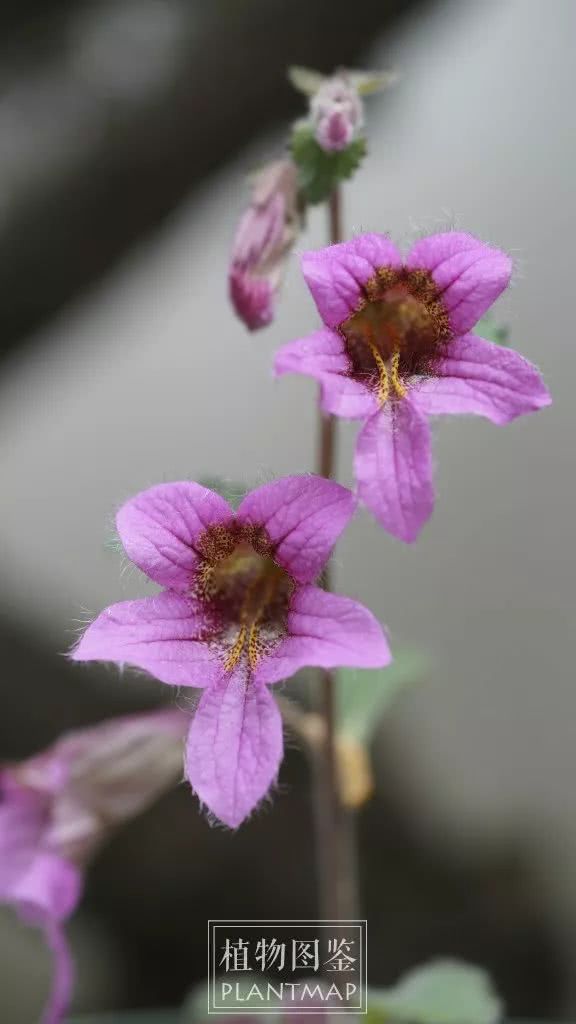
Actually, the south also has plants of the Rehmannia genus - Rehmannia chingii, about which I once wrote an article. (Reposted today as the secondary article.) Rehmannia chingii is a relatively rare plant. In Hangzhou, you can only catch sight of Rehmannia chingii in the mountains of Lin'an or in the Hundred Herbs Garden of Hangzhou Botanical Garden.
The photo shows Rehmannia chingii
So I originally thought that Rehmannia, like Rehmannia chingii, was also "rare." But recently in the north, I discovered that Rehmannia is completely different in temperament from its southern cousin - it not only likes the wild mountains but also likes the city.
The photo shows Rehmannia
[ Rehmannia Rehmannia glutinosa] Scrophulariaceae >> Rehmannia genus
Speaking of Rehmannia, the first thing that may pop into many people's minds is "Liuwei Dihuang Wan" (Six-Ingredient Rehmannia Pill). It naturally uses Rehmannia as its main ingredient. According to the Chinese Pharmacopoeia, the formula is: prepared Rehmannia 160g, cornus fruit 80g, moutan bark 60g, Chinese yam 80g, poria 60g, Oriental water plantain rhizome 60g. This formula has a long history; it is said to have been first created by Zhang Zhongjing of the Han Dynasty, and the people of the Song Dynasty simplified the formula into today's "six ingredients."[1]
The cultivation history of Rehmannia is presumably also very long. But cultivated Rehmannia was not used solely for medicine - in ancient times, Rehmannia was also a yellow dye. The yellow tone dyed from fresh Rehmannia was similar, close to golden yellow, and was the exclusive yellow of ancient emperors.[2]
For image sources see [2]
It can dye yellow, and grows wild everywhere - the name "Dihuang" (earth yellow) probably came about this way.
By the way, some time ago I went to the Temple of Earth and learned that in the Ming and Qing dynasties, the four colors blue, yellow, red and white were used to sacrifice to heaven, earth, sun and moon respectively. Therefore, the sacrificial items used at the Temple of Earth were also often yellow. The Rehmannia that grows everywhere gradually became noble in my eyes.
Unfortunately, I did not see any Rehmannia growing in the Temple of Earth. Instead, on the tile roofs of the siheyuan courtyard houses separated from the Temple of Earth by a single wall, Rehmannia was growing luxuriantly.
This was also my first time seeing Rehmannia. But soon, I saw Rehmannia again in park lawns, on curbs, in cracks in sidewalks, on rock faces...
These wild Rehmannia presumably do not have thick roots and stems underground like cultivated Rehmannia - you can tell just by looking at their barren growing environment... Compared with Rehmannia chingii, the wild Rehmannia plant is smaller, with a height of about 10 to 30 cm.
The flowers are also much smaller than those of Rehmannia chingii, and the flower color is not gaudy either - it is just the yellow of the earth. The color inside the corolla is slightly darker, giving people a sense of unfathomable depth.
All kinds of bees like to burrow into its corolla, and when they retreat, their backs are covered with pollen.
[1] Wikipedia entry for Liuwei Dihuang Wan
[2] Confucius Institute "Same Origin of Medicine and Dyeing: The Beauty of Dyeing with Chinese Herbal Medicines", author: Shao Min http://www.cim.chinesecio.com/hbcms/f/article/info?id=3b47b83a5f014de087e086f9aa03a1a3
Author: Jiang Mouren
Images: Jiang Mouren (unless otherwise noted)
This work is licensed under the (CC BY-NC-ND 4.0) license agreement. Please retain this statement when reposting.
iPhone users can tip the author via the QR code below