What is happiness? It is simply planting flowers in your own garden.
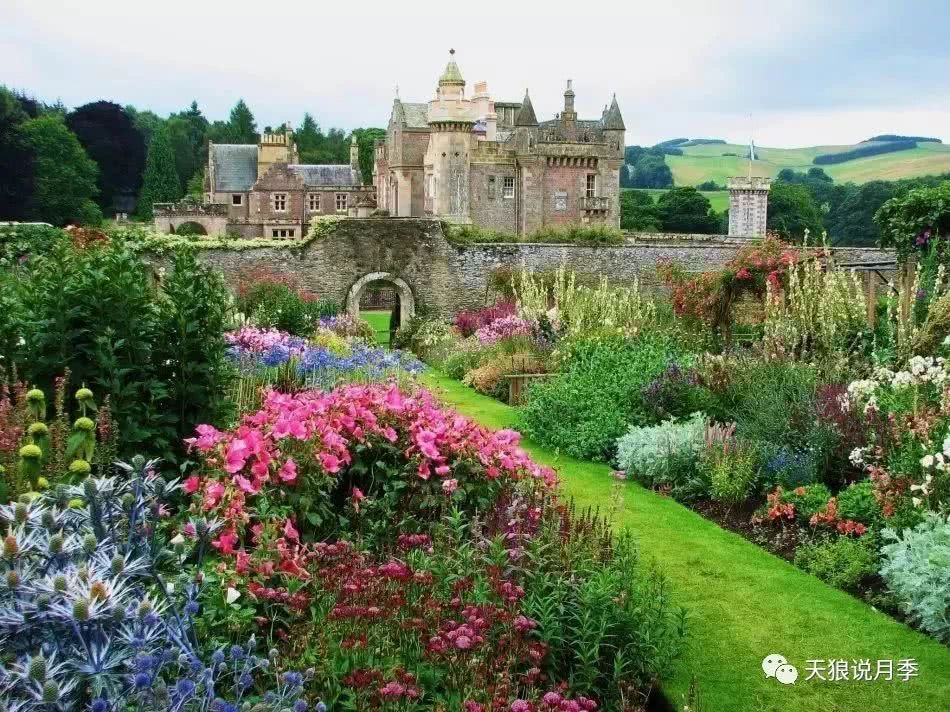
Every flower lover must have dreamed of having a country garden of their own, with fragrant grass and fallen blossoms all year round.
In real life, there are quite a few such "hidden paradises," but the Cotswolds is absolutely one of the most famous among them.
Cottages built of honey-colored stone are scattered across grassy green hillsides;
Murmuring streams carry blossoms tumbling along with a gurgle, as delicate fragrance drifts in on the gentle breeze;
And in the distance, low-hanging white clouds and round fluffy flocks of sheep stretch on and on...
"The ideal life of universal harmony
is to live in the English countryside."
-- Lin Yutang
The Cotswolds is located in the heart of England. It is not a formal administrative region, has no "county" title, and is instead a collective name for a region.
From Stratford, Shakespeare's hometown, in the north to Bath, the spa town famous since Roman times, in the south, it stretches over 160 km.
Within it, rich rural charm blends with the rolling Cotswold Hills landscape, and once people step inside, they feel as if they are in a poetic, songlike painting.
Ancient honey-colored stone houses are covered in dense vines dotted with brightly colored small flowers, carrying a fresh, crisp yet not overly sweet scent like wild mountain-flower honey.
In every household's garden, flowers bloom in profusion; among tender greens, gentle English roses sway in the breeze, and looking up, they already merge with the countryside hundreds of meters beyond the village.
In the Cotswolds, there are many very dignified and elegant English-style private estates and parks.
Highgrove Gardens
Bourton House Garden
Sudeley Castle & Gardens
But what moves flower lovers even more are these country gardens right at the doorstep.
"The Cottage Garden,
with its naturally formed quiet, refinement and elegance"
The cottage garden began in England, so it is also called an English Cottage Garden. It belongs to ordinary households and is an informal garden.
People often plant vegetables, herbs and fruit trees in front of and behind the house, then fill the gaps with annual flowering plants, add some old-fashioned roses, and also arrange some lawn and small water features.
Cottage gardens do not emphasize layout and structure; they care only about practicality and the beauty of plant combinations. High planting density is one of their important characteristics.
Trees, flowers and plants present natural soft lines and strive to maintain plant diversity and richness.
To this day, the cottage garden has developed a complete set of color knowledge and spatial aesthetics techniques, combined with specific plant selection, so that the garden blooms with dazzling beauty 360 degrees with no dead angles all year round.
To create your own cottage garden,
what should we do?
Step 1 Layout
No matter the size of the garden, lawn is an indispensable part of an English garden. To avoid a dull design, it should also be paired with brilliant flowers and plants.
In traditional English country gardens, old-fashioned flowers and plants are usually grown, such as hollyhocks, oxeye daisies, lilies, violets and lavender. Fragrant roses of many varieties are also very suitable.
Step 2 Color
Using color rendering is also an important feature of English gardens. The colorful gardens we admire come from the visual impact brought by flowers and plants.
The most classic English gardens, however, use monochrome design -- arranging the garden with one specific color while other colors serve as a foil to set off the main color.
So when arranging your garden, you can first determine the garden's main color, which allows for more reasonable matching and arrangement of plants.
Step 3 Framework
The framework is an important part of an English country garden. Natural, old-fashioned materials are usually chosen, and the more rustic the better.
Fences are often used to add rural flavor to the garden. Arches are another common decorative structure; wooden or iron arches serve to welcome guests. Plant some brightly colored climbing plants on the arch to light up the space.
Some say a garden is an art closer to what God made by hand than poetry is.
So, gardeners, work hard to build your own work of art.
If you have the chance in the future, remember to visit the Cotswolds!
A happy life
is probably just planting flowers & drinking tea in the garden.
Don't you agree?
END