Detailed Explanation of the Production Methods and Steps for Cedar Bonsai
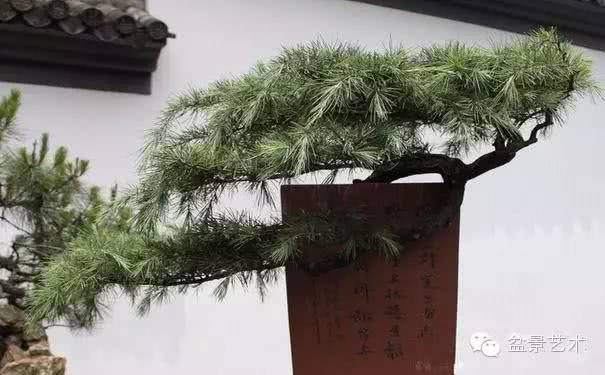
(1) Botanical Knowledge
Cedar belongs to the Pinaceae family, genus Cedrus. It is an evergreen tree with a spire-shaped crown, large branches spreading horizontally, and small branches slightly drooping. The leaves are needle-shaped, hard in texture, gray-green or silver-gray, scattered on long shoots and clustered on short shoots. It blooms from October to November. The cones mature the following year, are oval-ovate, and turn reddish-brown when ripe.
Main Varieties
1. Weeping Cedar: large branches spread horizontally and droop, like jade tassels, with a beautiful tree form.
2. Silver-leaf Cedar: the leaves are silvery white or tinged with grayish blue.
3. Golden-leaf Cedar: the crown is tower-shaped, and the needles are golden yellow in spring, turning yellow-green in autumn, very eye-catching.
4. Dense-cluster Cedar: the crown is tower-shaped, the branches are dense and curved, and the small branches droop.
The cedar is native to the Himalayas, and is distributed in southern Tibet of China as well as in India and Afghanistan. It is suitable for the temperate and subtropical regions of China with an annual rainfall of 600-1000 mm, and grows well when cultivated in various places along the middle and lower reaches of the Yangtze River.
The cedar likes light and also has a certain shade tolerance. It prefers a cool and humid climate and has quite strong adaptability to temperature changes. It is suitable for neutral or slightly acidic soil with deep soil layers and good drainage. It fears waterlogging; when water accumulates in the soil, it often grows poorly or even dies.
(2) Material Collection and Propagation Measures
Artificial propagation: Cedar propagation usually adopts methods such as sowing, cuttings, layering, and grafting. Because the cedar is dioecious and requires artificial pollination to set seed, seed sources are insufficient, so the cutting method is the main method of cedar propagation at present.
Cuttings are divided into two types: spring cuttings and summer cuttings. Spring cuttings are best done in February to March. Select 1-year-old robust branches from strong young seedling mother trees as cuttings. If selecting from large trees, branches from the upper part of the crown should be used, 10-15 cm long. Cut off the needles on the lower part of the cuttings, dip the base in a 500 ppm naphthaleneacetic acid solution for 3-5 seconds, then insert into the cutting bed. The insertion depth is 1/3 to 1/2 of the cutting length, with a plant-to-row spacing of 6-10 cm, then spray water. After insertion, a shade frame should be set up in time to provide shade and reduce evaporation. Spray water 2-3 times a day to keep the soil moist and provide appropriate light. If management is thorough, roots can generally develop in about 60 days. Summer cuttings are carried out from May to June, using the new shoots produced in that spring as cuttings; the rest is the same as for spring cuttings. In March of the following spring, divide the seedlings and transplant them, keeping the original soil or a soil ball. For seed propagation, collect seeds in mid-to-late October, sun-dry to remove the seeds, bag them, and store them dry. Sow in spring from February to March of the following year. To save seeds, dibbling can be used. Insert the seeds into the soil with the pointed end downward, with a row spacing of 15 cm and a plant spacing of 5 cm. After sowing, cover with soil, cover with grass, and water. Seedlings emerge after about half a month, and a shade frame should be set up. Fertilize once every 15 days, preferably with decomposed human manure and urine, or chemical fertilizer can also be used. In the following spring, transplant or pot them for cultivation and carry out processing and shaping.
Layering propagation is also very convenient because its branches droop and are close to or even touch the ground, so these branches can be used for layering. For cedar layering, it is best to choose 1- to 2-year-old branches. First use a sharp knife to make a horizontal cut or girdle the bark on the branch to be pressed into the soil, reaching the xylem, then press the part below the cut into the soil to a depth of 5-8 cm, fix the layer with a branch, cover with soil, and press firmly so that it does not spring upward. Cedars layered in spring can root in the same year. In the following spring, separate them from the mother plant and transplant.
Grafting propagation is best carried out in early February using the cut grafting method. The scion uses 2-year-old branches from the sunny side, about 10-15 cm long. The rootstock can be Huangshan pine or black pine seedlings.
(3) Potting Process
Pot selection: For cedar, purple clay pottery pots are suitable, and glazed pottery pots can also be used. Large bonsai can use deep round pots, and various carved stone pots can also be used, but the root base must be fixed with metal wire. Medium bonsai should use begonia-shaped or manger-shaped pots. For small seedlings planted together in a forest style, shallow carved stone pots such as white alum stone or marble can be used.
Soil: For cedar, loose, well-drained, slightly acidic sandy loam soil can be used. For potting, aged garden soil or leaf mold mixed with sand is commonly used.
Planting: It is best in spring from March to April, and also possible after autumn. Cedar seedlings dug from the ground must retain the original soil to help survival. Also thin out and prune dead roots, spread out the fibrous roots, cover with fine soil, gently shake the pot, and press firmly with a bamboo stick so that the pot soil and root system are firmly attached. For the planting position, it is best for the main trunk to lean toward one side at 1/3 of the pot.
(4) Shaping Techniques
Processing: The processing and shaping of cedar bonsai is mainly based on binding, combined with pruning as a supplement. Binding is best in winter and spring, and palm fiber is often used for binding. The cedar's main trunk stands upright and its side branches spread horizontally, so the side branches are often bent into an S shape. The main trunk is generally not bent, naturally forming a large-tree type upward, with an extremely simple and beautiful posture. It is also possible to take 5-7 small seedlings of the current year, arrange them at different heights, and plant them together in a forest style, with graceful branches and leaves, possessing a distinctive charm.
Tree form: The cedar tree body is tall and upright, and its side branches spread and droop gracefully. When making bonsai, its natural form must be used. Tree forms such as the straight-trunk style, double-trunk style, slanting-trunk style, and forest style are good. Through binding and pruning, the branches and leaves can be made into layered or cloud-like forms. After years of care, they can become excellent bonsai works that combine strength and softness with elegant posture.