Characteristics and Care Methods of the Echeveria runyonii 'Topsy Turvy' Succulent
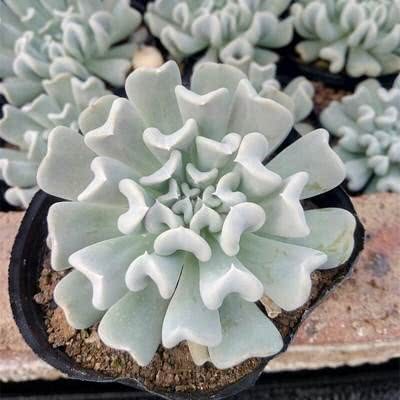
Echeveria runyonii 'Topsy Turvy', in the subfamily Sempervivoideae, genus Echeveria in the family Crassulaceae, is a perennial succulent and a variant of Echeveria runyonii, with a very peculiar leaf shape, and even the shape of its flowers can be twisted to a certain degree. Its original species (Echeveria runyonii) originates from Tamaulipas in Mexico, while the first variant originated in California in the United States.
Echeveria runyonii 'Topsy Turvy'
The leaf base is a twisted spoon shape, with both edges curving outward, causing the middle part to arch up, while the leaf tip curves inward toward the growth point; the back of the leaf has a distinct groove in the center, and the surface is covered with a thick layer of natural white farina, arranged in a rosette. After the farina is wiped off, it is blue-green or gray-green; 6-8 cm long and 2.5-4 cm wide. In an environment with sufficient light, it takes on a faint pink color.
Echeveria runyonii 'Topsy Turvy'
The plant can reach 20-30 cm in diameter and 15-30 cm in height. It mostly blooms in spring and autumn, and mature plants usually grow two or more arching racemes at the same time, 15-20 cm tall. The corolla is pentagonal, 1.9-2.0 cm long and 1.0 cm in diameter, bright red-orange. It is worth mentioning that sometimes both the flowers and the sepals, like the leaves, take on a twisted form.
Echeveria runyonii 'Topsy Turvy'
The main pest is mealybugs. More than 80% of plants bought from flower markets and similar places have mealybugs on their roots. In the early stage, the pests are commonly found on the roots or in the center of the plant. After discovering the pests, it must be isolated from other plants immediately, and the roots infested with mealybugs should be cut off; the affected areas can be sprayed with Huhuashen or drenched at the roots to kill them (fungicides such as chlorothalonil and carbendazim do not have insecticidal effects). Completely killing mealybugs may require several cycles. For prevention, a small amount of carbofuran or Tuchongdan can be mixed into the soil mix.
Echeveria runyonii 'Topsy Turvy'
The common disease is mainly black rot of the plant (that is, the plant parts turn black and rot, mostly seen at the roots), which occurs mostly in summer, usually caused by poor ventilation and a high-humidity, high-temperature environment, but it can sometimes also be caused by mealybugs.