How to quickly identify Aglaia odorata, Murraya paniculata, and boxwood? Bonsai knowledge sharing
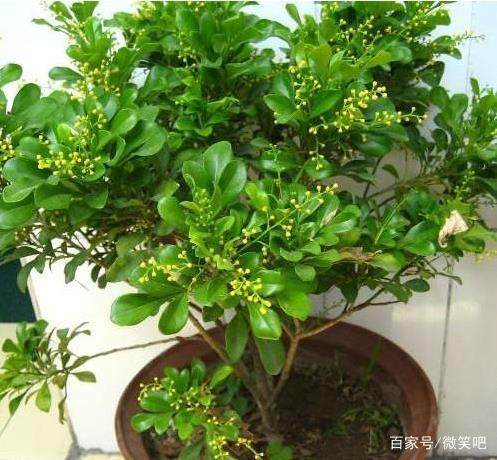
Distinguishing the three plants Aglaia odorata, Murraya paniculata, and boxwood may not be difficult, but for most people it may not be very clear, especially for those who are plant-blind. In fact, Aglaia odorata is a genus of the Meliaceae family. The species belongs to the genus Aglaia. Today I will teach you one or two tricks.
To help you quickly identify Aglaia odorata, Murraya paniculata, and Euonymus.
1. Leaf identification method
The leaves of Aglaia odorata are about 2 to 7 cm long and about 1 to 3.5 cm wide, and are obovate. Usually the leaves at the top are the largest, and the smaller they are, the less velvety hairs there are on both sides of the leaf.
Its leaves are about 1 to 6 cm long and about 0.5 to 3 cm wide, and are elliptical-ovate. The leaves on both sides of the branch are asymmetrical, with one side slightly skewed.
The leaves of boxwood are about 1.5 to 3.5 cm long and about 0.8 to 2 cm wide, and are broadly obovate. There will be some fine fuzz on the lower part of the leaf.
From these data, it can be seen that the leaves of Aglaia odorata are the largest, followed by Murraya paniculata, and the smallest leaves are boxwood.
2. Flower identification method
Summer and autumn are the season when Aglaia odorata blooms. Its flowers are yellow, like a grain of yellow millet. Although the flowers of Aglaia odorata are small, they are numerous and have a strong fragrance.
Unlike the flowers of Aglaia odorata, which bloom in summer and autumn, Murraya paniculata usually blooms in late summer and early autumn. Its flowers are white and shaped like a small trumpet, appearing where the leaves and branches meet or at the tips of flowering branches. The flowers of this species are also fragrant, but not as fragrant as those of Aglaia odorata.
The flowers of boxwood and Aglaia odorata are very similar in shape and color. They are like a grain of yellow millet. The difference is that boxwood flowers usually appear in March and April, and the flowers fall in May. Its fragrance is faintly sweet.
In this way, the color and shape of the flowers of Aglaia odorata and Murraya paniculata are similar. Aglaia odorata and boxwood have similar colors and shapes, but different flowering periods. Is this a good way to distinguish them?
3. Fruit identification method
The fruit of Aglaia odorata smells very fragrant, just like the scent of the flowers, but the taste is very bitter, even numbing. In addition, there is mucus adhering to the outside of the fruit.
The fruit of Murraya paniculata is round, and the flesh inside is red. Generally, it does not mature until October. There is a sticky liquid in the pulp, and there are some short hairs on the seeds.
The fruit of Euonymus is also round and round. There are three supports at the bottom of the fruit, like a tripod. This is its characteristic, and its fruit is blue.
With the help of these three methods, I believe that next time you encounter these three plants at the same time, you will quickly be able to tell them apart.