Orchids, clivia and Christmas cactus: three tricks to encourage buds and blooming, and they will flower right on time
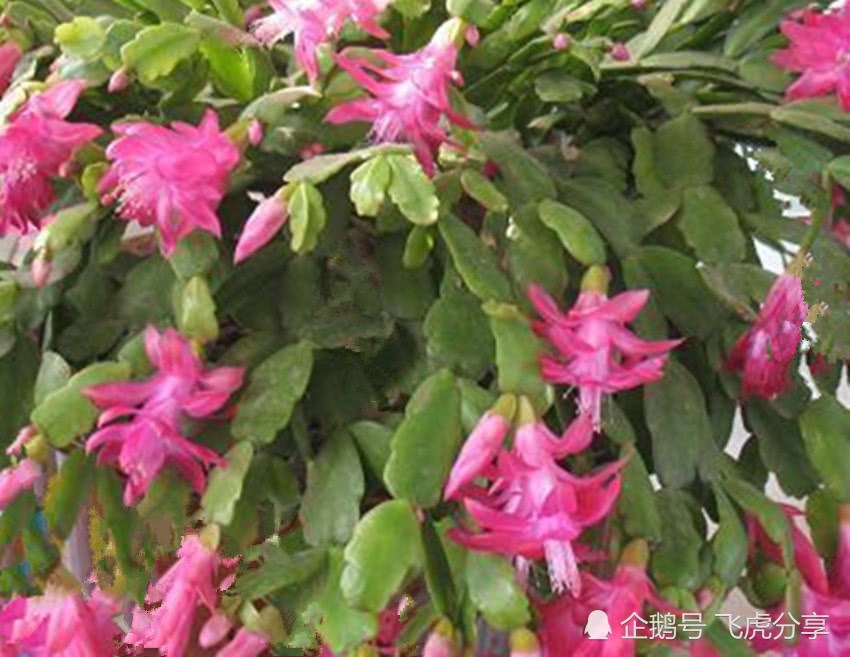
Orchids, clivia and Christmas cactus generally bloom from winter to spring, and some orchids bloom in summer or autumn. But many hobby growers' plants of these three kinds, although the plants grow lush stems and leaves, simply show no flower buds, which is really frustrating. So how can they be made to form buds and bloom? Here we introduce three tricks to prompt orchids, clivia and Christmas cactus to form buds and bloom, for the reference of fellow growers.
1. The temperature difference must be large. According to years of experience, a suitable temperature difference has a certain effect on bud formation in orchids, clivia and Christmas cactus. Wild orchids, clivia and Christmas cactus generally grow in dense mountain forests, with good ventilation and a large day-night temperature difference; in autumn the temperature difference is generally between 8-12 degrees, which is very favorable for storing nutrients in the plant body to be used for bud formation and blooming. Home cultivation is basically indoors, where the temperature difference between day and night is too small, so the nutrients are used only for the growth of stems and leaves, with no surplus nutrients stored, and not enough nutrients to support bud formation; this is what causes the phenomenon of no blooming or few blooms. Therefore, in autumn, increase the indoor temperature difference, or move the plants to a balcony and open the windows at night so they get full ventilation and air exchange; it is best to make the nighttime balcony temperature close to the outdoor temperature, so that the temperature difference reaches about 8-12 degrees. In this way, orchids, clivia and Christmas cactus can store more nutrients and prepare for bud formation and blooming.
2. Light must be sufficient. Light is the source of photosynthesis in plants and a necessary condition for prompting blooming. With sufficient light, the plant can store more nutrients in its body, which favors bud formation and blooming. Therefore, for indoor cultivation of orchids, clivia and Christmas cactus, which are semi-shade flowers, apart from appropriate shading in high-temperature weather, they should all be given appropriately sufficient light; indoors they can be placed near a window or another bright spot, which not only favors bud formation and blooming but also makes the stems and leaves more vigorous.
3. Clever use of phosphorus fertilizer. Many hobby growers cannot distinguish what is nitrogen fertilizer and what is phosphorus fertilizer. Sometimes too much nitrogen fertilizer is applied, while the plant lacks phosphorus fertilizer for blooming, resulting in the phenomenon of growing only stems and leaves without blooming. Phosphorus fertilizer is an indispensable substance for promoting flower bud differentiation. If phosphorus is lacking, it is very difficult for the plant to form buds and bloom. Therefore, before bud formation, that is, in autumn, phosphorus fertilizer can be appropriately increased, which has a marked effect on flower bud differentiation. The simplest method is to spray the leaves with a 0.2% potassium dihydrogen phosphate solution, once every 10 days, for three consecutive sprays, with obvious results. In addition, before the flower buds form, watering must be reduced, just enough that the potting soil is slightly dry and slightly moist, forcing the plant to shift from stem and leaf growth to reproductive growth, so that it forms more buds and more flowers.