Lucky bamboo with 3 added things, grown for half a year: leaves stay glossy green with no yellowing, and roots grow fast
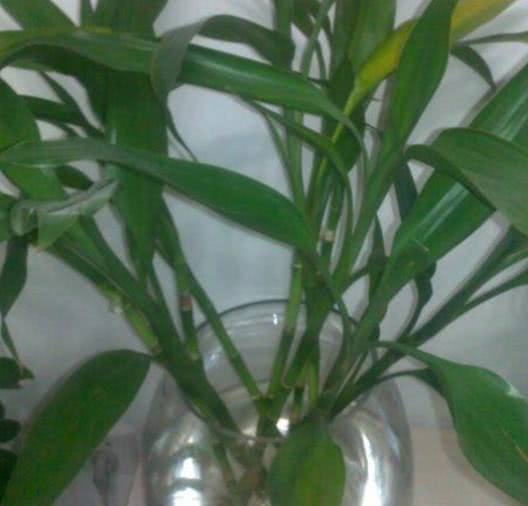
The first thing is fertilizer. If you keep fish in a fish tank, there is fish waste, so it is a very good organic fertilizer. Fallen fish scales are also a very good phosphorus fertilizer. However, you need to keep quite a few fish to supply enough for such a large pot of lucky bamboo. If you do not keep fish, keep only a few, or find it troublesome, you can also use organic nutrient solution; the effect is the same, with balanced nitrogen, phosphorus and potassium, and it is organic and ecological too! Flower lovers who like to keep things clean, or who are busier, should of course use this kind of organic nutrient solution, and it is convenient to use. Finally, pay attention to light. Lucky bamboo likes a semi-shaded environment, so it is more suitable to place indoors, but if the light is too good, you should properly put the lucky bamboo in a dark spot.
Lucky bamboo, also known as green leaf immortal, ten thousand year bamboo, and green leaf bamboo banana, is a perennial evergreen shrub. Lucky bamboo likes warm, humid and shaded environments, likes scattered light, avoids harsh sun exposure, and prefers loose, fertile soil. Lucky bamboo can be grown in pots or in water in bottles. When grown in water at home in a clear glass bottle, the old and new roots, yellow and white, stand out in the clear water, making it look even more full of life. For lucky bamboo like this, the best fertilizer is organic nutrient solution. After using it, the leaves basically will not turn yellow, rooting is also relatively fast, and the plant grows sturdy. If you do not have this kind of nutrient solution at home, you can also put a rusty iron nail or iron wire in the pot; for yellow leaves on lucky bamboo, the effect is very good. For fertilizer, you can use fermented fruit peels and so on, but the smell is a bit strong. In winter, be sure to keep it warm. If the temperature is too low, lucky bamboo will not only have yellow leaves, but is also likely to die. A temperature above 15 degrees is more suitable. Avoid wind. Do not place lucky bamboo next to a TV or in places where an air conditioner or electric fan often blows on it, so as to avoid dry tips and edges of the leaves.
The color of lucky bamboo is dark green or emerald green, and this color helps delight people's body and mind; lucky bamboo can absorb harmful gases and dust indoors, and can regulate indoor humidity; lucky bamboo also has the effect of reducing radiation, which is good for people who often face computers and mobile phones. In feng shui, the role of lucky bamboo is to promote official career and academic luck. That is to say, it benefits people who are seeking promotion or advancement in studies. If you have a child at home who is about to face further schooling, or if you want to get promoted, according to feng shui you can place lucky bamboo indoors. However, lucky bamboo should not be placed in the wealth position, otherwise it will make your fortune worse.
Lucky bamboo, also known as ten thousand year bamboo and bamboo banana, is native to western Africa and mainly grows in the southwestern part of China. It is a perennial evergreen herbaceous plant. Lucky bamboo is rough-growing and rough-spreading, generally planted in gardens and nurseries, and likes dark and damp places. Its stems and leaves are thick, the leaves are dark green, and the cultivated height can reach 80-100 cm. Lucky bamboo gives people an elegant and soft feeling, with an extremely graceful posture and a rich bamboo charm. Lucky bamboo is suitable for small pot cultivation, often placed in bedrooms, studies, living rooms and other places, or on desks, coffee tables and tabletops. It is elegant and refined, exquisite and unique, and has very good ornamental value. In addition, the stems of lucky bamboo are highly malleable, so people can freely shape and bend them, or cut them into sections and combine them. At present, the bonsai shapes of lucky bamboo on the market are diverse and very distinctive, and some even give off a rich artistic atmosphere.
Special reminder: In northern China, it is better to buy lucky bamboo in spring, and after buying it, it soon enters a suitable growing period. If there is heating in winter, you can also buy it before the New Year or Spring Festival. For potted plants, choose vigorous plants with thick green and glossy leaves, bright golden-edged stripes, no dry tips, no bare lower stems, a plant height under 30 cm, and 3 to 6 branches. For water-grown plants of various shapes, choose plants with evenly thick stems, beautiful shapes, and no rot at the base or roots. A special reminder is that lucky bamboo grows poorly in alkaline soil and dry climates, and leaf tips tend to dry up. If kept in a shaded indoor place for a long time, it also grows thin and weak, and the leaf color becomes dull and lusterless, so attention should be paid to this.