Bonsai approach grafting: how to obtain an elephant-foot trunk
Enjoying bonsai is all about the "play" in it. However, time waits for no one: a bonsai takes a day to complete but ten years of work, and life does not have many ten-year spans. Sometimes we can use certain techniques to quickly achieve the effect we want. For example, using the approach grafting method to obtain an elephant-foot trunk. "Elephant-foot trunk" is a term I came up with; perhaps some great master once mentioned it, so let us just say great minds think alike. An elephant-foot trunk, as the name suggests, is shaped like an elephant's foot, very thick and sturdy, with a root base that is slightly trumpet-shaped, and roots spreading out in all directions. This is one of the requirements for an old bonsai trunk. Usually, if you start cultivating from a young seedling to obtain an elephant-foot trunk, it takes a very long time, let us tentatively say 10 years. For some tree species, such as maple, elm, banyan, hackberry and so on, which have very strong healing ability, we can use the method of grafting them to each other to obtain one quickly.
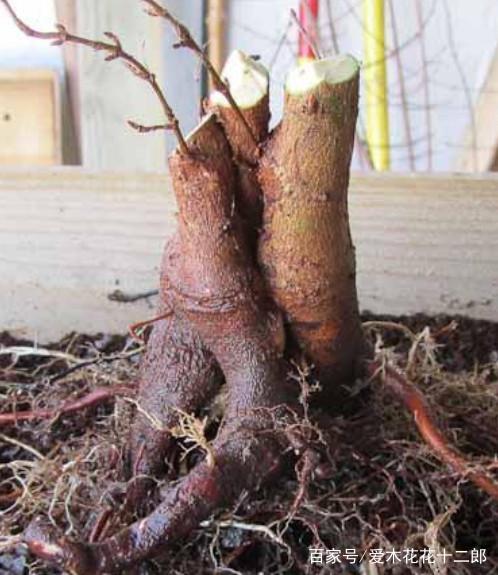
This is an example. Three trident maples about four years old. First find the right angles; what needs to be considered is the fit of the root system and the main trunk. After determining the relative positions of the three, shave off the bark at the contact points to expose the cambium, then press the cambium of the three against each other, wrap and fix them tightly with aluminum wire or zip ties, or grafting tape, and seal the contact points with sealing compound to avoid infection.
But this master still fell a little short when doing it. The three trunks used now are about the same height. If, when trunk-chopping, one of them were left a section longer, this section would later serve as the secondary trunk, and during cultivation, the best of the branches growing from the secondary trunk would be selected as the tertiary trunk. By the time the elephant-foot trunk takes shape, the transitions of both the secondary and tertiary trunks would have been developed at the same time, shortening the time by at least two or three years.
After being tied together and potted up to grow freely for a period of time, the three trunks completely fused together. With the state of these branches, after a bit of work they could be made into a broom-style form.
However, he still chose to make it into a single-trunk style. Looking at the picture below, is it not just as I said, that he now still has to slowly cultivate the secondary trunk, which will take at least two or three years. From the picture you can also see that the root base is still quite good. From the start of approach grafting to this state, it took about four years.
Personally, I think this method is very suitable for making a short, powerful bonsai.