An invasive plant that wreaks havoc abroad has become pig feed and a delicious wild vegetable in China
Warm reminder
Hemu Report aims to share and popularize information about various plants and their uses, for reference only. If medicinal use is needed, it is recommended to consult a professional physician to avoid problems!
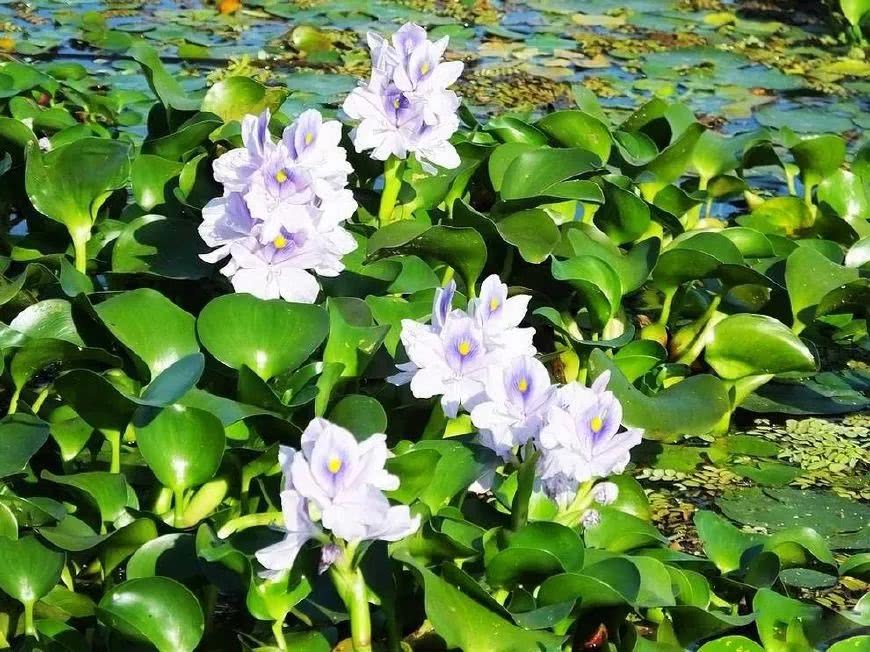
In China there is such an aquatic plant. Whether in the Yellow River, the Yangtze River, the Pearl River, or in lakes, ponds, and small puddles, as long as there is water, its figure can often be seen. It blooms blue flowers and looks quite beautiful. Originally an ornamental plant in South America, it was later praised at foreign expositions as "the lavender crown that beautifies the world," and was then introduced to various countries for cultivation, and China also introduced it. But at the time no one knew it would become one of the "world's 100 worst invasive species," and now everyone regrets it deeply.
This aquatic plant has a name known to everyone in China, called "water hyacinth." I believe many people have seen it! In fact, its scientific name is "water hyacinth" (Eichhornia crassipes), because there is a purple patch in the middle of its flower, shaped like a phoenix eye, and it looks very beautiful. It was originally introduced as a flower. The water hyacinth is native to Brazil in South America. In Brazil it has natural enemies to keep it in check, but after entering other countries, it lost its natural enemies and began its path of rampant reproduction and mischief, becoming the "number one public enemy" of agriculture, water conservancy, and environmental protection in various countries.
The water hyacinth has strong survival ability. It can grow both in clear water and in domestic wastewater and industrial sewage. It was once used to purify water environments, but who knew its reproductive ability was so strong that after entering a certain body of water, it would quickly become the dominant species, "walking its own path and leaving others nowhere to go." In waters invaded by it, even many plankton cannot survive. The water surface is completely covered, there is no oxygen in the water, and photosynthesis cannot be carried out. Fish also die in large numbers, and eventually the entire body of water turns green and stinks.
Moreover, the water hyacinth can settle everywhere with the flow of water, seriously blocking river navigation channels. Some water hyacinths grow so densely that they can even bear the weight of a person walking on them, causing river shipping to be paralyzed. In addition, the water hyacinth also seriously harms waterworks. It not only causes water quality to deteriorate, but once it is sucked in by water pumps, it can clog filter pools and cause water supply outages.
However, the water hyacinth is not completely useless. At least in rural China, it has many uses. It can not only be used to raise fish, but also to feed chickens, ducks, pigs, and so on. Many farmers cannot do without it.
The water hyacinth contains a variety of trace elements, as well as various crude proteins, crude fats, and fiber. After being crushed or beaten into pulp and mixed into various bran feeds, it becomes feed for raising poultry and livestock. It was once a very common pig feed in Grandpa's generation. The tender stems and leaves of the water hyacinth are also a delicious wild vegetable, tender and juicy, with the effects of clearing heat and detoxifying, and moistening the intestines to relieve constipation. However, be careful to choose water hyacinths from clean waters. Dear readers, have you ever eaten water hyacinth?
Text/Hemu Report, Images/Internet
If you like Hemu's articles, you are welcome to follow