4 trailing flowers that bloom more than 300 days a year, beautiful and easy to grow, better than pothos and succulents
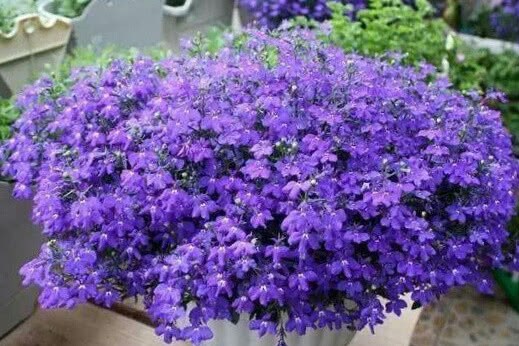
1. Lobelia
It is one of the flowers best suited to hanging basket care. It has charming, brilliant blooms and produces an especially abundant flush of flowers. Besides blue-purple flowers, it also has pink and white ones. The tiny blossoms look like colorful butterflies resting on the branches. It needs light, frequent fertilizing plus proper pruning to cover its branches with blooms.
Lobelia is very easy to grow and is generally propagated from seed. Lobelia seeds are tiny, so when sowing you can mix in a little fine sand before sowing, or raise seedlings first and transplant them into pots or flower beds once they have 6 to 8 true leaves. Use a fine-nozzle watering can to water, and never let the force be too strong, to prevent the seeds from washing away.
When planting out, add a slow-release fertilizer at the same time, then top-dress about every three weeks. Especially before the flowering season arrives, supply a relatively larger amount of phosphorus fertilizer to encourage blooming.
2. Fuchsia (ladies' eardrops, hanging bellflower)
Fuchsia, also known as ladies' eardrops or lantern fuchsia, is a perennial shrub flower of the genus Fuchsia in the family Onagraceae. The fuchsia's flower stalks are slender, the flowers droop, and the calyx tube is bell-shaped. When in bloom they look like colorful lanterns or golden bells hanging upside down one after another, swaying in the wind, very gorgeous. It is a flower well worth choosing for home pot cultivation.
Care is as follows:
For potting, use a growing medium mixed from 5 parts leaf mold, 4 parts sandy loam, and 1 part decomposed cake fertilizer powder. Generally, repot and change the soil once every spring.
During the flowering period, water every day and fertilize once every two weeks. From late autumn to winter, generally keep the soil slightly dry, and fertilizing once a month is enough. During the summer dormancy period, you only need to water the fuchsia; generally no fertilizing is needed.
Because the fuchsia produces flower buds in the leaf axils of new shoots, to make it bloom more you need to make it branch more. Pinching at the right time is an effective measure to make it branch more.
Generally, when the seedling grows to about 10 cm tall, carry out the first pinching to encourage branching. After about 1 month, when the new branches have grown 6-8 leaves, carry out the second pinching, and remove the extra buds, keeping 5-7 branches per plant.
3. Purple necklace plant (Othonna capensis, ruby necklace)
The purple necklace plant is also called yellow-flowered new moon or purple string of moons. Just from these names you can tell its characteristics: it opens small yellow flowers, its leaves are green, and in good light they slowly turn purple. The stems are also purple under good light.
Care is as follows:
The purple necklace plant is mostly propagated by cuttings, with a high survival rate. Prepare some peat soil, and you can use a spray bottle to spray water so the soil is moist but not dry. Then fill a flower pot, insert the purple necklace plant cuttings into the soil one after another, and spray a little water with the spray bottle; do not spray too much at a time. Then place it in a shady spot.
In the early stage of rooting, the purple necklace plant does not need much water. Once the roots have fully combined with the soil, it will grow explosively and madly. Its growth rate can be considered among the faster-growing trailing succulents.
The suitable growing temperature is between 15-28 degrees, but in winter the temperature must not be lower than 10 degrees. During its growing period, fertilize once a month; during the growing period, keep to a watering cycle of watering thoroughly only after the soil has dried out completely; for the soil mix, you can use a mixed soil of vermiculite, perlite, and peat.
4. Sweet alyssum
Planting a pot of sweet alyssum beside you can keep you very cheerful all day long. It has a charming fragrance and small, lovely flowers. It is a very suitable choice for both balconies and rooftops. It likes a warm, slightly moist environment, and needs plenty of sunlight and light, frequent fertilizing to grow better.
Care is as follows:
The sweet alyssum plant is low-growing with many branches, and it can bloom in a full pot without pinching. Its flower colors are rich, mainly white shades. Depending on temperature, light, and flowering time, the same plant can even open flowers of different colors. At peak bloom the flowers outnumber the leaves, a mass of white fragrant blooms, accompanied by waves of floral fragrance, leaving people intoxicated.
Sweet alyssum has strong vitality, likes sunlight, fears strong light, and is not strict about soil. Therefore, when growing sweet alyssum, when planting it in a pot you should choose soil with good drainage.
Before early summer, carry out necessary pruning, and move it to a cool place. Usually pay attention to the water supply, and only apply dilute liquid fertilizer. As long as you do these things well, the sweet alyssum can grow healthily.