Rosette Aeonium is one type of the Aeonium succulents.
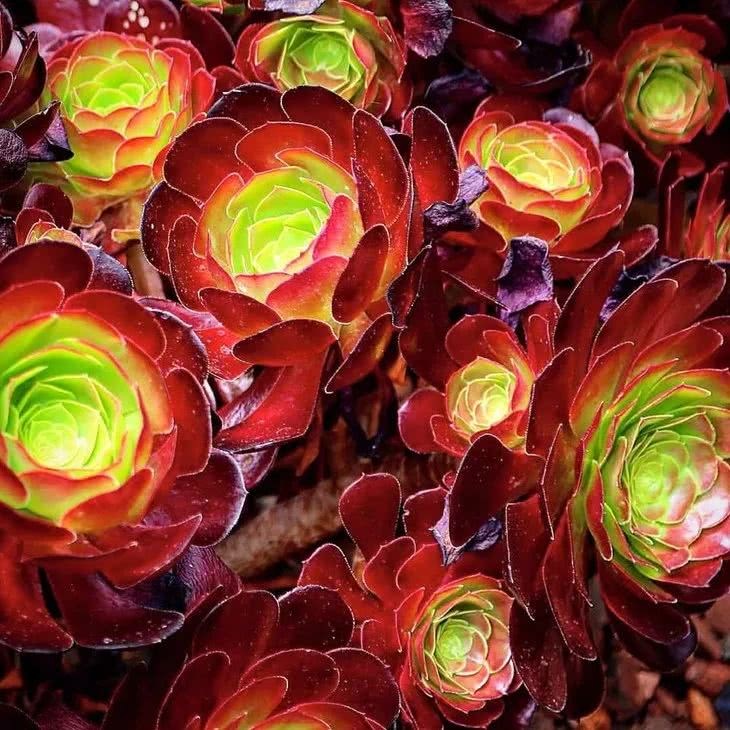
Mention the name Rosette Aeonium, and half of the growers will love it to death, while the other half will hate it with grinding teeth.
The reason the name Rosette Aeonium is so polarising is that Rosette Aeonium is not an exact variety, but a big collection of Aeonium varieties that look similar and are hard to tell apart.
If you don't much care about the details of varieties and just pick by appearance, then you will mostly like the generic name Rosette Aeonium. If you genuinely want to collect one particular Aeonium variety, then you will feel that the generic name Rosette Aeonium exists only to fool you.
Some growers think the name Rosette Aeonium was invented by unscrupulous Chinese sellers. If you think so too, then you are doing an injustice to the sellers who sell Rosette Aeonium. Because the term Rosette Aeonium is originally a genuine foreign word; we merely translated it.
To understand Rosette Aeonium, you must get to know a very old and classic original species of Aeonium - Aeonium canariense.
Aeonium canariense has an English common name, Giant Velvet Rose. Translated into Chinese, it means giant velvet rose. Three important pieces of characteristic information are hidden in this name: the giant rosette size, the fine hairs on the leaves, and the rose-like cupped rosette. Besides these, Aeonium canariense has a fourth important piece of characteristic information hidden in its Chinese name, which is that it is fragrant.
About fragrance, I should say a few more words here. Some people find Aeonium canariense fragrant, some may find it stinky; even for the same plant, people's assessments of the scent differ. This is something decided by our genes. Just like durian, it is also a fruit where love and hate coexist. People who love durian have never found durian to be a stinky fruit. By the way, let me take a side here: I am a huge durian lover.
So in the future, when talking about scent, there is no need to argue endlessly over whether a scent is fragrant or stinky. The scent is the same scent; it is just that different people experience it differently.
Back to Aeonium canariense. Aeonium canariense is the hybrid parent of all Rosette Aeoniums. There are also some plants claimed to be XX Rosette Aeonium that are in fact Aeonium canariense itself; it is just that the name Aeonium canariense is really not flashy enough, so we have overlooked it.
Let me casually list a few hybrid descendants of Aeonium canariense, so we can feel the influence of Aeonium canariense.
Aeonium 'Ziborui', Aeonium 'Shaoxiu', Copper Pot Aeonium, Golden Rose Aeonium, Halloween Aeonium, Plum Blossom Perdi... and many more, but please forgive my poor memory, which does not allow me to keep listing them.
If you have ever felt that the varieties above are truly dazzling and impossible to distinguish, then I suggest you simply call them all Rosette Aeonium. In fact, abroad, including Japan and South Korea and Europe and America, most of the time calling them Rosette Aeonium is enough; there is no real need to distinguish them.
Last time I went to a greenhouse in Weifang that specialises in Aeoniums to look at stock; it really was an ocean of Aeoniums. When I carried a pot of Aeonium over to ask the boss what variety it was, the boss said to me very seriously: "Where did you take it from? If you want to ask about a variety, just ask over there where you are standing." What he meant was: whatever you do, don't carry it over to ask me, and don't move it around, otherwise I won't recognise it either.
This shows how small the individual differences among these Rosette Aeoniums are.
All kinds of Aeonium compendiums and Aeonium illustrated guides circulate online, and every so often some expert comes out and rewrites one. But for this group, the Rosette Aeoniums, which are extremely hard to tell apart, just putting out a few pictures and labelling them with Aeonium names is really of no use in helping everyone recognise them; at most they can only be used for appreciation.
The most basic lesson in identifying Rosette Aeonium should be distinguishing Aeonium 'Ziborui' from Aeonium 'Shaoxiu'. Both Aeonium 'Ziborui' and Aeonium 'Shaoxiu' are varieties with a long history; their hybrid parents are the same, both Aeonium 'Zwartkop' and Aeonium canariense, so it is very normal that they look similar.
According to the variety descriptions, the colour of Aeonium 'Ziborui' is deep purple, while Aeonium 'Shaoxiu' is red. As for fuzz and scent, they are not hard indicators for distinguishing them.
In the past, when Aeonium 'Shaoxiu' was relatively rare and expensive, people called the plants with a good scent Aeonium 'Shaoxiu', and the plants with a stinky smell Aeonium 'Ziborui'. Now that Aeonium 'Ziborui' has a better market than Aeonium 'Shaoxiu', the ones that don't smell good are called Aeonium 'Shaoxiu'. And as we said earlier, different people perceive the scent of the same plant differently, so scent alone cannot distinguish them either.
If you grow both Aeonium 'Ziborui' and Aeonium 'Shaoxiu', in the same season you should be able to easily distinguish the obvious colour difference between Aeonium 'Shaoxiu' and Aeonium 'Ziborui'.
Another thing to mention is the different versions under the same name. For example, Aeonium 'Ziborui' is divided into European Purple (European version Aeonium 'Ziborui') and ordinary Aeonium 'Ziborui', and there is said to be a Korean version too. Copper Pot Aeonium is also divided into black, red, European version, Korean version and many other versions. Aeonium 'Shaoxiu' not only has European version and Korean version differences, but surprisingly also has Dutch Aeonium 'Shaoxiu' and French Aeonium 'Shaoxiu' distinctions; even in this small area of Europe, differentiation appears. Is such a complicated way of classifying really reliable?
Here I want to tell everyone responsibly that the above practice of further subdividing the various Rosette Aeoniums, which are already hard to tell apart, is very unreliable.
The purpose of sellers doing this is nothing more than to stop you from worrying too much about the difference between the online pictures you once saw and the real pictures, and to make you believe that the Aeonium they are selling is the genuine version.
For Aeonium of the same variety, one grown in a greenhouse, one grown outdoors, and one grown at home will certainly not look the same in colour and condition. Even for the same Aeonium, viewed at different times, it will look completely different. If we obsess too much over what kind of Aeonium is the genuine version, it will force sellers to come up with countless sales strategies and make up countless stories to try to prove that the Aeonium they sell is the one you want. This will only make the classification of Aeonium more and more chaotic.
So, if I am not willing to just call all the Aeoniums above Rosette Aeonium, how should they be distinguished? To be honest, I am not a breeder, and before finding authoritative variety descriptions from breeders, I have no way to teach everyone how to distinguish them accurately either. But I have a few tips for everyone's reference.
1. Do not identify these varieties when they are not in their prime condition, because when these horticultural varieties were bred, what was selected was their performance in extreme condition, so when they are not in condition or even leggy, don't trust any variety name; wait until they are in condition.
2. Pay more attention to the big hard indicators such as leaf arrangement, leaf tip shape, leaf margin, leaf centre, and overall colour changes. Compare the two varieties item by item at the same time and under the same care environment. If you find consistent differences, that is, every plant of one variety differs from every plant of the other variety at some point, then you can confirm they are two different varieties.
3. Ignore those deliberately profound answers, such as telling you that the inflorescence differs when flowering, or that the hybrid parents differ, and other answers that seem technically sophisticated. Even less should you believe claims like a certain plant carries more Aeonium 'Ziborui' genes, so its colour is different. Believe your own eyes; for horticultural varieties, looking different now matters more than anything, and don't believe anything else.
If you own a large collection of Aeoniums and you clearly know the differences between them, then even if you don't know their exact names, they are still your successful collection. If the Aeoniums all over your garden all look the same and you can't explain how they differ, then even if every pot has a label stuck in it stating the hybrid parents and Latin names, what meaning does that have?