Are slipper orchids easy to grow? An introduction to slipper orchid cultivation methods
There are many kinds of orchids, did you know? And do you know about the slipper orchid? How do you grow and cultivate it? Want to know? Let's find out together.
The slipper orchid is popular because its flowers are charming, and its place of origin is southern Asia and Southeast Asia. Some of them are alpine species that prefer cooler and damper climates. These mostly bloom in winter. Another type grows in tropical rainforests and is terrestrial. These mostly bloom in summer. Slipper orchids have a very long flowering period, sometimes blooming for four to six weeks, and the flower stems are slender, so they are suitable for cut flowers.
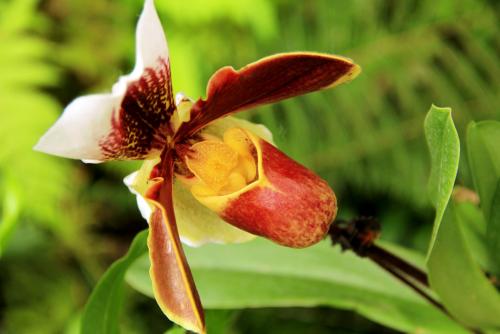
Slipper orchids have high requirements for potting medium, so it is best to change the potting medium Orchid Mix once a year, or even better every half year. Slipper orchids have no pseudobulbs and do not store water, so the potting medium must be kept moist, but there must be no standing water, to prevent root rot. (So use a pot with many holes.) The average watering interval is about once every seven to ten days.
Like other orchids, during growth you can apply a balanced fertilizer, or a high-nitrogen fertilizer. But before the flowering period, you can use a high-phosphorus fertilizer to encourage blooming. The amount used should be low, once every two to three weeks. To avoid too much accumulated fertilizer in the potting medium, every two or three months you can rinse the entire pot's potting medium thoroughly with clean water. But remember that afterward you must drain off the excess water, to avoid standing water. Occasionally you can mist around the plant to keep it moist, but do not get water on the flowers, otherwise they will fade faster.
The roots of slipper orchids will grow and become larger, so when repotting do not separate the roots, because the more and bigger the roots, the more flowers will be produced. And it is best to use a smaller pot, to let the roots be somewhat cramped, and the flowering will also be better.
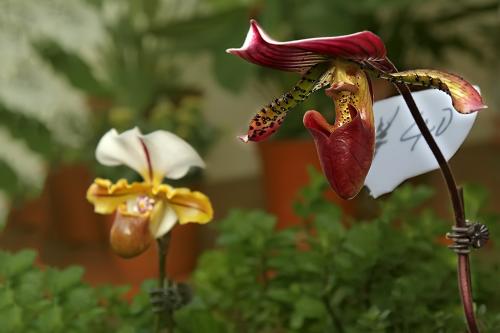
Most potted plants are tropical species, and the nighttime temperature is best at 18 degrees Celsius (65 degrees Fahrenheit), and daytime about 24-29 degrees (75-85 degrees Fahrenheit). Choose a bright window; if the leaf color turns pale, or yellowish, the light is too strong. If you pick a spot where it grows very well, try not to move it again.
Below is one of the recently very popular tree orchids, also called the green-lipped tree orchid; its flower stems and petals are both very slender, and besides being beautiful it is also very easy to grow.
Below, in Key West, Florida (left) and in Cuba (right), I saw people growing Dendrobium and Cattleya on tree trunks, very much at ease. At first you need to tie them with string, and once they are fixed you can remove the string. (Actually the whole state of Florida and the Caribbean area are suitable for growing orchids this way; the local weather with a few minutes of heavy rain every day is most suitable for tropical orchids.)
Pests and diseases
Orchids generally have fewer pests and diseases, but when grown indoors, they may develop tiny mites, or aphids, scale, or mealybug, etc.; simply wiping with a damp cloth or cotton dipped in soapy water can solve it. To prevent orchids from getting mold or pests, the most important thing is to keep good ventilation.
Actually orchids are very easy to grow; you just need to be careful and patient, and solve problems promptly when they arise.