This flower is beautiful and easy to care for; just drop it in water and it survives, with tenacious vitality and blooms in all four seasons.
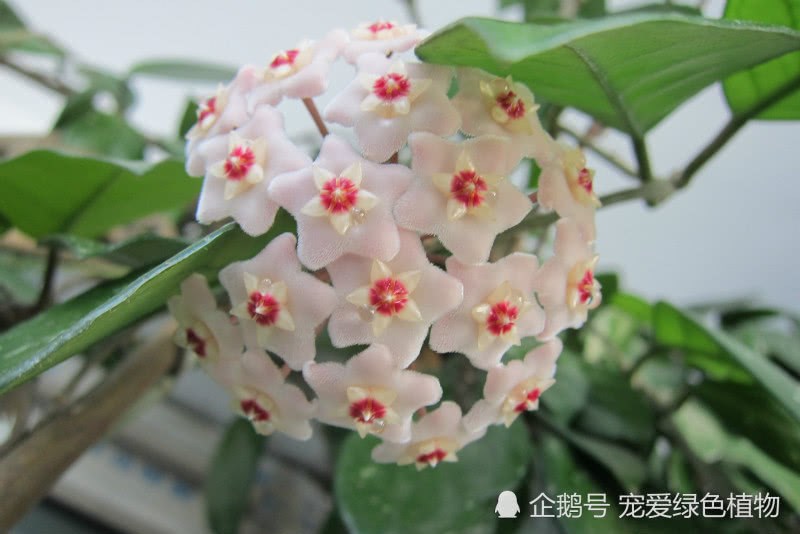
Hoya, also known as Ma Liu Jie, Gou She Teng, and Tie Jiao Ban, blooms in umbel-like clusters with about 30 flowers; the flowers are white and especially beautiful, not only highly ornamental but also of strong medicinal value, such as clearing heat and resolving phlegm, reducing swelling and relieving pain, treating lung-heat cough, carbuncles and swellings, scrofula, insufficient milk in nursing women, joint pain, orchitis, and more.
Hoya prefers fertile, breathable, well-draining soil and dislikes heavy, sticky potting soil, so the planting medium needs good air permeability and drainage. If growing hoya in a pot, a loose, fertile, slightly acidic humus soil is best; you can use peat soil, sand, and vermiculite to make a potting mix, and add an appropriate amount of superphosphate as a base fertilizer. This kind of soil is good for hoya growth, has good air permeability, and is not prone to root rot.
Hoya prefers diffused light and a semi-shaded environment, tolerates shade, and avoids direct scorching sun. As summer approaches, we need to move hoya to a shaded spot when caring for it, to prevent strong direct light from scorching the leaves, causing them to lose green color and turn yellow, and in severe cases causing leaf drop and affecting the ornamental effect. If hoya is kept in insufficient light for a long time, the leaf color becomes pale and the flowers are few and not vivid, so light is very important for hoya; it needs about 3-4 hours of light each day.
The potting soil for hoya should be kept moist at all times, but there must be no standing water in the pot, and water must not be excessive, to avoid causing root rot. However, when the environment is too dry, the leaves lose their luster, affecting the beauty of the leaves and further affecting flower bud formation; even if flower buds grow, they often fail to open or the opening time is shortened.
So when watering hoya, do it in moderation; too much will cause root rot. As long as the potting soil is kept moist, watering once a week is enough. You can often mist the leaf surface to increase the humidity of the leaves and the surrounding environment to benefit its growth.
Fertilizing hoya should mainly use compound fertilizer and organic fertilizer. Hoya usually needs little fertilizer; during the peak growing season, apply a dilute fertilizer solution combining nitrogen and phosphorus 1-2 times a month, preferring dilute over concentrated. Proper fertilization can promote flowering. Remember these few points, and caring for hoya is really very simple. Hoya can be grown not only in soil but also in water; drop it in water and it can still bloom and fill the pot, with flowers to enjoy in all four seasons!