My succulents are growing faster and getting uglier, what should I do?
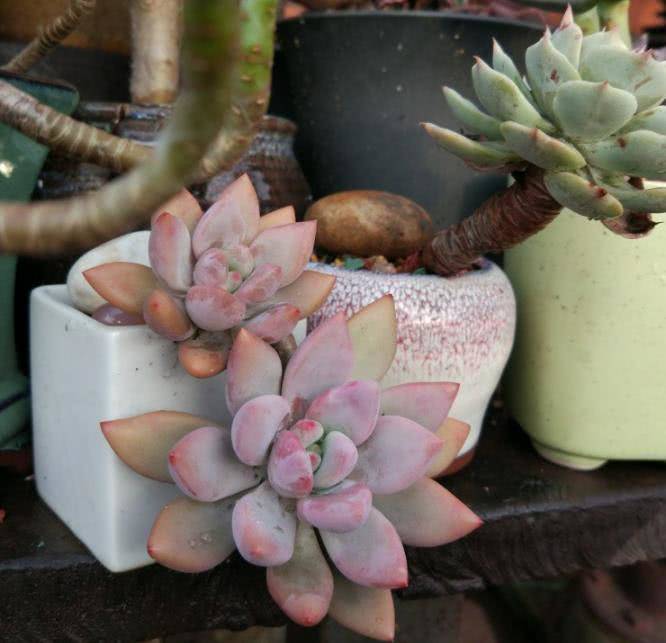
When a succulent grows taller and taller and looks very ugly, that is what we commonly call succulent etiolation. If etiolation is left unchecked, after a while you will find that from above its shape still looks quite good, but some of the lower leaves will wither or fall off. So first we need to remove the lower leaves of the etiolated succulent that are not very vigorous, keeping the good leaves on top. When removing the leaves, be sure to try to preserve the connection point between the leaf and the stem.
There is no way to remedy a plant that has already become etiolated; you can only prevent it from continuing to etiolate in the future. If you are really dissatisfied with an etiolated plant, you can get a plant that does not look etiolated by beheading it. The main measures to suppress succulent etiolation: first, give more sun; second, control watering. It is because of a lack of sunlight, light that is too dim, and relatively too much watering that succulents lose their originally short, sturdy shape and their stems and leaves stretch out wildly in the "etiolation" phenomenon.
With excessive watering, the plant grows too fast. Some people ask why the succulents in a greenhouse grow so quickly, but the greenhouse also provides very sufficient light, so you must have moderate light and water less. A lack of light and light that is too dim greatly reduce the plant's chance of receiving ultraviolet rays, making the plant grow unhealthy. Wait until the spring and autumn growing season, cut off the top, let the wound dry, and then root it as a cutting. You can also break off the extra leaves to use as leaf-cutting material. With fewer main leaves on the stem cutting, it is easier for it to re-root and propagate. Be sure to give it plenty of sun (except at noon in summer); if you cannot guarantee sunlight, then control the watering a bit more.
Prepare the moist nutrient soil needed for succulent leaf cuttings and stem cuttings, and get ready the succulent leaves and succulent tops you set aside earlier. First insert the leaves into the soil by the leaf-cutting method. When doing leaf cuttings, note that you should lay the leaves flat on the soil with both ends tilted up, and then just wait for the leaves to root. After the leaf cuttings are done, watering about once a week is generally enough, but also be careful not to make it too wet; just keep it moist. When small roots slowly emerge, the leaves will gradually wither and grow new small seedlings.
What should you do if a Lithops succulent etiolates? Lithops should be placed in sufficient sunlight all year round; only in the hot summer can you cover it with a layer of shade film or two layers of window screen. For an etiolated Lithops, later, before it sheds its skin, place it in the sun and do not water it; you can spray a little water on the leaf surface. When you see a new head in the middle, immediately water some nitrogen fertilizer or organic fertilizer at the roots, the purpose being to make the new body grow quickly and push the old elongated body apart, so the new body is shorter and fatter than the old body.
This is a gathering place for succulent lovers, sharing succulent care tips; you are welcome to follow and exchange ideas.