Give your kalanchoe a hard prune once, then just sit back and wait for the buds to burst out all over the pot
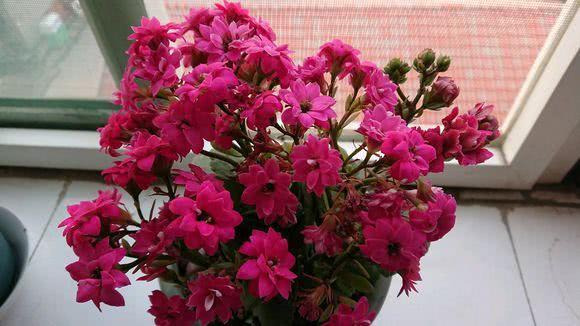
Kalanchoe flowers are delicate and small, come in a wide range of colors, and grow fairly densely; the leaves make it a good foliage succulent, and a single flower stem can send out several branches. Especially during a full bloom, they look just like little umbrellas. If during the bud stage you are a little more ruthless, the flowers will all open in clusters.
Caring for kalanchoe is also fairly simple: just snap off a few small stems - as long as they are not diseased - then use some nutrient soil in the pot, add a little vermiculite, and judge the ratio yourself. A bit more or a bit less does not matter. However, if you have leaf mold, you can add more of it, since it is richer in nutrients and humus.
If the nutrient soil you use has only average water retention, you can water more; if it has strong water retention, then water appropriately less.
One advantage of kalanchoe is that its flowering period is especially long - it can bloom all year round, and in southern regions it never stops at all. This is because kalanchoe prefers a warm, humid environment and has poor cold tolerance, but it can tolerate partial shade and drought, so when watering, it is better to keep it dry than wet. The soil needs to be loose, airy and well draining, and the suitable temperature is 15-25°C.
If you want kalanchoe to bloom in clusters, the first few buds that emerge should be picked off first, so that the later buds do not vary in size and bloom unevenly, and the nutrients are concentrated on the dominant flowering branches. This increases the number of buds.
Kalanchoe is essentially a succulent, and its leaves have a fairly strong water-storing capacity, making it more drought tolerant than ordinary plants, so watering must be well controlled and it must not be too wet. If you accidentally water too much, you can take the pot out and let the roots dry in the sun to avoid bacterial growth, which causes root rot, red leaves and a delayed flowering period.
Kalanchoe is not strict about soil. As just mentioned, think about what kind of soil its native Africa would have? Generally it is soil with a fairly high sand content, so for our home potted plants the same applies - just choose a fertile sandy loam as far as possible.
For kalanchoe to bloom abundantly and cluster together, it also needs enough fertilizer. An organic fertilizer rich in nitrogen, phosphorus and potassium is a good choice - purely plant fermented, rich in nitrogen, phosphorus and potassium, with various organic matter, minerals and amino acids added, it promotes the plant to grow steadily, bloom vigorously and grow strongly.
If fellow flower lovers choose to prune their kalanchoe, then generally pruning twice is enough, because after two prunings it will basically have split into quite a few branches, and it will bloom even more.