Quick identification methods for Aglaia odorata, Murraya paniculata and boxwood
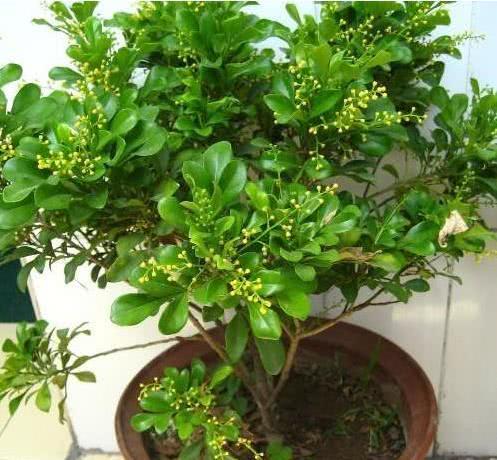
When it comes to the three plants Aglaia odorata, Murraya paniculata and boxwood, people with some knowledge of plants may not find it hard to tell them apart, but for most people, especially those who know nothing about plants, they may be hopelessly confused. In fact, Aglaia odorata belongs to the genus Aglaia in the Meliaceae family; Murraya paniculata belongs to the genus Murraya in the Rutaceae family; and boxwood is Buxus in the Buxaceae family, so they are actually fairly easy to distinguish. Today I will teach you one or two tricks
to help you quickly identify Aglaia odorata, Murraya paniculata and boxwood.
1. Leaf identification method
The leaves of Aglaia odorata are about 2-7 cm long and about 1-3.5 cm wide, and are obovate. Usually the leaf at the very tip is the largest, and the leaves get smaller further down, and both sides of the leaves have no fine fuzzy hairs.
The leaves of Murraya paniculata are about 1-6 cm long and about 0.5-3 cm wide, and are obovate-elliptic. The leaves on the two sides of the branch are asymmetrical, with one side slightly slanted.
The leaves of boxwood are about 1.5-3.5 cm long and about 0.8-2 cm wide, and are broadly obovate. The lower half of the leaf has some fine down.
From these figures we can see that the leaves of Aglaia odorata are the largest, those of Murraya paniculata are next, and the smallest leaves are those of boxwood.
2. Flower identification method
Summer and autumn are the season when Aglaia odorata is in full bloom, and its flowers are yellow, like little yellow grains of millet. Although the flowers of Aglaia odorata are rather small, they have the advantage in number, and their fragrance is very strong.
Unlike Aglaia odorata, which blooms in summer and autumn, Murraya paniculata generally forms buds in late summer and early autumn, and its flowers are white and shaped rather like little trumpets, and tend to grow where the leaf and the flowering branch meet or at the tip of the flowering branch. The flowers of Murraya paniculata are also very fragrant, but not as fragrant as those of Aglaia odorata.
The flowers of boxwood are very similar to those of Aglaia odorata in both shape and color, both being like little yellow grains of millet. The difference is that boxwood flowers usually open in March and April, and the flowers fall by May. Their fragrance is a faint sweet smell.
Seen this way, Aglaia odorata and Murraya paniculata, which have similar flowering periods, differ in both the color and shape of their flowers. And Aglaia odorata and boxwood, which are similar in the color and shape of their flowers, differ in their flowering periods. Isn't it easy to tell them apart now?
3. Fruit identification method
The fruit of Aglaia odorata smells very fragrant, just like the fragrance of its flowers, but when eaten it is very bitter and even numbing. In addition, the outside of the fruit is covered with a sticky liquid.
The fruit of Murraya paniculata is a round sphere, and the flesh inside is red, and it generally does not ripen until October. Inside the flesh there is a sticky liquid, and the seeds have some short fine hairs on them.
The fruit of boxwood is also a round sphere, and the bottom of the fruit has three supports like those of a tripod cauldron, which is its special feature, and the fruit is green.
With the help of these three methods, I believe that the next time you come across these three plants at the same time, you will certainly be able to tell them apart quickly!