Hyacinth flowers are so beautiful, one look brings happiness
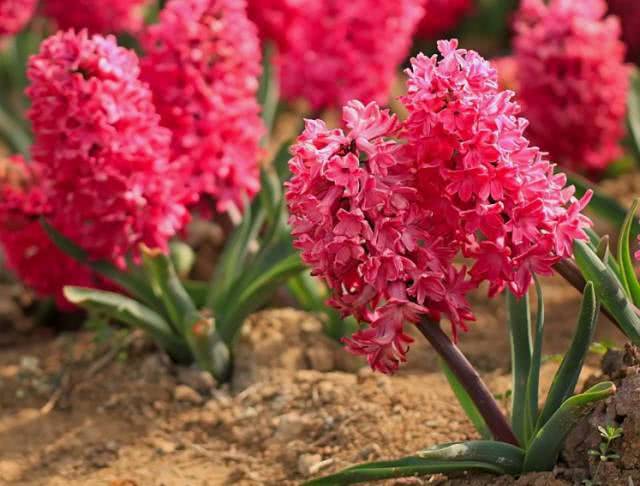
Hyacinth is a perennial herbaceous bulbous plant, with an oval bulb and a membranous outer skin. The color of the skin membrane is positively correlated with the flower color. Before blooming, it looks like garlic. It originates from the Mediterranean coast and Asia Minor, and is the most fragrant variety among the flowering plants discovered by research. It prefers a growing environment with ample sunlight and relatively humid conditions, and requires well-drained and fertile sandy loam, etc.
Morphological characteristics: Hyacinth is a perennial herbaceous bulbous plant, with a spherical or flattened spherical bulb, covered with a membranous outer skin. The outer skin membrane is purple-blue or white, etc., and the skin membrane color is positively correlated with the flower color. Before blooming, it looks like garlic.
Leaves 4-9, narrowly lanceolate, fleshy, basal, thick, strap-shaped lanceolate, with shallow longitudinal grooves, green and glossy. The flower stem is fleshy, the scape is 15-45 cm tall, hollow, with a raceme at the top; 10-20 florets densely borne on the upper part, mostly growing horizontally, rarely drooping, funnel-shaped, with a tubular perianth, the upper part four-lobed, the corolla funnel-shaped, the basal floral tube relatively long, with 5 lobes.
Curling outward and downward. According to their flower color, they are roughly divided into eight series: blue, pink, white, goose yellow, purple, yellow, crimson, and red. The original species is light purple and fragrant. Capsule.
Flowering period is early spring, with the natural flowering period from March to April.
Ecological habits: Hyacinth likes sunlight and is cold-tolerant. It is suitable for growing in cool and humid environments and in loose, fertile sandy soil, and dislikes waterlogging. It prefers warm and humid winters, cool and slightly dry summers, and environments with ample sunlight or partial shade. It likes fertilizer and is suitable for fertile, well-drained sandy loam. It can be planted in the ground, in pots, or grown in water.
It takes root in autumn, new shoots emerge in early spring, blooms in March, fruits ripen in late May, and the aboveground parts wither in early June and enter dormancy.
Flower bud differentiation occurs during the dormant period, with an optimal differentiation temperature of about 25°C, and the differentiation process takes about 1 month. After flower bud differentiation and before elongation growth, there needs to be a low-temperature stage of about two months, and the temperature must not exceed 13°C.
During the growth process of hyacinth, the root system grows best when the bulb is at a low temperature of 2-6°C. The optimal temperature for bud sprouting is 5-10°C, the optimal temperature for leaf growth is 5-12°C, and 15-18°C is most favorable during the bud appearance and flowering stage. The storage temperature for bulbs is 20-28°C, with 25°C being the most suitable, and most ideal for flower bud differentiation. It can tolerate short periods of frost.
Propagation methods
Bulb division: After digging up the bulbs in June, separate the large bulbs from the small bulbs. "Large bulbs planted in autumn can bloom in early spring the following year, while small bulbs need 3 years of cultivation before they can bloom. Because the natural bulb division rate of hyacinth is low, generally the mother plant can only produce 1-2 small bulbs after one year of planting. To increase the propagation coefficient, the large bulbs can be subjected to a scoring operation during the summer dormant period to stimulate them to produce small bulbs.
Sowing: Mostly used when breeding new varieties. Sow in autumn in the culture soil of a cold frame, cover with 1 cm of soil, and they germinate in late January to early February of the following year. Small bulbs cultivated from seedlings bloom after 4-5 years. Under ordinary storage conditions, the seed germination capacity can be maintained for 3 years.
Soil: For hyacinth, it is advisable to choose well-drained, not too dry sandy loam, requiring fertile soil, high organic matter content, good aggregate structure, neutral to slightly alkaline, with a pH level of 6-7; the culture soil can be prepared in the ratio of 5 parts leaf mold : 3 parts garden soil : 1.5 parts coarse sand : 0.5 part bone meal; before planting, chemical agents such as formalin can be used. At a soil temperature of 10-15°C, apply the agent to the soil surface and immediately cover with plastic film. After 3 days of warm weather, remove the film, air for 1 day, then plant, keeping the soil moist. Before planting, apply sufficient base fertilizer. For field cultivation, avoid continuous cropping.
It is suitable to carry out in October-November, and choosing well-drained soil is the most important condition. Before planting, apply sufficient base fertilizer, add a thin layer of sand on top, then arrange the bulbs with a plant spacing of 15 cm-18 cm and cover with 5 cm-8 cm of soil. Also cover with grass to keep the soil loose and moist. Generally, no other management is done before flowering. After flowering, if seeds are not to be collected, the flower stems should be cut off to promote bulb development, and the cutting position should be as high on the flower stem as possible. In early June, the bulbs can be dug out, spread out, graded, and stored in a cold storage. The summer temperature should not exceed 28°C.
For pot cultivation, use a mixture of loam, leaf mold, fine sand, etc. as nutrient soil. Generally, a 10 cm diameter pot holds one bulb, and a 15 cm diameter pot holds 2-3 bulbs. Then bury the pot in the soil and cover it with 10 cm-15 cm of soil. After 7-8 weeks, when the buds grow to more than 10 cm, remove the covering soil to allow sunlight exposure. Generally planted in October-November and blooms in March.
Water cultivation For water cultivation of hyacinth, the water level must leave a space of 1-2 cm from the basal plate of the bulb, so that the root system can breathe. It is strictly forbidden to fill the water so that it covers the bottom of the bulb.
In December, the bulbs can be placed in a wide-mouthed glass bottle with a grid, and a small amount of charcoal can be added to help prevent rot and disinfect.
The bulb only needs to be soaked to the bottom of the bulb, then placed in a dark place, and the bottle covered with black cloth. After about 20 days of germination in a completely dark environment, place it outdoors to receive sunlight. Initially, expose it to 1-2 hours of sunlight per day, then gradually increase it to 7-8 hours. In most cases, under good weather conditions, it will bloom by the Spring Festival.